

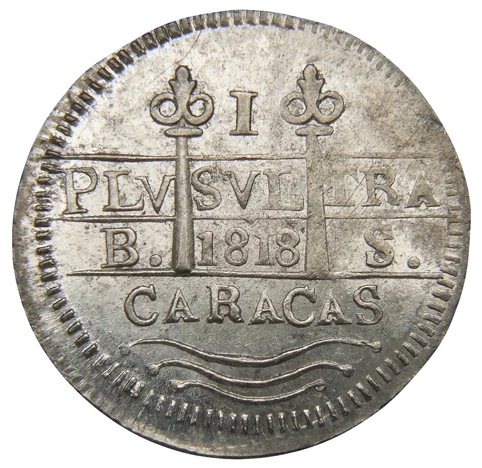
1 Real – Caracas
Venezuela

Obverse
Reverse
Description:
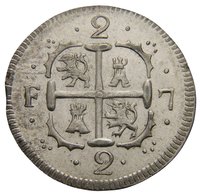
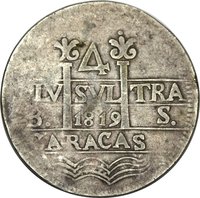
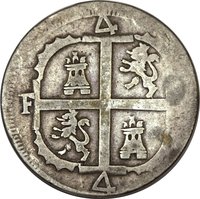
Cross with rampant lions and castles. Value above and below, King's initial and numeral at sides.
Inscription:
I
F 7
I
F 7
I
Translation:
I, Frederick the Seventh, by the Grace of God, King of Denmark, of the Vends and the Goths, Duke of Schleswig, Holstein, Stormarn, Dithmarschen, and Oldenburg.
Script: Latin
Language: Latin
Edge
Mintings
| Year | Mint Mark | Mintage | Quality | Collection |
|---|---|---|---|---|
| 1817 | BS | 6,500 | ||
| 1818 | BS | 14,000 | ||
| 1820 | BS | 11,000 | ||
| 1821 | BS | 8,000 |
Historical background
In 1817, Caracas existed within a vortex of competing currencies and profound economic dislocation, a direct consequence of the ongoing Venezuelan War of Independence. The royalist authorities, controlling the capital, struggled to maintain the legitimacy and value of the Spanish colonial monetary system. The primary circulating coin was the debased Spanish silver real, but its supply was critically low due to the collapse of legal trade, the diversion of precious metals to finance warfare, and the effective blockade of the coast by patriot forces. This scarcity of sound money crippled everyday commerce and fostered widespread hoarding.
Alongside the scarce official coinage, a chaotic array of alternative currencies flooded the markets to facilitate necessary transactions. These included foreign coins like Peruvian pesos and Colombian macuquinas, often accepted by weight and assay rather than face value. More tellingly, the royalist government and even local merchants resorted to issuing paper money and vales (promissory notes), but these instruments were widely distrusted and prone to drastic depreciation. The lack of a unified, trusted medium of exchange created a barter economy for basic goods, while speculation and currency manipulation became rampant.
This monetary anarchy was both a cause and a symptom of the broader crisis. The patriots, led by Simón Bolívar and operating from the Orinoco basin, further complicated the situation by introducing their own revolutionary coinage from makeshift mints in Angostura and elsewhere, aiming to undermine royalist economic authority. Consequently, the people of Caracas navigated a daily reality where the value of money was uncertain, prices were wildly unstable, and economic survival depended as much on access to hard currency or reliable credit networks as on one's political allegiances in the fractured landscape of a war-torn country.
Alongside the scarce official coinage, a chaotic array of alternative currencies flooded the markets to facilitate necessary transactions. These included foreign coins like Peruvian pesos and Colombian macuquinas, often accepted by weight and assay rather than face value. More tellingly, the royalist government and even local merchants resorted to issuing paper money and vales (promissory notes), but these instruments were widely distrusted and prone to drastic depreciation. The lack of a unified, trusted medium of exchange created a barter economy for basic goods, while speculation and currency manipulation became rampant.
This monetary anarchy was both a cause and a symptom of the broader crisis. The patriots, led by Simón Bolívar and operating from the Orinoco basin, further complicated the situation by introducing their own revolutionary coinage from makeshift mints in Angostura and elsewhere, aiming to undermine royalist economic authority. Consequently, the people of Caracas navigated a daily reality where the value of money was uncertain, prices were wildly unstable, and economic survival depended as much on access to hard currency or reliable credit networks as on one's political allegiances in the fractured landscape of a war-torn country.
✨ Legendary