

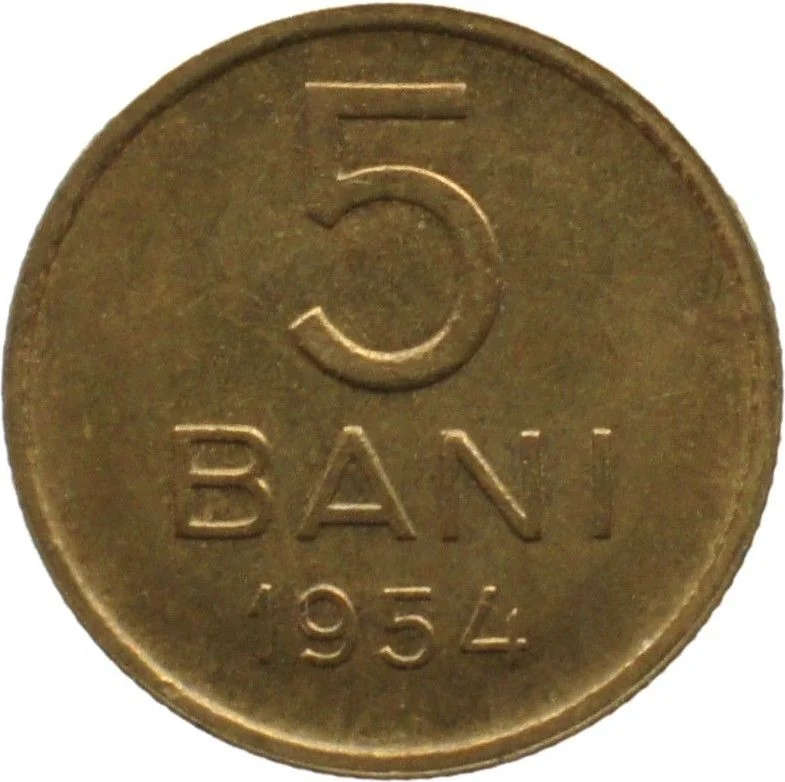
5 Bani – Romania
Romania
Context
Years: 1953–1958
Issuer: Romania 
Period: 
(1947—1965)
Currency:
(1952—2005)
Demonetization: 31 December 1996
Total mintage: 220,900,000
Material
Diameter: 20 mm
Weight: 2.4 g
Thickness: 1.2 mm
Shape: Round
Composition: Nickel brass
Magnetic: No
Technique: Milled
Alignment: Coin alignment

flip
References
KM: #Click to copy to clipboard83.2
Numista: #5970
Value
Exchange value: 0.05 ROL
Obverse
Description:
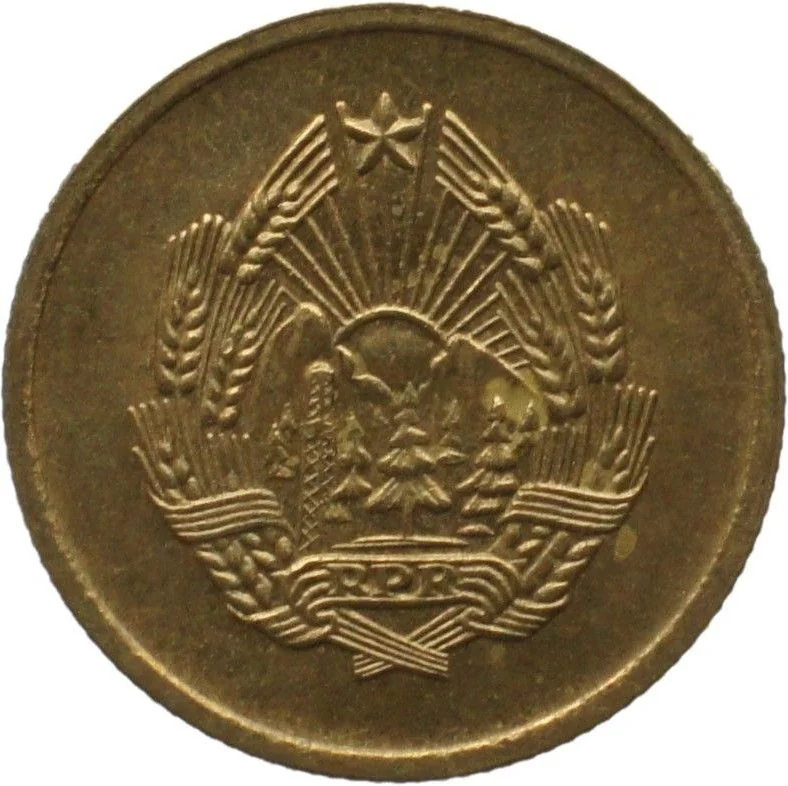
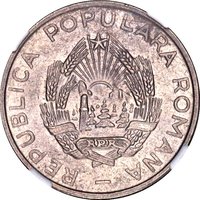
Romanian People's Republic Coat of Arms.
Inscription:
RPR
Script: Latin
Engraver: Haralambie Ionescu
Reverse
Edge
Reeded
Mintings
| Year | Mint Mark | Mintage | Quality | Collection |
|---|---|---|---|---|
| 1953 | — | 54,600,000 | ||
| 1954 | — | 57,500,000 | ||
| 1955 | — | 38,100,000 | ||
| 1956 | — | 39,800,000 | ||
| 1957 | — | 30,900,000 | ||
| 1958 | — | — |
Historical background
In 1953, Romania's currency situation was a direct reflection of its rigid, Soviet-style command economy and the severe economic distortions of the early Cold War period. The national currency, the leu, was essentially a non-convertible instrument of state accounting with multiple, arbitrary exchange rates set by the communist government. Its value on the international market was fictitious, while domestically, it operated within a system of severe shortages, rationing, and a burgeoning black market where real prices and values diverged dramatically from official rates.
The year is particularly notable for the monetary revaluation enacted on January 28-29, 1953. This was not a reform to stabilize the economy but a politically-driven confiscation designed to consolidate the regime's control and erase the monetary overhang from the previous period of rapid, chaotic industrialization. Old banknotes were exchanged for new at drastically tiered rates: 100 "old lei" for 1 "new leu" for cash holdings up to a very low minimum, but at far worse rates (up to 400:1) for larger sums. The primary aim was to wipe out the savings of the pre-communist middle classes, peasants, and private traders, while minimizing impact on the state itself and the nascent working class.
This draconic measure, coupled with a simultaneous cancellation of much of the population's ration cards, succeeded in reducing the nominal money supply but at a tremendous social cost. It solidified the Party's control over all economic activity, further dismantled the remnants of the private sector, and deepened public hardship. The 1953 revaluation entrenched the leu as a purely domestic tool for a planned economy isolated from the world market, a characteristic that would define it for decades under Nicolae Ceaușescu's later rule.
The year is particularly notable for the monetary revaluation enacted on January 28-29, 1953. This was not a reform to stabilize the economy but a politically-driven confiscation designed to consolidate the regime's control and erase the monetary overhang from the previous period of rapid, chaotic industrialization. Old banknotes were exchanged for new at drastically tiered rates: 100 "old lei" for 1 "new leu" for cash holdings up to a very low minimum, but at far worse rates (up to 400:1) for larger sums. The primary aim was to wipe out the savings of the pre-communist middle classes, peasants, and private traders, while minimizing impact on the state itself and the nascent working class.
This draconic measure, coupled with a simultaneous cancellation of much of the population's ration cards, succeeded in reducing the nominal money supply but at a tremendous social cost. It solidified the Party's control over all economic activity, further dismantled the remnants of the private sector, and deepened public hardship. The 1953 revaluation entrenched the leu as a purely domestic tool for a planned economy isolated from the world market, a characteristic that would define it for decades under Nicolae Ceaușescu's later rule.
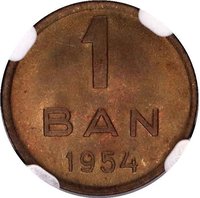
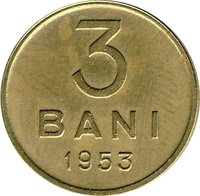
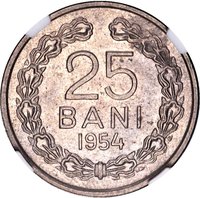
Series: 1953 Romania circulation coins

🌱 Very Common