


100 lei (monetary system and coinage establishment) – Romania
Add to wishlist
Non-circulating coins
Commemoration: 150 years since the enactment of the law concerning the establishment of a new monetary system and the minting of national coins
Romania
Obverse
Description:
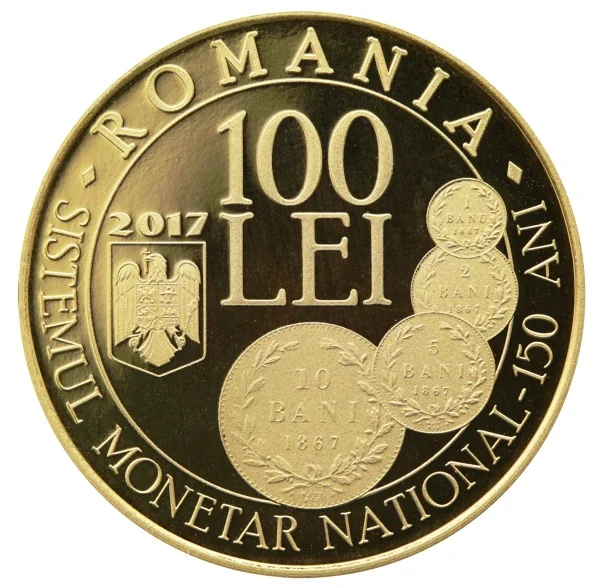
A 2017 100 Lei coin featuring 1867 coin designs, Romania's coat of arms, and the inscriptions "ROMANIA" and "SISTEMUL MONETAR NATIONAL-150 ANI".
Inscription:
ROMANIA
SISTEMUL MONETAR NATIONAL-150 ANI
100 LEI 2017
SISTEMUL MONETAR NATIONAL-150 ANI
100 LEI 2017
Script: Latin
Reverse
Description:
Portrait of Carol I with "CAROL I" and "1867" – the year the national monetary system was established.
Inscription:
CAROL I
1867
1867
Script: Latin
Edge
Milled
Categories
| Mustache/Beard |
| Currency> Coin depiction |
Mintings
| Year | Mint Mark | Mintage | Quality | Collection |
|---|---|---|---|---|
| 2017 | — | 150 | Proof |
Historical background
In 2017, Romania's currency situation was characterized by a period of relative stability and gradual appreciation for the Romanian Leu (RON) against the Euro, a notable shift from previous years of volatility. The RON strengthened to around 4.5-4.6 against the Euro, its strongest level in several years, driven by robust economic growth exceeding 7%—the highest in the EU—and significant inflows of European funds. This economic performance, coupled with higher interest rates from the National Bank of Romania (NBR) to combat rising inflation, made the Leu attractive for carry trades, where investors borrowed in low-interest currencies to invest in higher-yielding Romanian assets.
However, this appreciation occurred amidst underlying political and fiscal tensions that created a dual narrative. The government, led by the Social Democratic Party (PSD), pursued expansionary fiscal policies, including significant wage and pension increases, which raised concerns among investors and the NBR about long-term macroeconomic stability and inflation. These concerns periodically triggered warnings from credit rating agencies and brief episodes of volatility, as markets weighed strong short-term growth against potential overheating and fiscal slippage. The NBR thus walked a tightrope, maintaining a cautious monetary policy to manage inflation—which rose sharply to over 5% by year-end—without stifling growth or causing excessive currency strength that could hurt exporters.
Overall, 2017 presented a contrast between a strong, growth-driven currency and persistent structural vulnerabilities. While the Leu's performance reflected confidence in Romania's booming economy, the central bank remained vigilant, frequently intervening in the foreign exchange market to smooth out excessive fluctuations. The year ended with the currency stable but with clear cautionary signals regarding fiscal discipline and inflation, setting the stage for the economic policy debates that would follow in subsequent years.
However, this appreciation occurred amidst underlying political and fiscal tensions that created a dual narrative. The government, led by the Social Democratic Party (PSD), pursued expansionary fiscal policies, including significant wage and pension increases, which raised concerns among investors and the NBR about long-term macroeconomic stability and inflation. These concerns periodically triggered warnings from credit rating agencies and brief episodes of volatility, as markets weighed strong short-term growth against potential overheating and fiscal slippage. The NBR thus walked a tightrope, maintaining a cautious monetary policy to manage inflation—which rose sharply to over 5% by year-end—without stifling growth or causing excessive currency strength that could hurt exporters.
Overall, 2017 presented a contrast between a strong, growth-driven currency and persistent structural vulnerabilities. While the Leu's performance reflected confidence in Romania's booming economy, the central bank remained vigilant, frequently intervening in the foreign exchange market to smooth out excessive fluctuations. The year ended with the currency stable but with clear cautionary signals regarding fiscal discipline and inflation, setting the stage for the economic policy debates that would follow in subsequent years.



✨ Legendary