

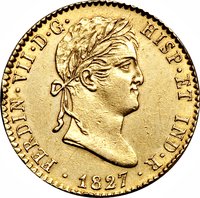
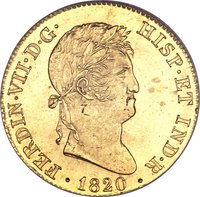
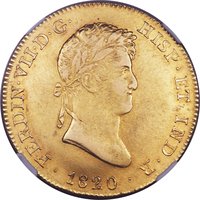
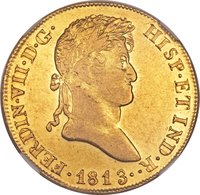
Obverse
Description:
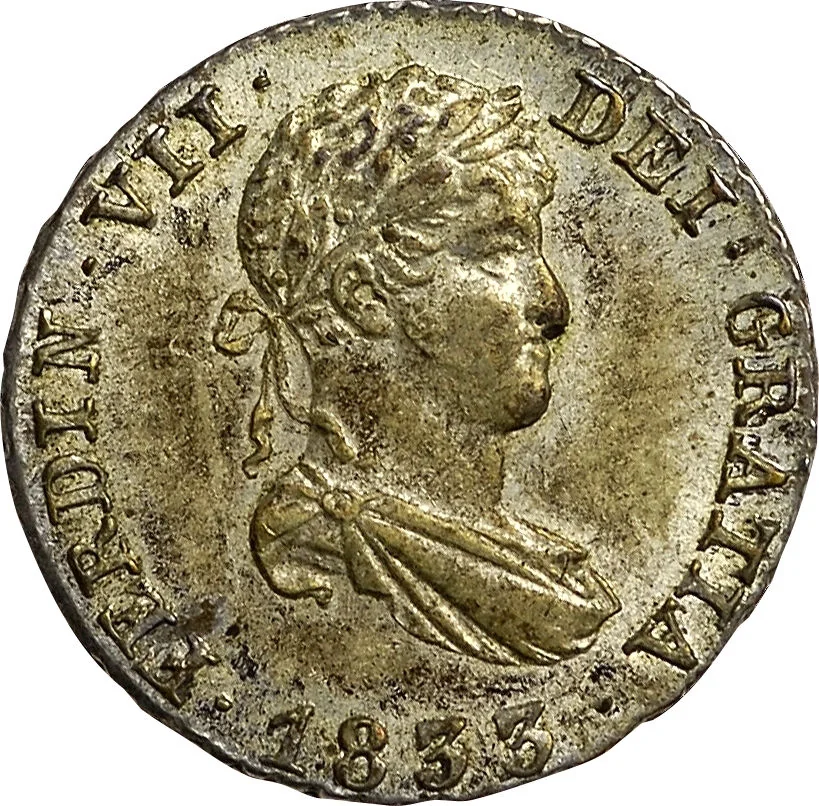
Ferdinand VII laureate bust facing right.
Inscription:
FERDIN · VII · DEI · GRATIA
· 1833 ·
· 1833 ·
Translation:
FERDINAND VII BY THE GRACE OF GOD
· 1833 ·
· 1833 ·
Script: Latin
Language: Latin
Engraver: Félix Sagau y Dalmau de Galcerán
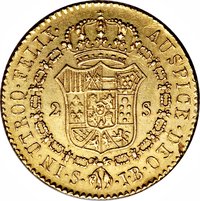
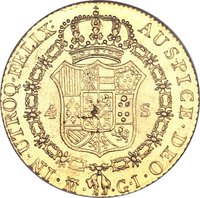
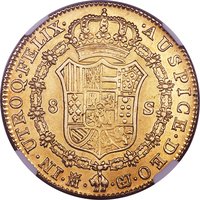
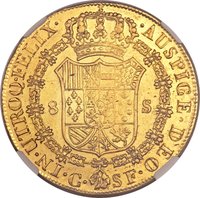
Reverse
Description:
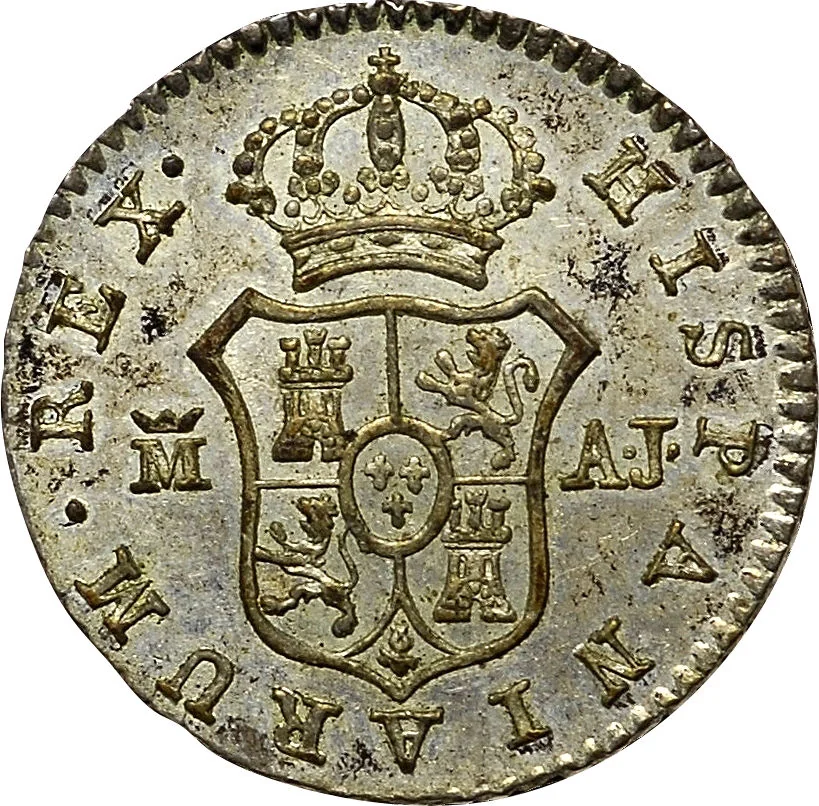
Royal arms of Spain.
Inscription:
HISPANIARUM · REX ·
M A·J·
M A·J·
Translation:
King of the Spains
Majesty
Majesty
Script: Latin
Language: Latin
Engraver: Félix Sagau y Dalmau de Galcerán
Edge
Categories
| Symbols> Coat of Arms |
Mints
| Name | Mark |
|---|---|
| Cádiz | (C) |
| Royal Mint of Madrid | (M) |
| Royal Mint of Seville | S |
Mintings
| Year | Mint Mark | Mintage | Quality | Collection |
|---|---|---|---|---|
| 1814 | C | — | ||
| 1814 | MGJ | — | ||
| 1815 | MGJ | — | ||
| 1816 | MGJ | — | ||
| 1817 | MGJ | — | ||
| 1818 | MGJ | — | ||
| 1819 | MGJ | — | ||
| 1820 | MGJ | — | ||
| 1824 | MAJ | — | ||
| 1826 | MAJ | — | ||
| 1828 | MAJ | — | ||
| 1830 | MAJ | — | ||
| 1831 | MAJ | — | ||
| 1831 | SJB | — | ||
| 1832 | MAJ | — | ||
| 1832 | SJB | — | ||
| 1833 | MAJ | — | ||
| 1833 | MJI | — |
Historical background
Following the Peninsular War (1808-1814), Spain in 1814 faced a catastrophic currency situation, a direct legacy of conflict and fiscal desperation. The war against Napoleon had been financed not by taxes—which collapsed alongside the state—but by the massive issuance of paper money, the vales reales (royal bonds), and an unprecedented expansion of coinage from makeshift mints. This flood of currency, backed by little more than hope and future promises, led to severe inflation and a profound loss of public confidence in the monetary system. The economy was effectively bimetallic in theory, based on silver reales and gold escudos, but in practice, it was overwhelmed by depreciating paper and debased coin.
The restored King Ferdinand VII, returning in 1814, inherited this monetary chaos. His absolutist government’s immediate priority was political consolidation, not economic reform, and it lacked the silver reserves to restore stability. Consequently, it continued to authorize the minting of low-quality fractional coinage, such as copper maravedís, to meet daily transactional needs, further eroding trust. The disparity between the nominal and intrinsic value of coins widened, and a complex system of circulating premiums for "good" silver coinage versus "bad" billon and paper emerged, crippling commerce.
This monetary disintegration reflected and exacerbated the wider crisis of the Spanish state and empire. The loss of American colonies, which had been the primary source of silver, severed the lifeline that could have stabilized the currency. The result was a fragmented and unreliable monetary landscape, characterized by multiple parallel circulations, rampant counterfeiting, and deep-seated public distrust—a financial quagmire that would hamper Spain's economic recovery and political stability for decades.
The restored King Ferdinand VII, returning in 1814, inherited this monetary chaos. His absolutist government’s immediate priority was political consolidation, not economic reform, and it lacked the silver reserves to restore stability. Consequently, it continued to authorize the minting of low-quality fractional coinage, such as copper maravedís, to meet daily transactional needs, further eroding trust. The disparity between the nominal and intrinsic value of coins widened, and a complex system of circulating premiums for "good" silver coinage versus "bad" billon and paper emerged, crippling commerce.
This monetary disintegration reflected and exacerbated the wider crisis of the Spanish state and empire. The loss of American colonies, which had been the primary source of silver, severed the lifeline that could have stabilized the currency. The result was a fragmented and unreliable monetary landscape, characterized by multiple parallel circulations, rampant counterfeiting, and deep-seated public distrust—a financial quagmire that would hamper Spain's economic recovery and political stability for decades.
Series: 1814 Spain circulation coins
⭐ Rare