

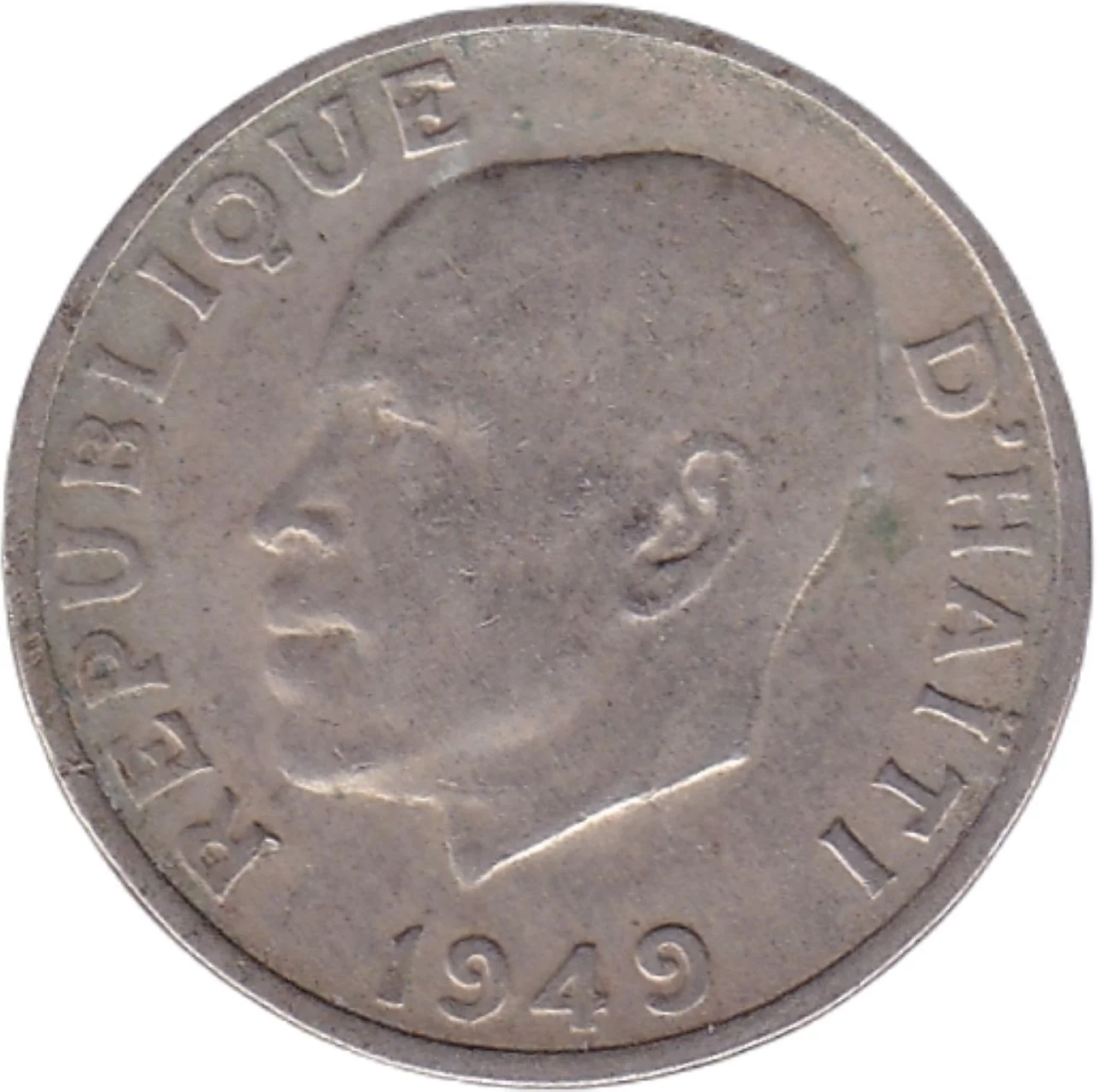
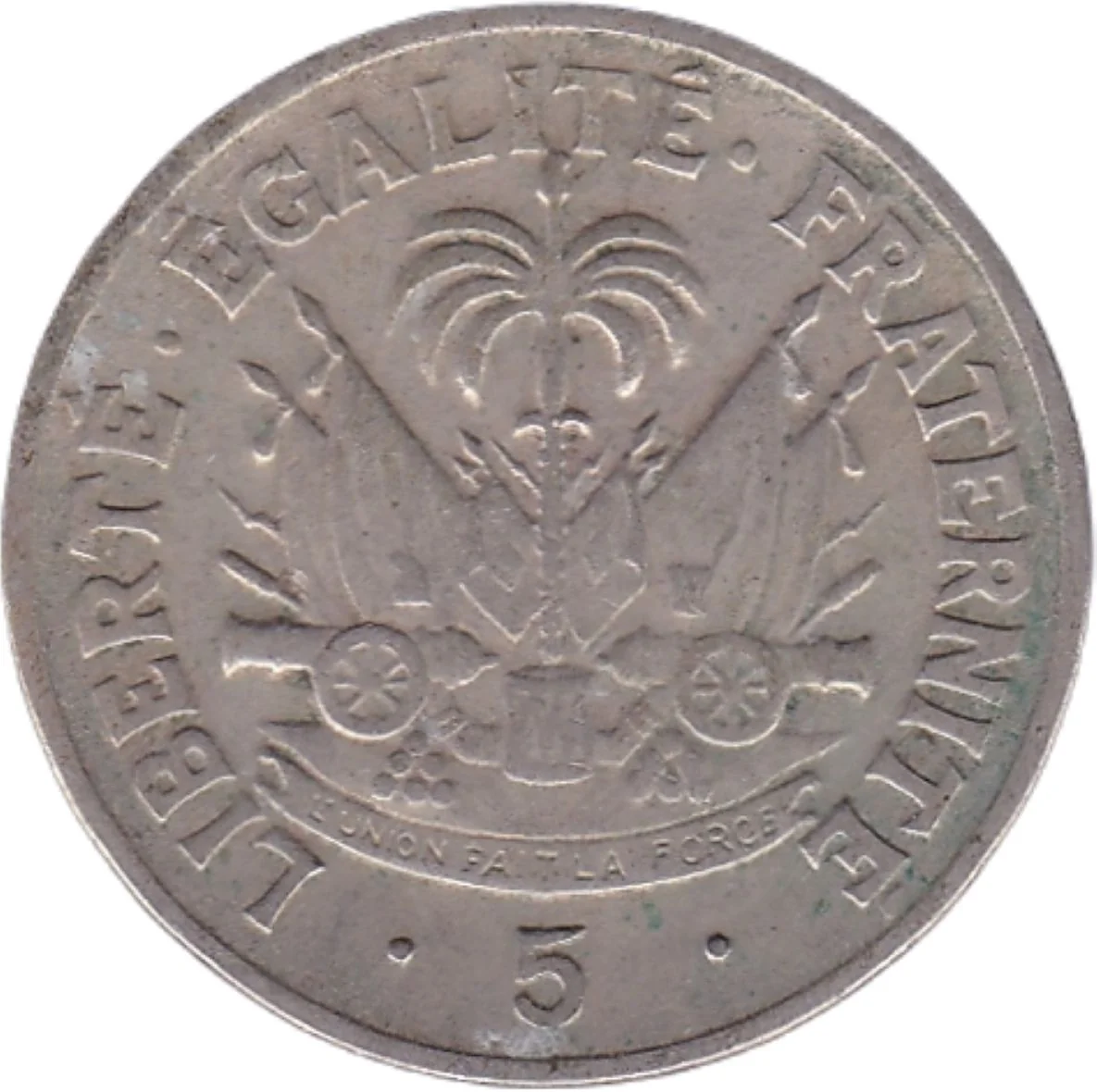
5 centimes – Haiti
Add to wishlist
Haiti
Context
Year: 1949
Issuer: Haiti
Period:
(1859—1957)
Currency:
(since 1872)
Demonetized: Yes
Total mintage: 10,000,000
Material
References
KM: #
Numista: #5920
Value
Exchange value: 0.05 HTG
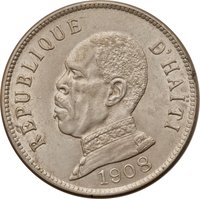
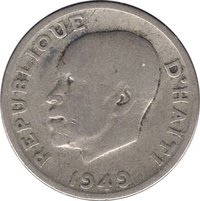
Obverse
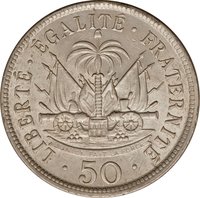
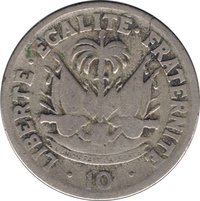
Reverse
Edge
Plain
Categories
| Person> Politician |
| Symbols> Coat of Arms |
Mints
| Name | Mark |
|---|---|
| United States Mint of Philadelphia | — |
Mintings
| Year | Mint Mark | Mintage | Quality | Collection |
|---|---|---|---|---|
| 1949 | — | 10,000,000 |
Historical background
In 1949, Haiti's currency situation was defined by the long-standing dominance of the Haitian gourde (HTG), which was pegged to the U.S. dollar at a fixed rate of 5 gourdes to 1 dollar. This peg, established in 1912, provided a measure of monetary stability and facilitated trade, primarily with the United States, which exerted significant economic and political influence over the country. However, this fixed exchange rate masked deeper structural issues within Haiti's economy, which was heavily reliant on agricultural exports like coffee and sisal, making it vulnerable to global price fluctuations.
The stability of the gourde was largely artificial, underpinned not by robust domestic production or foreign reserves, but by fiscal discipline and U.S. financial oversight stemming from the repayment of American loans. A major turning point came in 1947 when Haiti finally paid off the last of its debts from a 1922 U.S. loan, ending two decades of direct American fiscal control. While this was a point of national pride, it also removed an external constraint on government spending, coinciding with a period of increased public expenditure under President Dumarsais Estimé.
Consequently, by 1949, inflationary pressures were beginning to surface. Government spending on infrastructure and public works for the 1949 bicentennial celebrations of Port-au-Prince, funded in part by money creation, started to devalue the gourde on the informal market. Although the official peg held, the disparity between the fixed rate and the real value of the currency in practice signaled the beginning of chronic monetary instability that would plague Haiti in the decades to follow, as political turmoil and economic mismanagement eroded the gourde's foundation.
The stability of the gourde was largely artificial, underpinned not by robust domestic production or foreign reserves, but by fiscal discipline and U.S. financial oversight stemming from the repayment of American loans. A major turning point came in 1947 when Haiti finally paid off the last of its debts from a 1922 U.S. loan, ending two decades of direct American fiscal control. While this was a point of national pride, it also removed an external constraint on government spending, coinciding with a period of increased public expenditure under President Dumarsais Estimé.
Consequently, by 1949, inflationary pressures were beginning to surface. Government spending on infrastructure and public works for the 1949 bicentennial celebrations of Port-au-Prince, funded in part by money creation, started to devalue the gourde on the informal market. Although the official peg held, the disparity between the fixed rate and the real value of the currency in practice signaled the beginning of chronic monetary instability that would plague Haiti in the decades to follow, as political turmoil and economic mismanagement eroded the gourde's foundation.
🌱 Common