

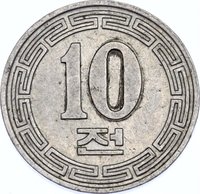
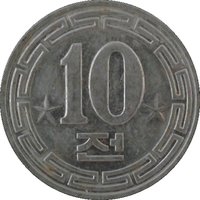
10 Chon – North Korea
North Korea
Context
Material
References
KM: #Click to copy to clipboard3
Numista: #5876
Value
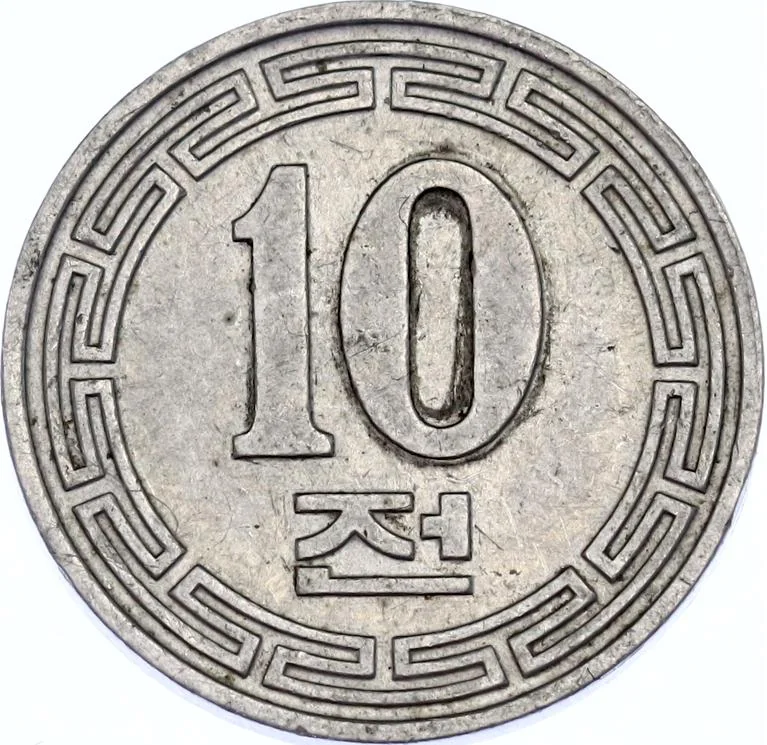
Exchange value: 0.10 KPW
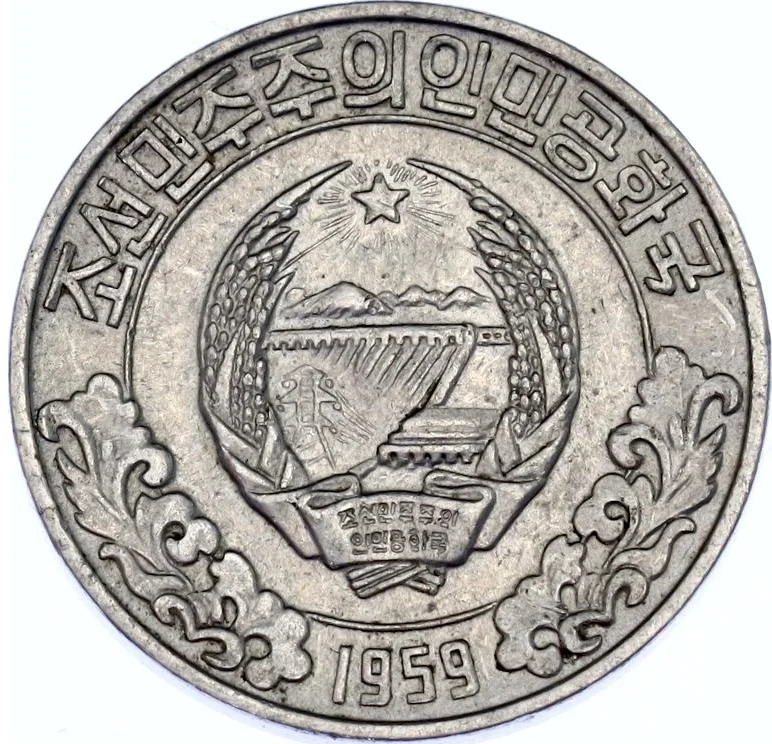
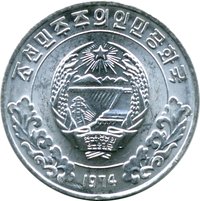
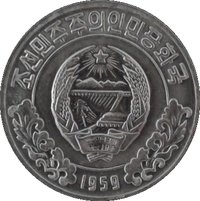
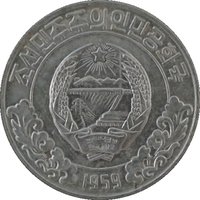
Obverse
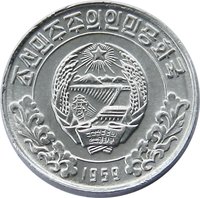
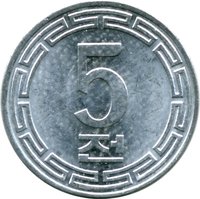
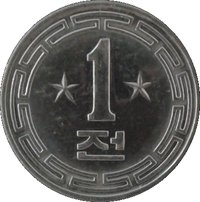
Reverse
Edge
Plain
Categories
| Symbols> Coat of Arms |
Mintings
| Year | Mint Mark | Mintage | Quality | Collection |
|---|---|---|---|---|
| 1959 | — | — |
Historical background
In 1959, North Korea's currency situation was characterized by a period of relative stability under a centrally planned, state-controlled financial system, but one that was fundamentally isolated and non-convertible. The North Korean won (KPW) was the sole legal tender, managed entirely by the Central Bank of the Democratic People's Republic of Korea. Its value was set by government fiat rather than market forces, and it was strictly forbidden for citizens to hold or exchange foreign currencies. This internal stability was artificially maintained through heavy state subsidies on essential goods and rationing via the Public Distribution System, which insulated most daily transactions from inflationary pressures visible in market economies.
This financial control served the broader goals of the Chollima Movement, a state-led mass mobilization campaign launched in 1958 to achieve rapid economic growth and industrial development through extreme collectivization and self-reliance (Juche). The currency system was a tool to direct all resources toward heavy industry and military buildup, while systematically eliminating private trade and market elements. By 1959, the collectivization of agriculture was completed, further cementing the state's monopoly over all economic activity and the flow of money.
However, this apparent stability was superficial and dependent on massive economic aid from the Soviet Union and China, which provided crucial foreign exchange and resources. Internally, the won had no meaningful purchasing power outside the state rationing system, and a nascent black market for goods beyond the state allocations likely existed, though severely suppressed. Therefore, the 1959 currency situation reflects a regime prioritizing absolute political control and ideological mobilization over economic efficiency, creating a fragile financial foundation that would face significant challenges in the decades to come.
This financial control served the broader goals of the Chollima Movement, a state-led mass mobilization campaign launched in 1958 to achieve rapid economic growth and industrial development through extreme collectivization and self-reliance (Juche). The currency system was a tool to direct all resources toward heavy industry and military buildup, while systematically eliminating private trade and market elements. By 1959, the collectivization of agriculture was completed, further cementing the state's monopoly over all economic activity and the flow of money.
However, this apparent stability was superficial and dependent on massive economic aid from the Soviet Union and China, which provided crucial foreign exchange and resources. Internally, the won had no meaningful purchasing power outside the state rationing system, and a nascent black market for goods beyond the state allocations likely existed, though severely suppressed. Therefore, the 1959 currency situation reflects a regime prioritizing absolute political control and ideological mobilization over economic efficiency, creating a fragile financial foundation that would face significant challenges in the decades to come.

🌱 Very Common