

2 centavos – Cuba
Add to wishlist
Cuba
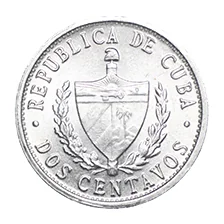
Obverse
Description:
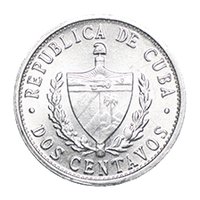
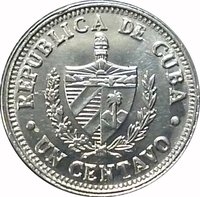
Cuban coat of arms with curved country name above, lettered face value below, denticles near rim.
Inscription:
REPUBLICA DE CUBA
• DOS CENTAVOS •
• DOS CENTAVOS •
Translation:
REPUBLIC OF CUBA
• TWO CENTS •
• TWO CENTS •
Script: Latin
Language: Spanish
Engraver: Charles Edward Barber
Reverse
Description:
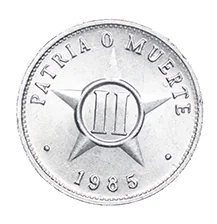
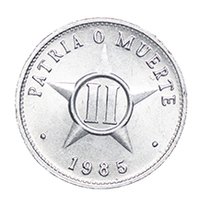
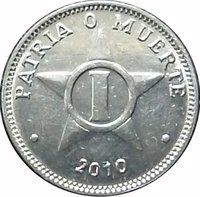
Roman numeral face value in circled star, "Fatherland or Death" above, date below.
Inscription:
PATRIA O MUERTE
• 1983 •
• 1983 •
Translation:
Fatherland or Death
• 1983 •
• 1983 •
Script: Latin
Language: Spanish
Engraver: Charles Edward Barber
Edge
Plain
Mints
| Name | Mark |
|---|---|
| Empresa Cubana de Acuñaciones | — |
| Saint Petersburg | — |
Mintings
| Year | Mint Mark | Mintage | Quality | Collection |
|---|---|---|---|---|
| 1983 | — | 3,996,000 | ||
| 1984 | — | 62,500,000 | ||
| 1985 | — | 70,000,000 | ||
| 1986 | — | 15,000,000 | ||
| 2010 | — | — |
Historical background
In 1983, Cuba's currency situation was defined by the entrenched use of the Cuban peso (CUP), a non-convertible currency operating within a tightly controlled, Soviet-subsidized command economy. The country was isolated from the global capitalist financial system due to the ongoing U.S. embargo, and its economic life was almost entirely planned by the state. The peso's value was administratively set and bore no relation to market forces; it was used for all domestic salaries, and for purchasing rationed goods and services at heavily subsidized prices in state-run stores. This system aimed to guarantee egalitarian access to basics, but often resulted in shortages and a lack of consumer choice.
The economy during this period was heavily dependent on the Soviet Union, which provided crucial economic aid, preferential trade agreements (notably purchasing Cuban sugar at above-market prices and supplying oil), and substantial lines of credit. This support effectively propped up the value and stability of the Cuban peso, insulating the population from the true external economic pressures. There was no significant black market for foreign currency at this time, as possession of hard currencies like U.S. dollars was illegal for ordinary citizens, a prohibition in place since the 1960s as part of the government's ideological stance against capitalist influence.
Thus, the currency landscape of 1983 was one of artificial stability and isolation. The Cuban peso functioned as the sole legal tender within a closed economic circuit, its viability entirely underpinned by Soviet subsidies rather than domestic productivity. This arrangement would persist until the severe economic crisis triggered by the collapse of the Soviet Union in the early 1990s, which forced Cuba to reluctantly legalize the U.S. dollar and eventually create a dual-currency system—a stark contrast to the seemingly monolithic, state-controlled monetary reality of 1983.
The economy during this period was heavily dependent on the Soviet Union, which provided crucial economic aid, preferential trade agreements (notably purchasing Cuban sugar at above-market prices and supplying oil), and substantial lines of credit. This support effectively propped up the value and stability of the Cuban peso, insulating the population from the true external economic pressures. There was no significant black market for foreign currency at this time, as possession of hard currencies like U.S. dollars was illegal for ordinary citizens, a prohibition in place since the 1960s as part of the government's ideological stance against capitalist influence.
Thus, the currency landscape of 1983 was one of artificial stability and isolation. The Cuban peso functioned as the sole legal tender within a closed economic circuit, its viability entirely underpinned by Soviet subsidies rather than domestic productivity. This arrangement would persist until the severe economic crisis triggered by the collapse of the Soviet Union in the early 1990s, which forced Cuba to reluctantly legalize the U.S. dollar and eventually create a dual-currency system—a stark contrast to the seemingly monolithic, state-controlled monetary reality of 1983.
🌱 Very Common