

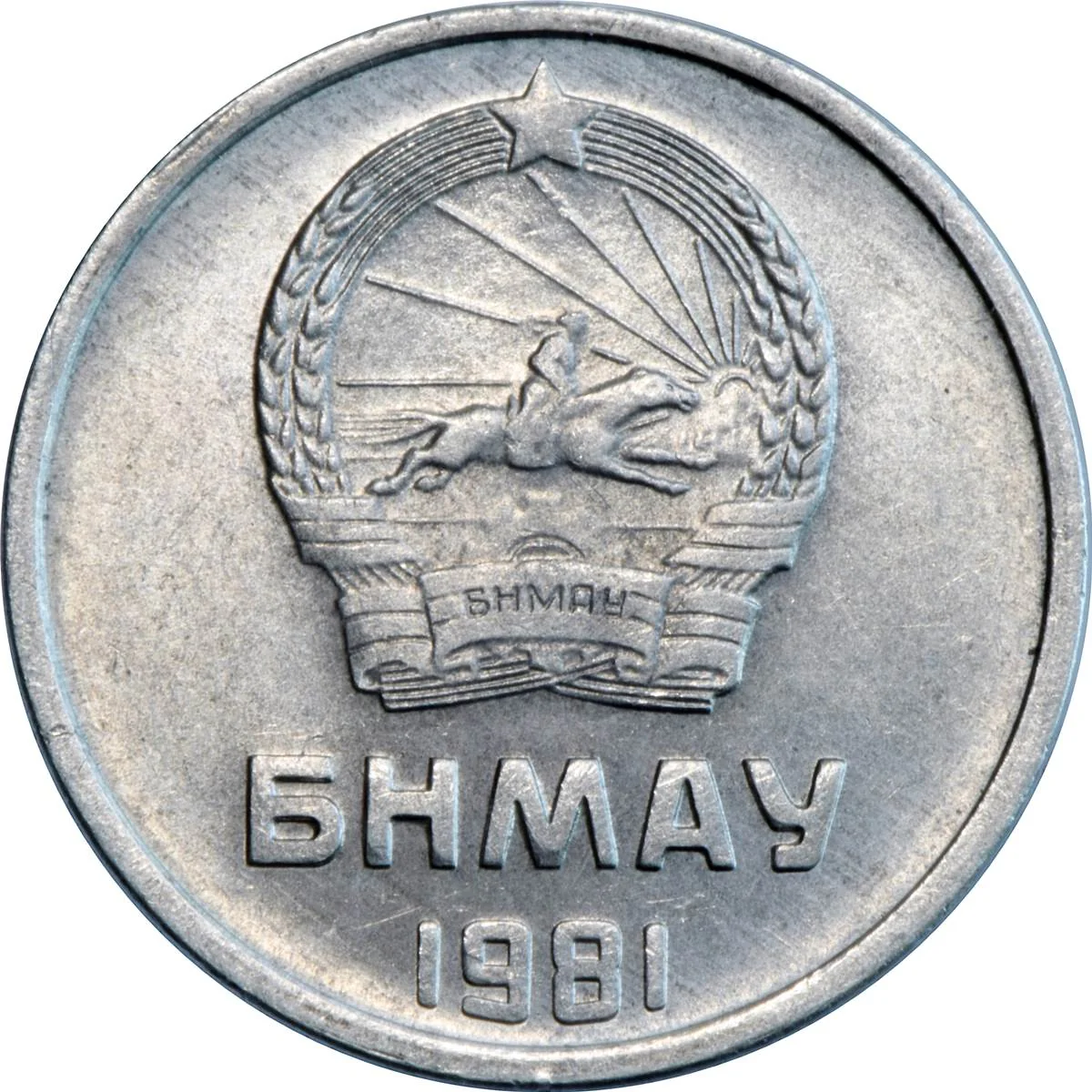
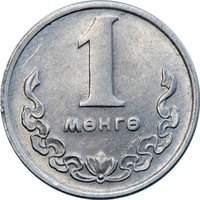
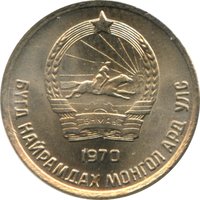
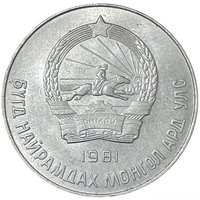
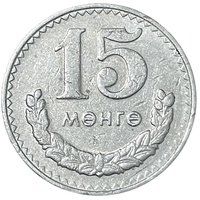
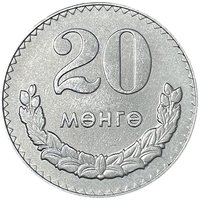
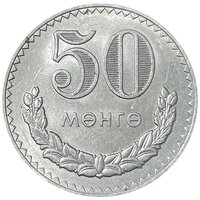
Obverse
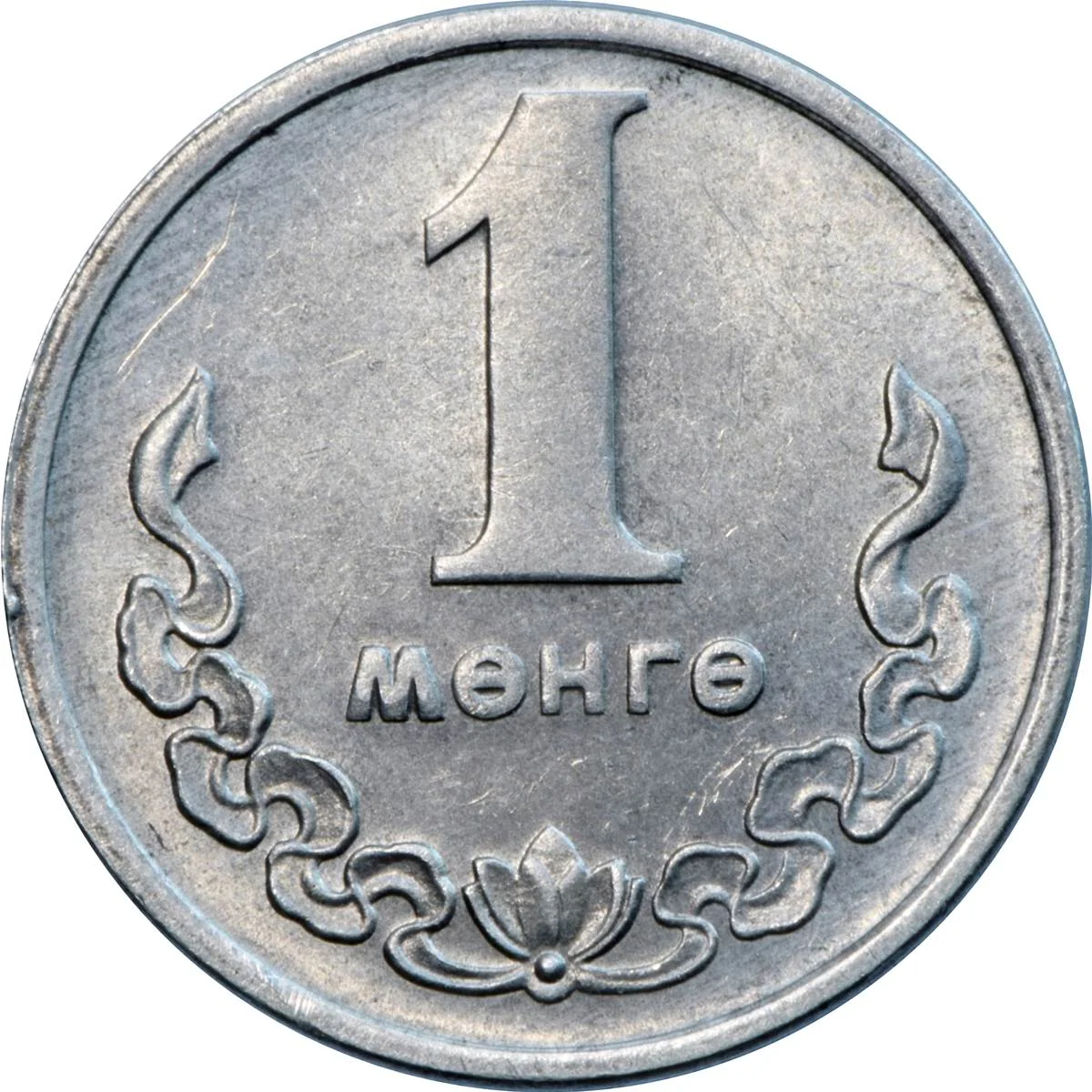
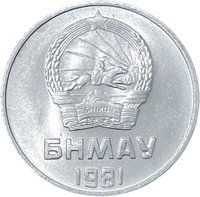
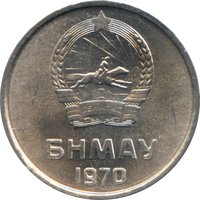
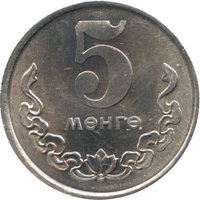
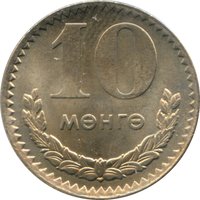
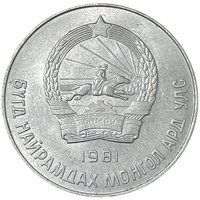
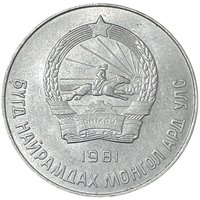
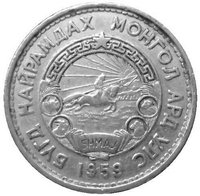
Reverse
Edge
Plain
Categories
| Symbols> Coat of Arms |
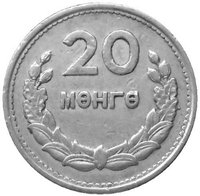
| Symbol> Wreath |
Mints
| Name | Mark |
|---|---|
| Berlin | — |
| Ulaanbaatar | — |
Mintings
| Year | Mint Mark | Mintage | Quality | Collection |
|---|---|---|---|---|
| 1970 | — | — | ||
| 1977 | — | — | ||
| 1980 | — | — | ||
| 1981 | — | — |
Historical background
In 1970, Mongolia operated under a centrally planned economy as a satellite state of the Soviet Union, and its currency situation was characterized by strict control, isolation, and dependence on the Soviet bloc. The national currency, the tögrög (MNT), was not a convertible currency on the global market. Its value was officially set and artificially maintained by the state, with an exchange rate pegged to the Soviet ruble rather than being determined by market forces or the country's economic performance. This peg provided an appearance of stability but masked underlying economic realities.
Domestically, the currency system was bifurcated. The tögrög used by Mongolian citizens was essentially confined to the purchase of locally produced goods and state-provided services, which were often subject to shortages. More significantly, a separate "convertible" or "certificate" tögrög existed for use by foreigners, diplomats, and within special "hard currency" shops. This dual system allowed the state to control access to scarce imported luxury goods and to accumulate foreign exchange, primarily Soviet rubles and other COMECON transferable rubles, while insulating the domestic economy.
Internationally, Mongolia's financial interactions were almost exclusively channeled through the Soviet-led Council for Mutual Economic Assistance (COMECON). Trade and credit were conducted in transferable rubles, and the country relied heavily on Soviet economic aid and technical assistance. Consequently, the 1970 tögrög reflected Mongolia's geopolitical position: it was a non-market instrument of accounting and domestic rationing within a closed, subsidized system, entirely dependent on and subordinate to the economic and political dictates of Moscow.
Domestically, the currency system was bifurcated. The tögrög used by Mongolian citizens was essentially confined to the purchase of locally produced goods and state-provided services, which were often subject to shortages. More significantly, a separate "convertible" or "certificate" tögrög existed for use by foreigners, diplomats, and within special "hard currency" shops. This dual system allowed the state to control access to scarce imported luxury goods and to accumulate foreign exchange, primarily Soviet rubles and other COMECON transferable rubles, while insulating the domestic economy.
Internationally, Mongolia's financial interactions were almost exclusively channeled through the Soviet-led Council for Mutual Economic Assistance (COMECON). Trade and credit were conducted in transferable rubles, and the country relied heavily on Soviet economic aid and technical assistance. Consequently, the 1970 tögrög reflected Mongolia's geopolitical position: it was a non-market instrument of accounting and domestic rationing within a closed, subsidized system, entirely dependent on and subordinate to the economic and political dictates of Moscow.
Series: 1970 Mongolia circulation coins
🌱 Very Common