

1 franc – Rwanda
Add to wishlist
Rwanda
Context
Year: 1969
Issuer: Rwanda
Issuing organization: National Bank of Rwanda
Period:
(since 1962)
Currency:
(since 1964)
Demonetized: Yes
Total mintage: 5,000,000
Material
References
KM: #
Numista: #5866
Value
Exchange value: 1 RWF
Obverse
Description:
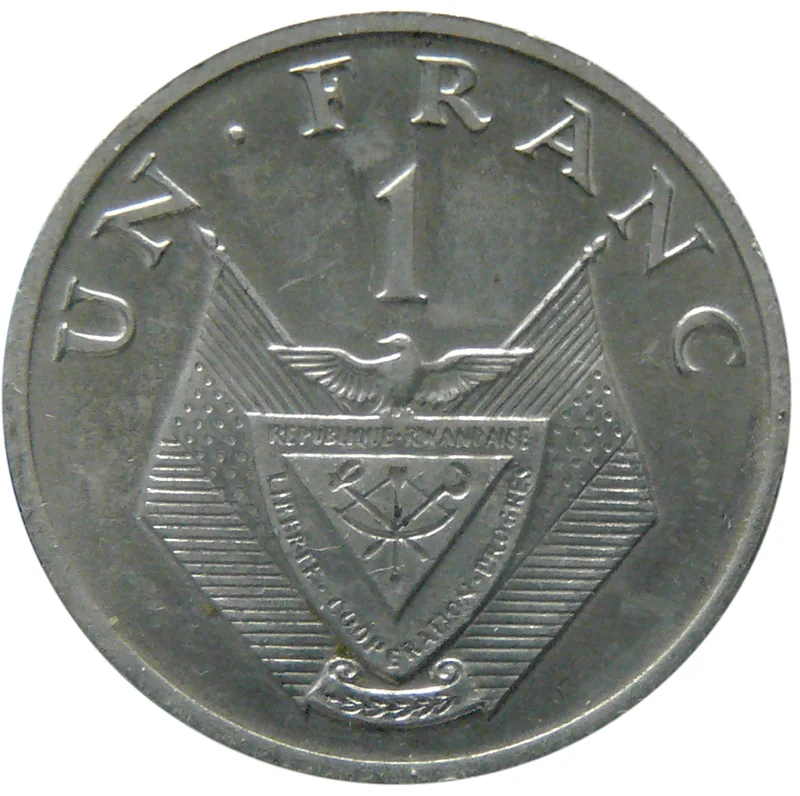
Rwanda's national motto.
Inscription:
UN · FRANC
1
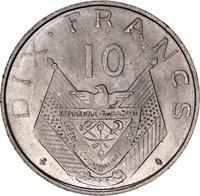
REPUBLIQUE RWANDAISE
LIBERTE COOPERATION PROGRES
1
REPUBLIQUE RWANDAISE
LIBERTE COOPERATION PROGRES
Translation:
One Franc
Republic of Rwanda
Liberty Cooperation Progress
Republic of Rwanda
Liberty Cooperation Progress
Script: Latin
Designer: Christopher Ironside
Reverse
Edge
Plain
Categories
| Symbols> Coat of Arms |
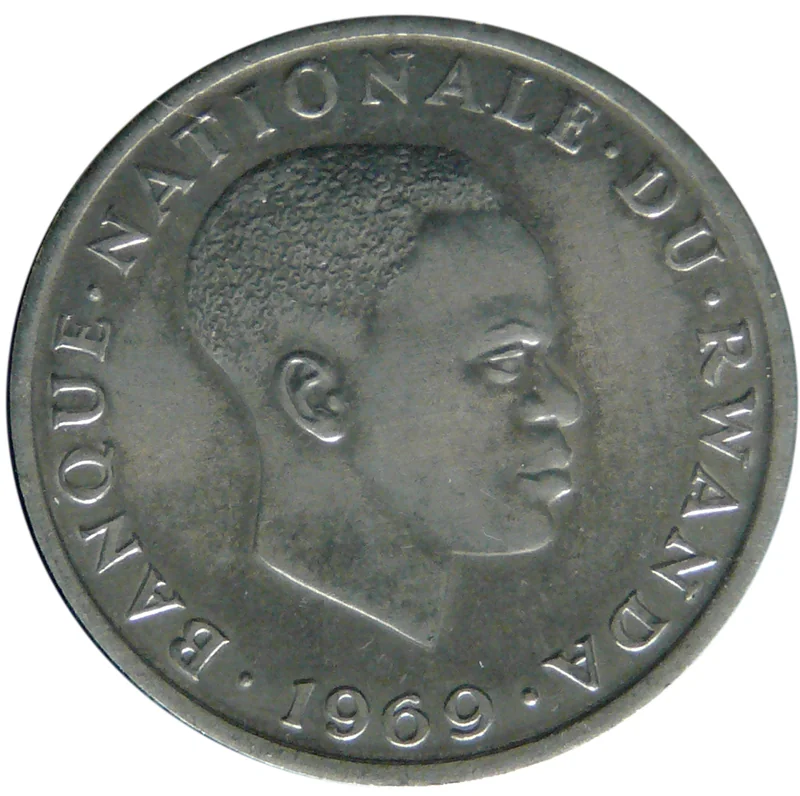
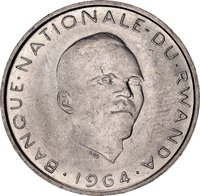
| Person> Politician |
Mints
| Name | Mark |
|---|---|
| Royal Mint (Tower Hill) | — |
Mintings
| Year | Mint Mark | Mintage | Quality | Collection |
|---|---|---|---|---|
| 1969 | — | 5,000,000 |
Historical background
In 1969, Rwanda's currency situation was defined by its membership in the Bank of Central African States (BCEAO) and the use of the CFA franc, a colonial-era currency peg that remained firmly in place. The CFA franc, created in 1945, was (and remains) a currency guaranteed by the French Treasury and pegged at a fixed rate to the French franc. This arrangement provided Rwanda with notable monetary stability and low inflation, as its currency was effectively backed by France. However, this stability came at the cost of monetary sovereignty; Rwanda had no independent central bank and could not set its own interest rates or conduct independent monetary policy tailored to its specific economic needs.
The Rwandan economy in this period was predominantly agrarian, with coffee and tea as the primary export earners. The fixed exchange rate of the CFA franc facilitated predictable trade with France and other members of the Franc Zone, which included several West and Central African nations. This was particularly important for a landlocked, resource-poor nation reliant on exporting a few primary commodities. Nonetheless, the system also drew criticism for potentially discouraging economic diversification and industrialisation, as the strong, fixed peg could make Rwandan non-commodity exports less competitive on the global market compared to countries with floating currencies.
This dynamic would soon change. The year 1969 proved to be a pivotal final chapter for Rwanda within the CFA franc system. Growing political and economic desires for greater autonomy, coupled with a sense that the BCEAO system favoured the interests of larger member states, led Rwanda to withdraw. In 1964, Burundi had already left to create its own central bank, setting a regional precedent. Following suit, Rwanda formally left the BCEAO and introduced its own national currency, the Rwandan franc, in 1964. Therefore, by 1969, Rwanda was operating with its own independent central bank, the National Bank of Rwanda, established in 1964, and its own sovereign Rwandan franc, having decisively ended its direct participation in the CFA franc system several years prior.
The Rwandan economy in this period was predominantly agrarian, with coffee and tea as the primary export earners. The fixed exchange rate of the CFA franc facilitated predictable trade with France and other members of the Franc Zone, which included several West and Central African nations. This was particularly important for a landlocked, resource-poor nation reliant on exporting a few primary commodities. Nonetheless, the system also drew criticism for potentially discouraging economic diversification and industrialisation, as the strong, fixed peg could make Rwandan non-commodity exports less competitive on the global market compared to countries with floating currencies.
This dynamic would soon change. The year 1969 proved to be a pivotal final chapter for Rwanda within the CFA franc system. Growing political and economic desires for greater autonomy, coupled with a sense that the BCEAO system favoured the interests of larger member states, led Rwanda to withdraw. In 1964, Burundi had already left to create its own central bank, setting a regional precedent. Following suit, Rwanda formally left the BCEAO and introduced its own national currency, the Rwandan franc, in 1964. Therefore, by 1969, Rwanda was operating with its own independent central bank, the National Bank of Rwanda, established in 1964, and its own sovereign Rwandan franc, having decisively ended its direct participation in the CFA franc system several years prior.
🌱 Common