

½ franc – Rwanda
Add to wishlist
Rwanda
Context
Year: 1970
Issuer: Rwanda
Issuing organization: National Bank of Rwanda
Period:
(since 1962)
Currency:
(since 1964)
Demonetized: Yes
Material
References
KM: #
Numista: #11989
Value
Exchange value: ½ RWF
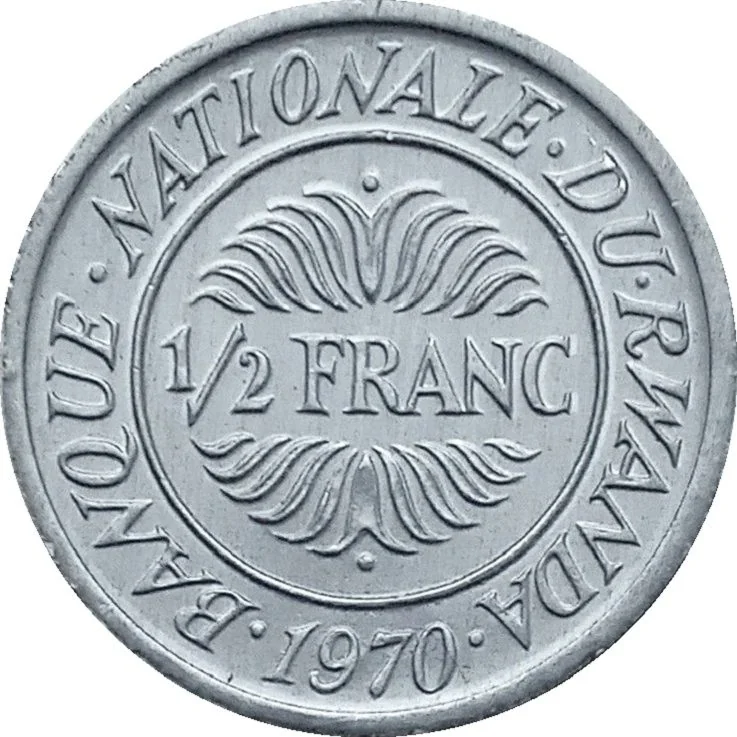
Obverse
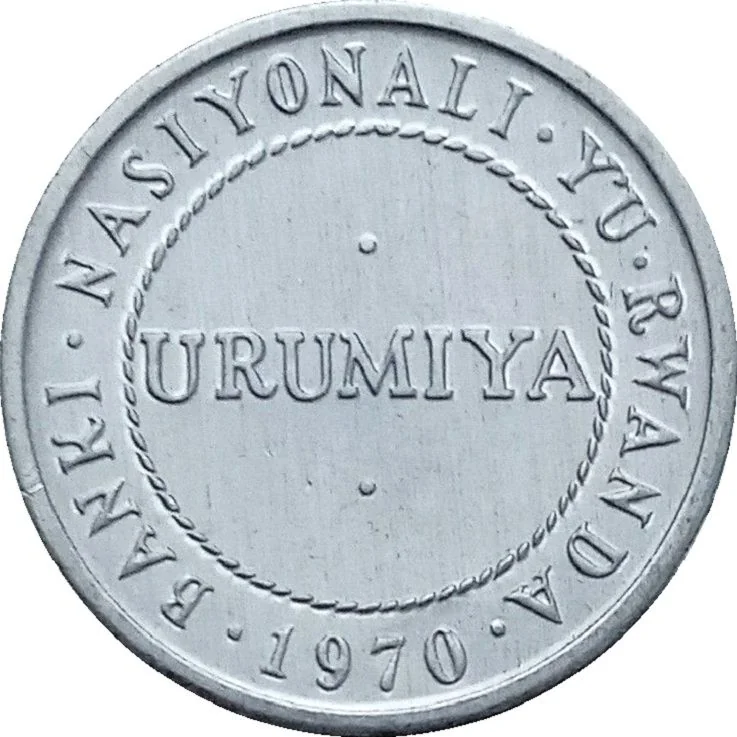
Reverse
Description:
Kinyarwanda value inside circle.
Inscription:
BANKI · NASIYONALI · YU · RWANDA
URUMIYA
· 1970 ·
URUMIYA
· 1970 ·
Translation:
National Bank of Rwanda
Five Francs
1970
Five Francs
1970
Script: Latin
Languages: Swahili, Kinyarwanda
Edge
Plain
Mints
| Name | Mark |
|---|---|
| Royal Mint (Tower Hill) | — |
Mintings
| Year | Mint Mark | Mintage | Quality | Collection |
|---|---|---|---|---|
| 1970 | — | — |
Historical background
In 1970, Rwanda's currency situation was defined by its membership in the Bank of Central African States (BCEAO) and the use of the CFA franc, a colonial-era arrangement that continued after independence in 1962. The Rwandan franc (RWF) was not yet an independent national currency; instead, the country used the CFA franc issued by the BCEAO, which was pegged at a fixed rate to the French franc (1 CFA franc = 0.02 French francs). This arrangement provided monetary stability and guaranteed convertibility through the French Treasury, but it also meant Rwanda had no direct control over its monetary policy, which was set collectively for the Central African Monetary Union.
Economically, this period was one of relative stability but underlying fragility. Rwanda was a poor, agrarian nation heavily dependent on coffee exports, with limited financial infrastructure. The fixed peg to the French franc helped control inflation and facilitated trade with France and other member states, yet it also tied Rwanda's economic fortunes to the monetary decisions of a broader union and the performance of the French franc itself. There was little domestic banking development, and the currency system was better suited for regional stability than for addressing Rwanda's specific developmental needs.
This arrangement would prove short-lived. Growing national sentiment and a desire for monetary sovereignty, particularly from the predominantly Hutu government under President Grégoire Kayibanda, led to a decisive break. In 1974, Rwanda withdrew from the BCEAO and established its own central bank, the National Bank of Rwanda, introducing the independent Rwandan franc. Therefore, the currency situation in 1970 was in its final years as part of a regional framework, on the cusp of a significant shift toward national monetary control.
Economically, this period was one of relative stability but underlying fragility. Rwanda was a poor, agrarian nation heavily dependent on coffee exports, with limited financial infrastructure. The fixed peg to the French franc helped control inflation and facilitated trade with France and other member states, yet it also tied Rwanda's economic fortunes to the monetary decisions of a broader union and the performance of the French franc itself. There was little domestic banking development, and the currency system was better suited for regional stability than for addressing Rwanda's specific developmental needs.
This arrangement would prove short-lived. Growing national sentiment and a desire for monetary sovereignty, particularly from the predominantly Hutu government under President Grégoire Kayibanda, led to a decisive break. In 1974, Rwanda withdrew from the BCEAO and established its own central bank, the National Bank of Rwanda, introducing the independent Rwandan franc. Therefore, the currency situation in 1970 was in its final years as part of a regional framework, on the cusp of a significant shift toward national monetary control.
🌟 Uncommon