

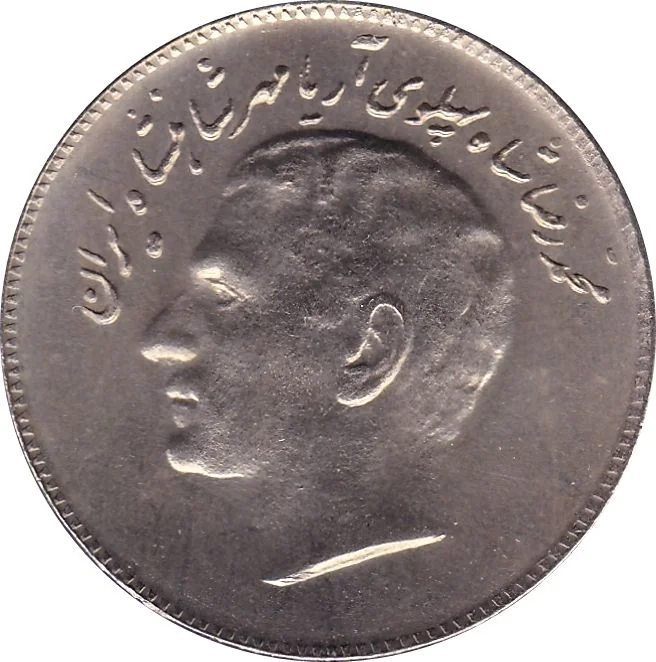
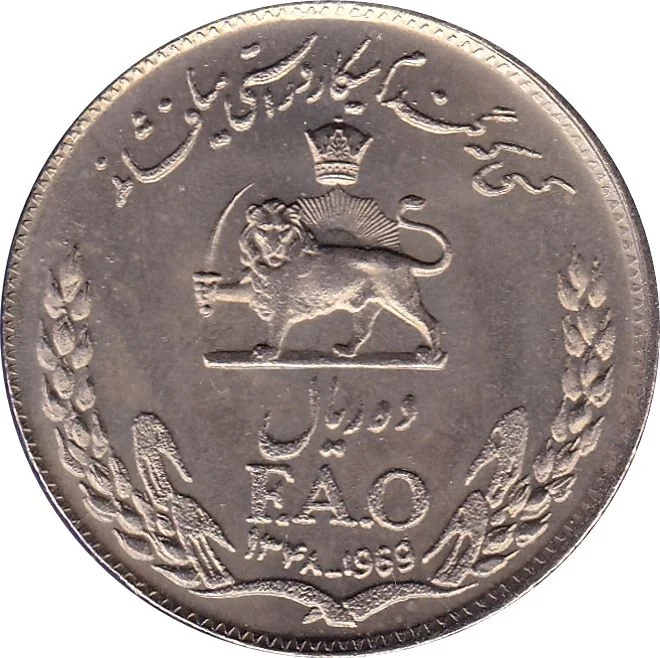
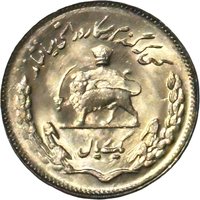
10 Rials – Iran
Circulating commemorative coins
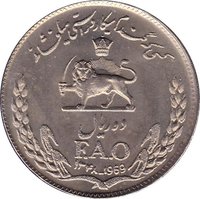
Commemoration: F.A.O.
Iran
Context
Year: 1969
Iranian - Persian Year: 1348
Issuer: Iran 
Ruler: Mohammad Reza
Currency:
(since 1932)
Demonetized: Yes
Total mintage: 150,000
Material
References
KM: #Click to copy to clipboard1182
Numista: #5864
Value
Exchange value: 10 IRR
Obverse
Reverse
Edge
Reeded
Categories
| Organization> FAO |
Mints
| Name | Mark |
|---|---|
| Tehran | — |
Mintings
| Year | Mint Mark | Mintage | Quality | Collection |
|---|---|---|---|---|
| 1969 | — | 150,000 |
Historical background
In 1969, Iran’s currency situation was characterized by relative stability and strength, underpinned by a period of significant economic growth and rising oil revenues. The national currency, the rial, was pegged to the U.S. dollar at a fixed rate of 75.75 rials per dollar, an exchange regime established in 1957. This peg provided a solid anchor for trade and investment, fostering confidence during a decade of ambitious modernization and industrialization projects under Shah Mohammad Reza Pahlavi’s "White Revolution."
This stability was largely financed by Iran's burgeoning oil sector. As a founding member of OPEC, Iran was steadily increasing its petroleum output and revenue, which flowed directly to the government. These substantial foreign exchange earnings allowed the Central Bank of Iran to maintain the dollar peg with comfortable reserves, funding large-scale imports of capital goods and technology for infrastructure development without causing severe balance of payments pressures.
However, beneath this surface stability, underlying pressures were beginning to emerge. The state-led development model, while rapidly transforming the economy, was also contributing to inflation, particularly in urban centers. Furthermore, the economy’s deepening dependence on oil revenue made it vulnerable to global market fluctuations—a vulnerability that would be dramatically exposed just a few years later with the 1973 oil price shocks and subsequent political upheaval. Thus, 1969 represented the calm apex of the Pahlavi monetary regime, immediately preceding the turbulent economic changes of the 1970s.
This stability was largely financed by Iran's burgeoning oil sector. As a founding member of OPEC, Iran was steadily increasing its petroleum output and revenue, which flowed directly to the government. These substantial foreign exchange earnings allowed the Central Bank of Iran to maintain the dollar peg with comfortable reserves, funding large-scale imports of capital goods and technology for infrastructure development without causing severe balance of payments pressures.
However, beneath this surface stability, underlying pressures were beginning to emerge. The state-led development model, while rapidly transforming the economy, was also contributing to inflation, particularly in urban centers. Furthermore, the economy’s deepening dependence on oil revenue made it vulnerable to global market fluctuations—a vulnerability that would be dramatically exposed just a few years later with the 1973 oil price shocks and subsequent political upheaval. Thus, 1969 represented the calm apex of the Pahlavi monetary regime, immediately preceding the turbulent economic changes of the 1970s.
🌱 Fairly Common