

50 kroner (World War II) – Norway
Add to wishlist
Non-circulating coins
Commemoration: 50 years since the end of World War II
Norway
Context
Material
References
KM: #
Numista: #58622
Value
Exchange value: 50 NOK
Bullion value: $39.06
Inflation-adjusted value: 103.47 NOK
Obverse
Description:
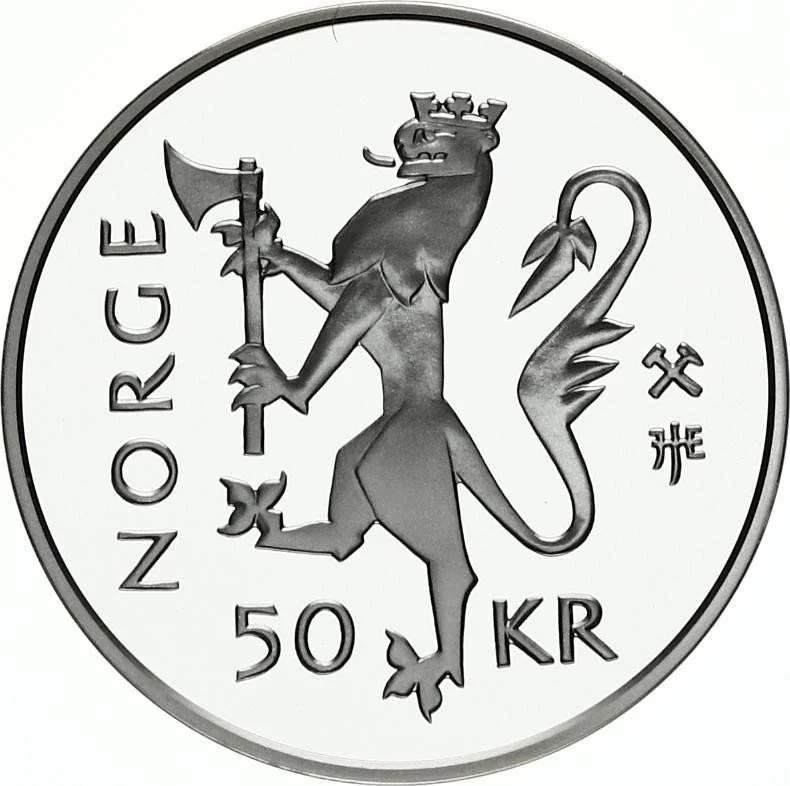
Norwegian lion crowned, facing left with halberd. Inscription left, mintmark and initials right. Value by rear leg. Solid rim ring.
Inscription:
NORGE
⚒
JEJ
50 | KR
⚒
JEJ
50 | KR
Translation:
NORWAY
I AM
50 | CROWNS
I AM
50 | CROWNS
Script: Latin
Engraver: Ingrid Austlid Rise
Reverse
Description:
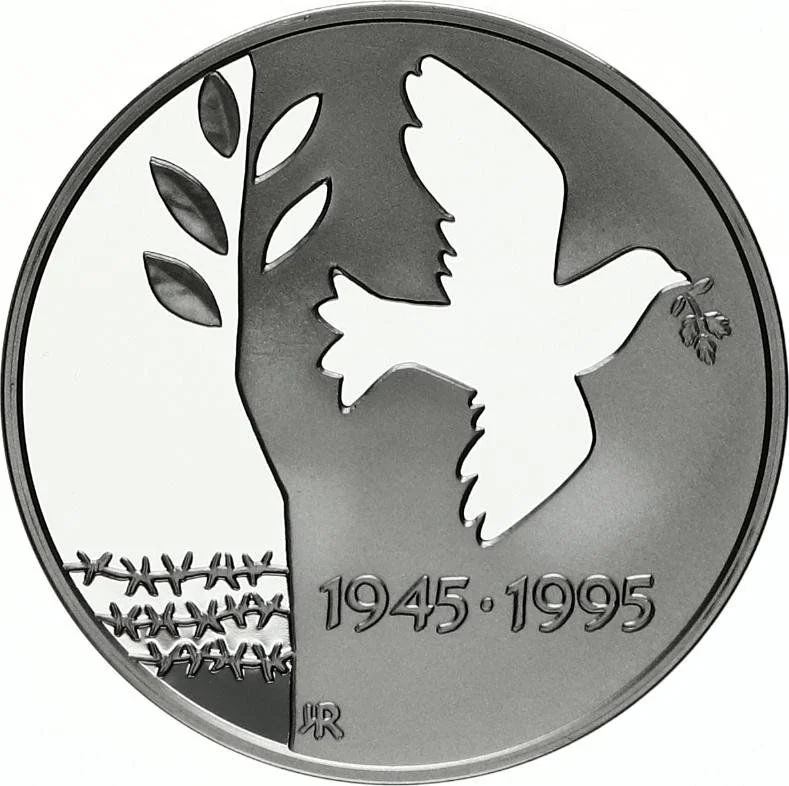
Vine splits coin; dove above dates, barbed wire left. Engraver's initials below. Solid ring on rim.
Inscription:
1945·1995
IAR
IAR
Script: Latin
Engraver: Ingrid Austlid Rise
Edge
Plain
Mints
| Name | Mark |
|---|---|
| Norwegian Mint | — |
Mintings
| Year | Mint Mark | Mintage | Quality | Collection |
|---|---|---|---|---|
| 1995 | — | 50,000 | Proof |
Historical background
In 1995, Norway's currency situation was defined by its managed float exchange rate regime. The Norwegian krone (NOK) was not pegged to any single currency but was instead monitored and occasionally influenced by Norges Bank, the country's central bank, to maintain stability. This period followed the tumultuous exit from the European Exchange Rate Mechanism (ERM) in late 1992, a move that spared Norway the severe speculative pressures faced by other European countries. By 1995, the policy focused on targeting low and stable inflation, with the krone's value allowed to fluctuate within a broad, unofficial band against a trade-weighted basket of currencies.
The economy in the mid-1990s was strong, fueled by significant petroleum exports from the North Sea, which created substantial trade surpluses and upward pressure on the krone. However, this strength presented a policy dilemma: a very strong krone could harm the competitiveness of Norway's non-oil export industries, such as shipping and manufacturing. Consequently, Norges Bank engaged in strategic foreign exchange interventions, both buying and selling kroner, to smooth out excessive volatility and prevent a too-rapid appreciation that could damage the broader economy.
Internationally, 1995 was a year of currency instability, notably with the dramatic depreciation of the Swedish krona. This regional volatility required careful management from Norwegian authorities to ensure financial stability. Domestically, the robust economic performance and high krone value contributed to rising living standards but also fueled debates about future monetary policy, particularly regarding a potential formal peg to the European Currency Unit (ECU) in preparation for European Union membership, a prospect Norwegians had rejected in a 1994 referendum. Thus, the currency situation in 1995 was one of cautious management, balancing oil wealth with industrial competitiveness in an uncertain European monetary landscape.
The economy in the mid-1990s was strong, fueled by significant petroleum exports from the North Sea, which created substantial trade surpluses and upward pressure on the krone. However, this strength presented a policy dilemma: a very strong krone could harm the competitiveness of Norway's non-oil export industries, such as shipping and manufacturing. Consequently, Norges Bank engaged in strategic foreign exchange interventions, both buying and selling kroner, to smooth out excessive volatility and prevent a too-rapid appreciation that could damage the broader economy.
Internationally, 1995 was a year of currency instability, notably with the dramatic depreciation of the Swedish krona. This regional volatility required careful management from Norwegian authorities to ensure financial stability. Domestically, the robust economic performance and high krone value contributed to rising living standards but also fueled debates about future monetary policy, particularly regarding a potential formal peg to the European Currency Unit (ECU) in preparation for European Union membership, a prospect Norwegians had rejected in a 1994 referendum. Thus, the currency situation in 1995 was one of cautious management, balancing oil wealth with industrial competitiveness in an uncertain European monetary landscape.
⭐ Rare