

100 Kroner – Norway
Non-circulating coins
Commemoration: Year 2000
Norway
Context
Material
References
KM: #Click to copy to clipboard466
Numista: #58563
Value
Exchange value: 100 NOK = $10.43
Bullion value: $87.20
Inflation-adjusted value: 190.19 NOK
Obverse
Description:
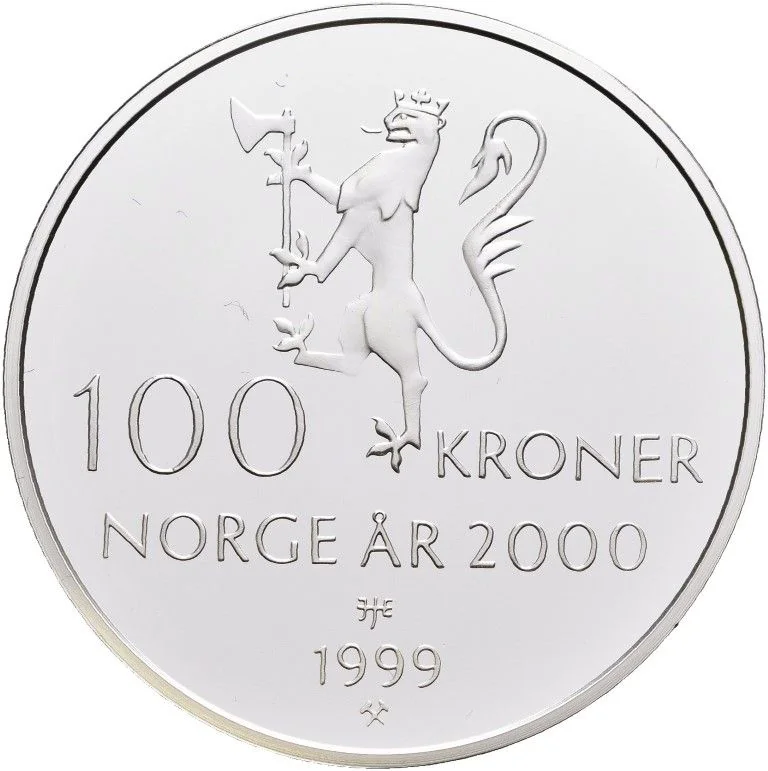
Norwegian lion left, holding halberd. Value behind leg. Legend, marks, and date below. Solid rim ring.
Inscription:
100 | KRONER
NORGE ÅR 2000
JEJ
1999
⚒
NORGE ÅR 2000
JEJ
1999
⚒
Translation:
ONE HUNDRED KRONER
NORWAY YEAR 2000
JEJ
1999
⚒
NORWAY YEAR 2000
JEJ
1999
⚒
Script: Latin
Language: Norwegian
Engraver: Ingrid Austlid Rise
Reverse
Description:
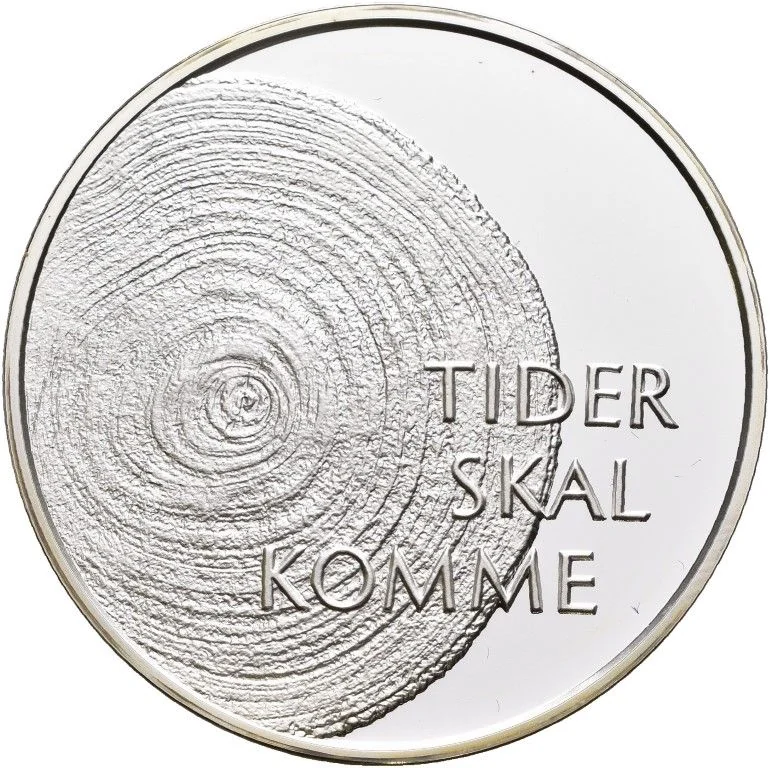
Tree trunk cross-section with growth rings, an inscription, and a solid rim ring.
Inscription:
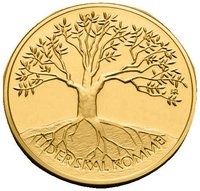
TIDER
SKAL
KOMME
SKAL
KOMME
Translation:
Time shall come
Script: Latin
Engraver: Ingrid Austlid Rise
Edge
Plain
Mints
| Name | Mark |
|---|---|
| Norwegian Mint | — |
Mintings
| Year | Mint Mark | Mintage | Quality | Collection |
|---|---|---|---|---|
| 1999 | — | 50,000 | Proof |
Historical background
In 1999, Norway found itself in a unique and deliberate position regarding currency, as it was one of the few Western European nations outside the newly launched Eurozone. While its neighbours Sweden and Denmark also remained outside, Norway's situation was distinct due to its status as a non-EU member following the 1994 referendum. The country's economic policy was firmly anchored by the Norwegian krone (NOK) operating within a managed float exchange rate regime, overseen by Norges Bank. The primary objective was not to target a specific fixed rate but to maintain low and stable inflation, a framework that provided flexibility to manage the economic shocks inherent to its significant oil and gas exports.
The year was dominated by active management of the krone in the face of considerable volatility, largely driven by fluctuating global oil prices. After a sharp decline in oil prices in 1998, 1999 saw a strong recovery, which typically would lead to a stronger krone. However, Norges Bank intervened in the foreign exchange market on several occasions, selling kroner to prevent excessive appreciation that could harm the non-oil export sector. This period underscored the central challenge of balancing the wealth generated from petroleum resources with the need to maintain competitiveness for mainland industries, a duality often referred to as the "Dutch disease" concern.
Ultimately, the events of 1999 reinforced Norway's consensus to retain its independent monetary policy and its national currency. The krone regime allowed Norges Bank to tailor interest rates and interventions specifically to Norway's cyclical conditions, which were often out of sync with the Eurozone due to the oil sector's influence. This independent path, coupled with the sovereign wealth fund (the Government Pension Fund Global) established just a few years prior, was seen as the optimal toolkit for managing the nation's petroleum wealth without sacrificing economic stability, a stance that has remained fundamentally unchanged since.
The year was dominated by active management of the krone in the face of considerable volatility, largely driven by fluctuating global oil prices. After a sharp decline in oil prices in 1998, 1999 saw a strong recovery, which typically would lead to a stronger krone. However, Norges Bank intervened in the foreign exchange market on several occasions, selling kroner to prevent excessive appreciation that could harm the non-oil export sector. This period underscored the central challenge of balancing the wealth generated from petroleum resources with the need to maintain competitiveness for mainland industries, a duality often referred to as the "Dutch disease" concern.
Ultimately, the events of 1999 reinforced Norway's consensus to retain its independent monetary policy and its national currency. The krone regime allowed Norges Bank to tailor interest rates and interventions specifically to Norway's cyclical conditions, which were often out of sync with the Eurozone due to the oil sector's influence. This independent path, coupled with the sovereign wealth fund (the Government Pension Fund Global) established just a few years prior, was seen as the optimal toolkit for managing the nation's petroleum wealth without sacrificing economic stability, a stance that has remained fundamentally unchanged since.
⭐ Rare