

2 Francs – French Cameroon
Cameroon
Context
Year: 1948
Country: Cameroon 
Issuer: French Cameroon
Period:
(1946—1958)
Currency:
(1945—1960)
Demonetized: Yes
Total mintage: 5,000,000
Material
References
KM: #Click to copy to clipboard9
Numista: #5851
Value
Exchange value: 2 FCFA
Obverse
Description:
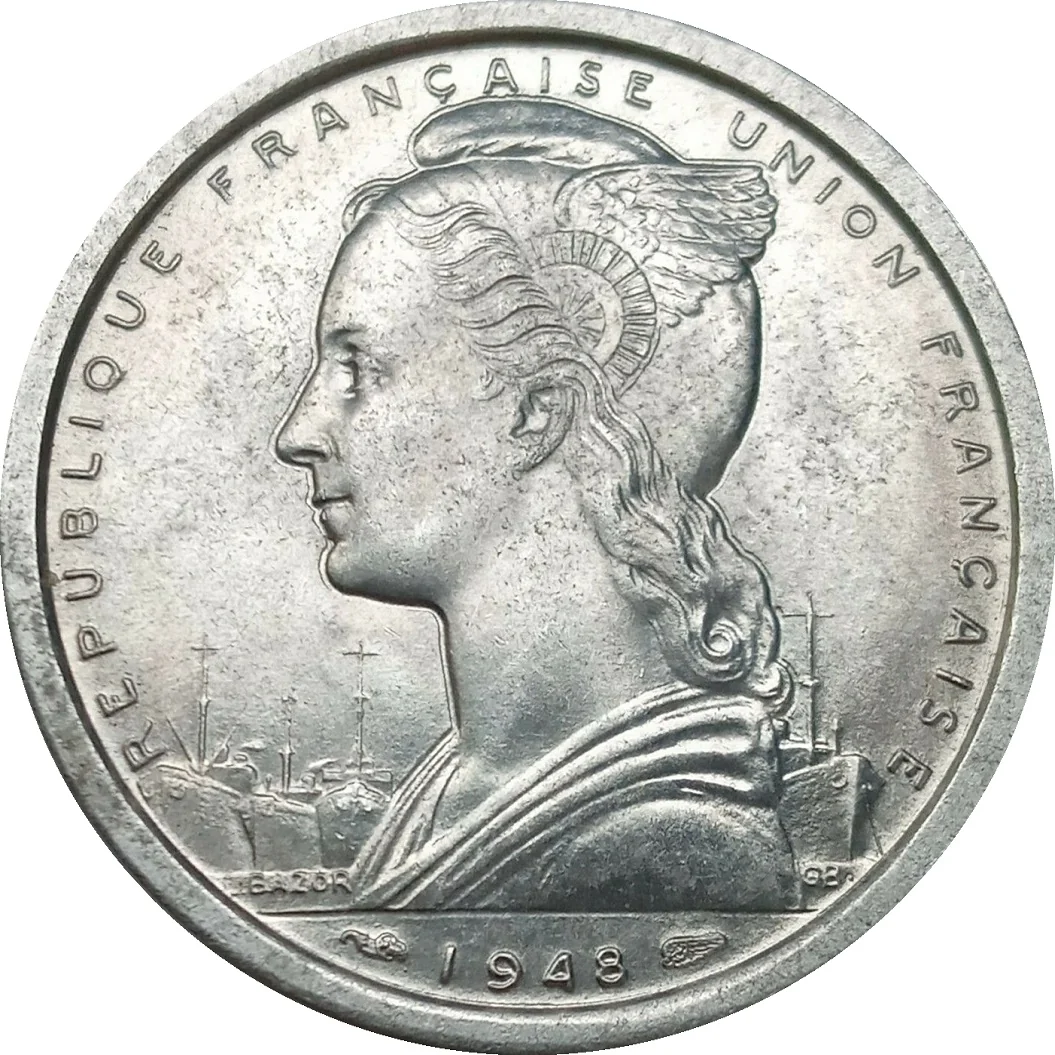
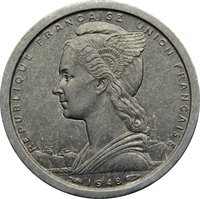
Liberty in winged cap, ships behind.
Inscription:
REPUBLIQUE FRANÇAISE UNION FRANÇAISE
L BAZOR GB
1948
L BAZOR GB
1948
Translation:
FRENCH REPUBLIC FRENCH UNION
L BAZOR GB
1948
L BAZOR GB
1948
Script: Latin
Language: French
Engraver: Lucien Georges Bazor
Reverse
Description:
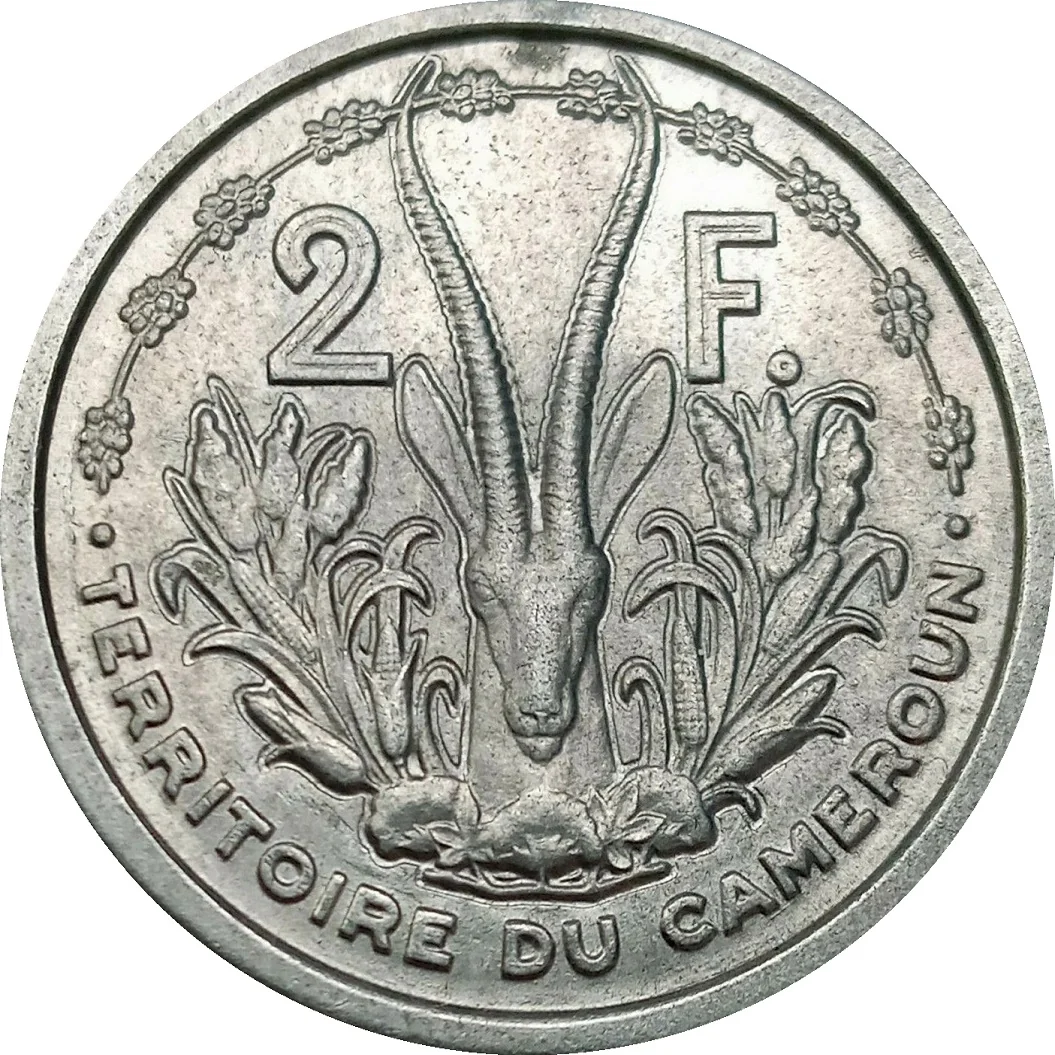
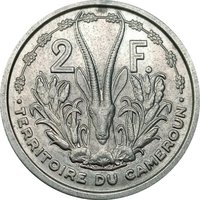
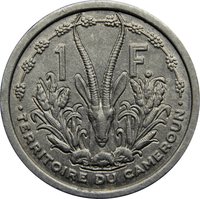
Rhim gazelle facing forward, flanked by plants with a semicircle of grapes above.
Inscription:
2 F.
TERRITOIRE DU CAMEROUN
TERRITOIRE DU CAMEROUN
Translation:
Territory of Cameroon
Script: Latin
Language: French
Engraver: Lucien Georges Bazor
Edge
Plain
Mints
| Name | Mark |
|---|---|
| Monnaie de Paris | — |
Mintings
| Year | Mint Mark | Mintage | Quality | Collection |
|---|---|---|---|---|
| 1948 | — | 5,000,000 |
Historical background
In 1948, the currency situation in French Cameroon was defined by its integration into the Franc Zone (Zone Franc), a monetary union orchestrated by France for its colonies and territories. The official currency was the CFA franc (Colonies Françaises d'Afrique), which had been created in 1945. A key feature of this system was a fixed and guaranteed exchange rate with the French franc, set at 1 CFA franc = 1.7 French francs (a revaluation from the initial 1945 rate). This arrangement provided monetary stability and facilitated trade with France, but it also meant that Cameroon's monetary policy was entirely directed from Paris, with the French Treasury holding the territory's foreign exchange reserves.
Economically, the post-World War II period was one of recovery and increased colonial investment under France's Fonds d'Investissement pour le Développement Économique et Social (FIDES). The stable CFA franc supported the growth of export-oriented agriculture, particularly cocoa, coffee, and bananas, which were channeled to the metropole. However, this currency peg also tied Cameroon's economy directly to France's post-war inflation and reconstruction challenges. While beneficial for French importers and the colonial administration, some local planters and merchants chafed under a system they perceived as designed primarily to serve French economic interests and control.
Politically, the currency was a tangible symbol of Cameroon's status as a United Nations Trust Territory administered by France, rather than a colony. While it offered stability, it also underscored a lack of economic sovereignty. Discussions about autonomy or self-governance, which would gain momentum in the 1950s, inherently questioned this monetary dependency. Thus, in 1948, the CFA franc was more than just a medium of exchange; it was a cornerstone of the territory's integrated, yet subordinate, position within the French imperial economic bloc.
Economically, the post-World War II period was one of recovery and increased colonial investment under France's Fonds d'Investissement pour le Développement Économique et Social (FIDES). The stable CFA franc supported the growth of export-oriented agriculture, particularly cocoa, coffee, and bananas, which were channeled to the metropole. However, this currency peg also tied Cameroon's economy directly to France's post-war inflation and reconstruction challenges. While beneficial for French importers and the colonial administration, some local planters and merchants chafed under a system they perceived as designed primarily to serve French economic interests and control.
Politically, the currency was a tangible symbol of Cameroon's status as a United Nations Trust Territory administered by France, rather than a colony. While it offered stability, it also underscored a lack of economic sovereignty. Discussions about autonomy or self-governance, which would gain momentum in the 1950s, inherently questioned this monetary dependency. Thus, in 1948, the CFA franc was more than just a medium of exchange; it was a cornerstone of the territory's integrated, yet subordinate, position within the French imperial economic bloc.
Series: 1948 series
🌱 Common