

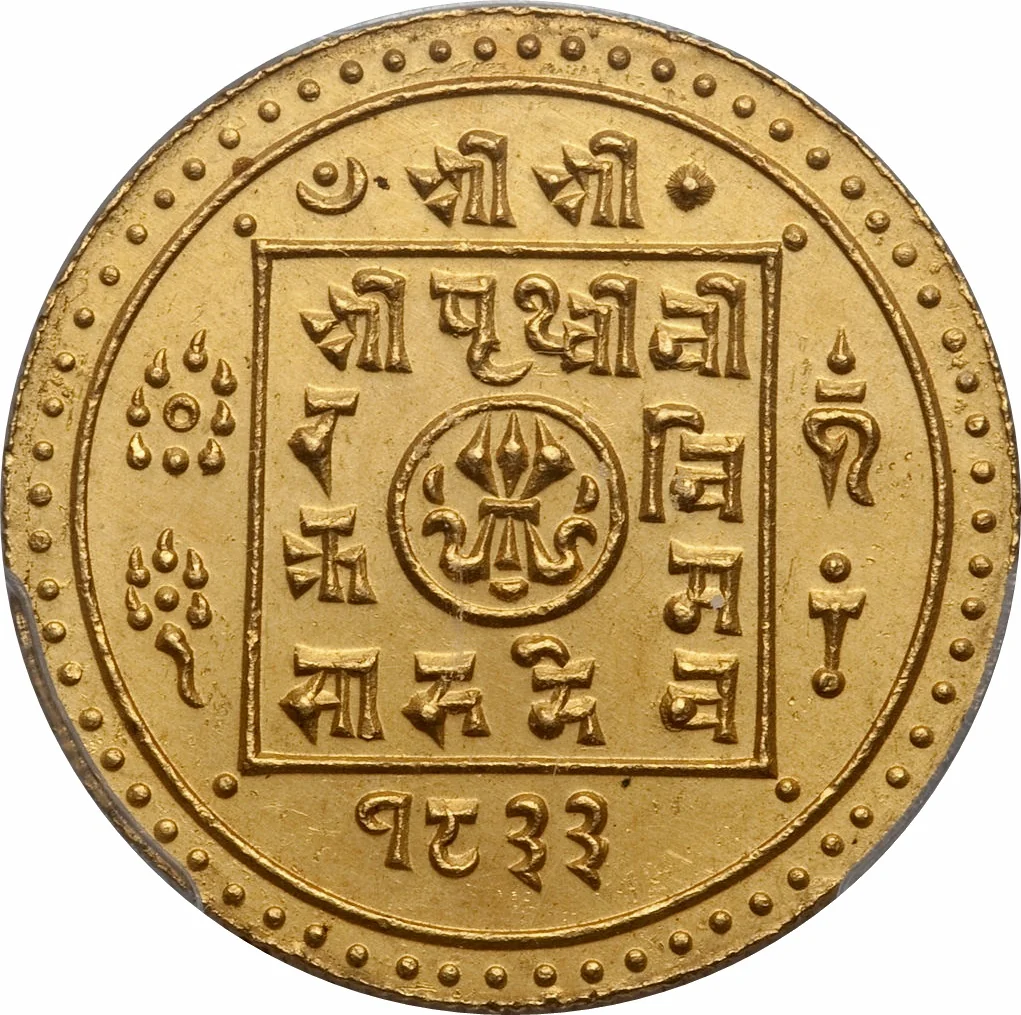
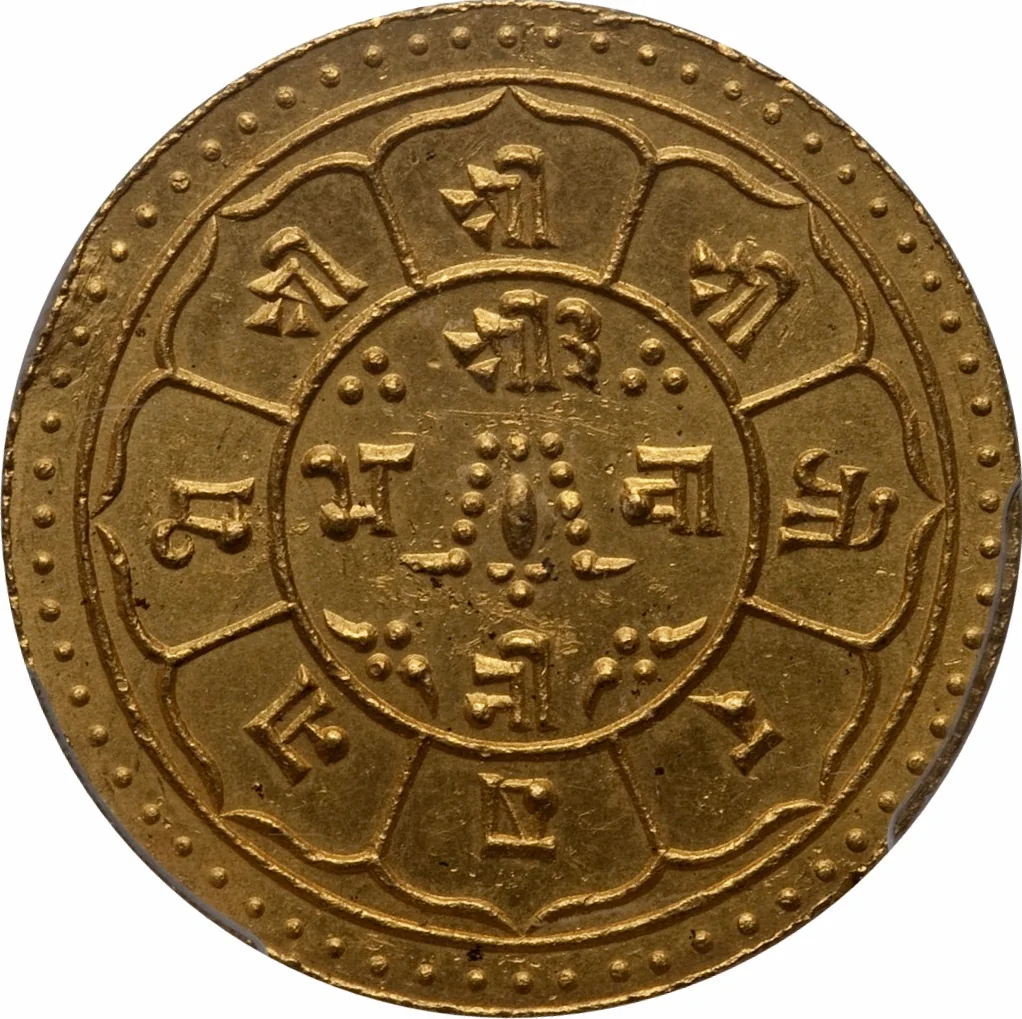
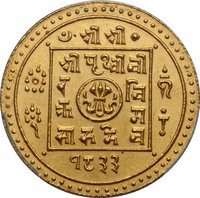
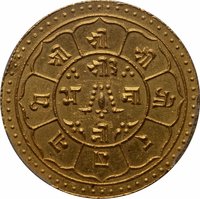
2 Tola – Nepal
Nepal
Context
Year: 1911
Nepal - Saka era Year: 1833
Issuer: Nepal 
Ruler: Prithvi Bir Bikram Shah
Currency:
(1546—1932)
Demonetized: Yes
Material
References
KM: #Click to copy to clipboard680
Numista: #58455
Value
Bullion value: $3882.31
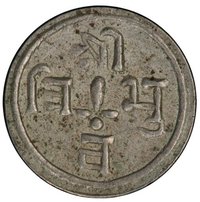
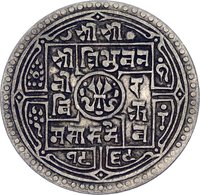
Obverse
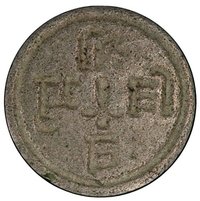
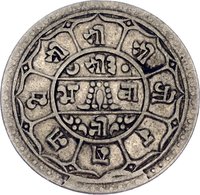
Reverse
Edge
Milled
Mintings
| Year | Mint Mark | Mintage | Quality | Collection |
|---|---|---|---|---|
| 1911 | — | — |
Historical background
In 1911, Nepal's currency system was a complex and transitional one, deeply rooted in its historical autonomy while being pulled into the economic orbit of British India. The official currency was the Nepali Mohar, a silver coin minted by the state, but the economy operated on a bimetallic standard of silver and copper. More significantly, the Indian Rupee, a stronger and more widely recognized currency, circulated extensively, especially for larger transactions and trade. This created a dual-currency reality where the value of the Nepali Mohar fluctuated against the Rupee, often at a disadvantage, leading to periodic economic instability and confusion.
This monetary duality was a direct consequence of Nepal's political and economic relationship with the British Empire. Following the 1816 Sugauli Treaty, Nepal was formally independent but functionally within Britain's sphere of influence. The Treaty of Commerce (1923, but building on earlier agreements) was being negotiated, which would later formalize Nepal's right to mint its own currency, but in 1911 the situation was fluid. The Rana regime (1846–1951), which ruled Nepal autocratically, relied heavily on the export of Gorkha recruits to the British Indian Army, and much of this income was in Indian Rupees, further entrenching its use.
Internally, the currency system was archaic. The state mints in Kathmandu produced coins that were often irregular in weight and purity, leading to distrust. Counterfeiting was also a problem. For ordinary people, daily transactions were conducted in a cumbersome array of old Mohars, Dams (copper coins), and Indian coins. There was no unified paper currency, and banking was virtually non-existent outside of traditional money-lending. Thus, in 1911, Nepal's currency landscape was characterized by a weak national coinage competing with a foreign powerhouse currency, reflecting the country's struggle to maintain monetary sovereignty while being inextricably linked to the British Indian economy.
This monetary duality was a direct consequence of Nepal's political and economic relationship with the British Empire. Following the 1816 Sugauli Treaty, Nepal was formally independent but functionally within Britain's sphere of influence. The Treaty of Commerce (1923, but building on earlier agreements) was being negotiated, which would later formalize Nepal's right to mint its own currency, but in 1911 the situation was fluid. The Rana regime (1846–1951), which ruled Nepal autocratically, relied heavily on the export of Gorkha recruits to the British Indian Army, and much of this income was in Indian Rupees, further entrenching its use.
Internally, the currency system was archaic. The state mints in Kathmandu produced coins that were often irregular in weight and purity, leading to distrust. Counterfeiting was also a problem. For ordinary people, daily transactions were conducted in a cumbersome array of old Mohars, Dams (copper coins), and Indian coins. There was no unified paper currency, and banking was virtually non-existent outside of traditional money-lending. Thus, in 1911, Nepal's currency landscape was characterized by a weak national coinage competing with a foreign powerhouse currency, reflecting the country's struggle to maintain monetary sovereignty while being inextricably linked to the British Indian economy.
Series: 1911 Nepal circulation coins
✨ Legendary