

1000 Schilling – Austria
Austria

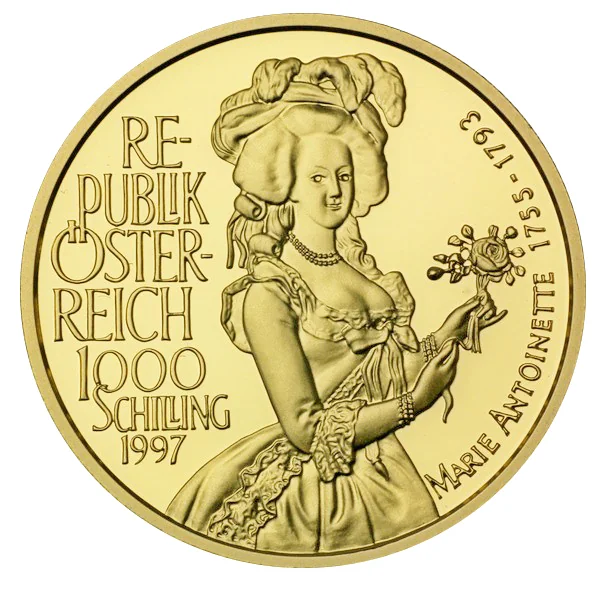
Obverse
Inscription:
RE-
PUPLIK
ÖSTER-
REICH
1000
SCHILLING
1997
MARIE ANTOINETTE 1755-1793
PUPLIK
ÖSTER-
REICH
1000
SCHILLING
1997
MARIE ANTOINETTE 1755-1793
Translation:
REPUBLIC OF AUSTRIA
1000
SCHILLING
1997
MARIE ANTOINETTE 1755-1793
1000
SCHILLING
1997
MARIE ANTOINETTE 1755-1793
Script: Latin
Engraver: Herbert Wähner
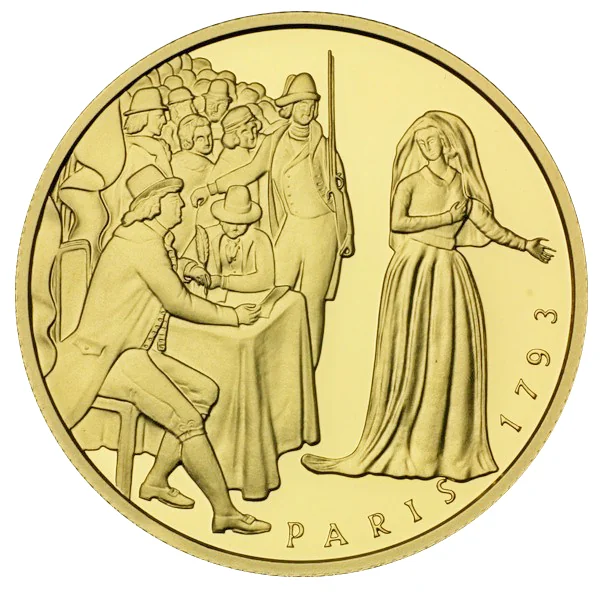
Reverse
Edge
Mints
| Name | Mark |
|---|---|
| Münze Österreich | — |
Mintings
| Year | Mint Mark | Mintage | Quality | Collection |
|---|---|---|---|---|
| 1997 | — | 50,000 | Proof |
Historical background
In 1997, Austria was a nation in a state of monetary transition, firmly embedded within the European integration process. As a member of the European Union since 1995, the country was actively preparing for the launch of the Economic and Monetary Union (EMU) and the introduction of the euro, scheduled for January 1, 1999. The Austrian schilling, the national currency since 1925, was operating under the framework of the European Exchange Rate Mechanism (ERM II), which pegged it within a narrow band against other European currencies, particularly the Deutsche Mark. This linkage provided stability and was a crucial prerequisite for euro adoption, reflecting Austria's strong economic alignment with Germany.
Domestically, the schilling was characterized by remarkable stability and low inflation, a legacy of the hard-currency policy pursued by the Austrian National Bank (OeNB) since the 1970s. This policy had fostered high public confidence in the currency. Consequently, the population viewed the impending shift to the euro with a mixture of pragmatic acceptance and quiet nostalgia, rather than significant anxiety. The year 1997 was part of the final phase of the "convergence period," where Austria, along with other aspiring eurozone members, worked diligently to meet the strict Maastricht criteria on inflation, interest rates, budget deficits, and public debt.
Thus, the currency situation in 1997 was one of calm anticipation and technical preparation. The legal framework for the changeover was being finalized, with the exact conversion rate for the schilling to be irrevocably fixed in 1998. Public information campaigns began to intensify, explaining the timeline and procedures for the introduction of euro banknotes and coins in 2002. In essence, Austria was smoothly and confidently transitioning from a stable national currency to what was envisioned as an even more stable supranational one, with 1997 representing the quiet culmination of years of economic policy aimed at European monetary integration.
Domestically, the schilling was characterized by remarkable stability and low inflation, a legacy of the hard-currency policy pursued by the Austrian National Bank (OeNB) since the 1970s. This policy had fostered high public confidence in the currency. Consequently, the population viewed the impending shift to the euro with a mixture of pragmatic acceptance and quiet nostalgia, rather than significant anxiety. The year 1997 was part of the final phase of the "convergence period," where Austria, along with other aspiring eurozone members, worked diligently to meet the strict Maastricht criteria on inflation, interest rates, budget deficits, and public debt.
Thus, the currency situation in 1997 was one of calm anticipation and technical preparation. The legal framework for the changeover was being finalized, with the exact conversion rate for the schilling to be irrevocably fixed in 1998. Public information campaigns began to intensify, explaining the timeline and procedures for the introduction of euro banknotes and coins in 2002. In essence, Austria was smoothly and confidently transitioning from a stable national currency to what was envisioned as an even more stable supranational one, with 1997 representing the quiet culmination of years of economic policy aimed at European monetary integration.
💎 Extremely Rare