

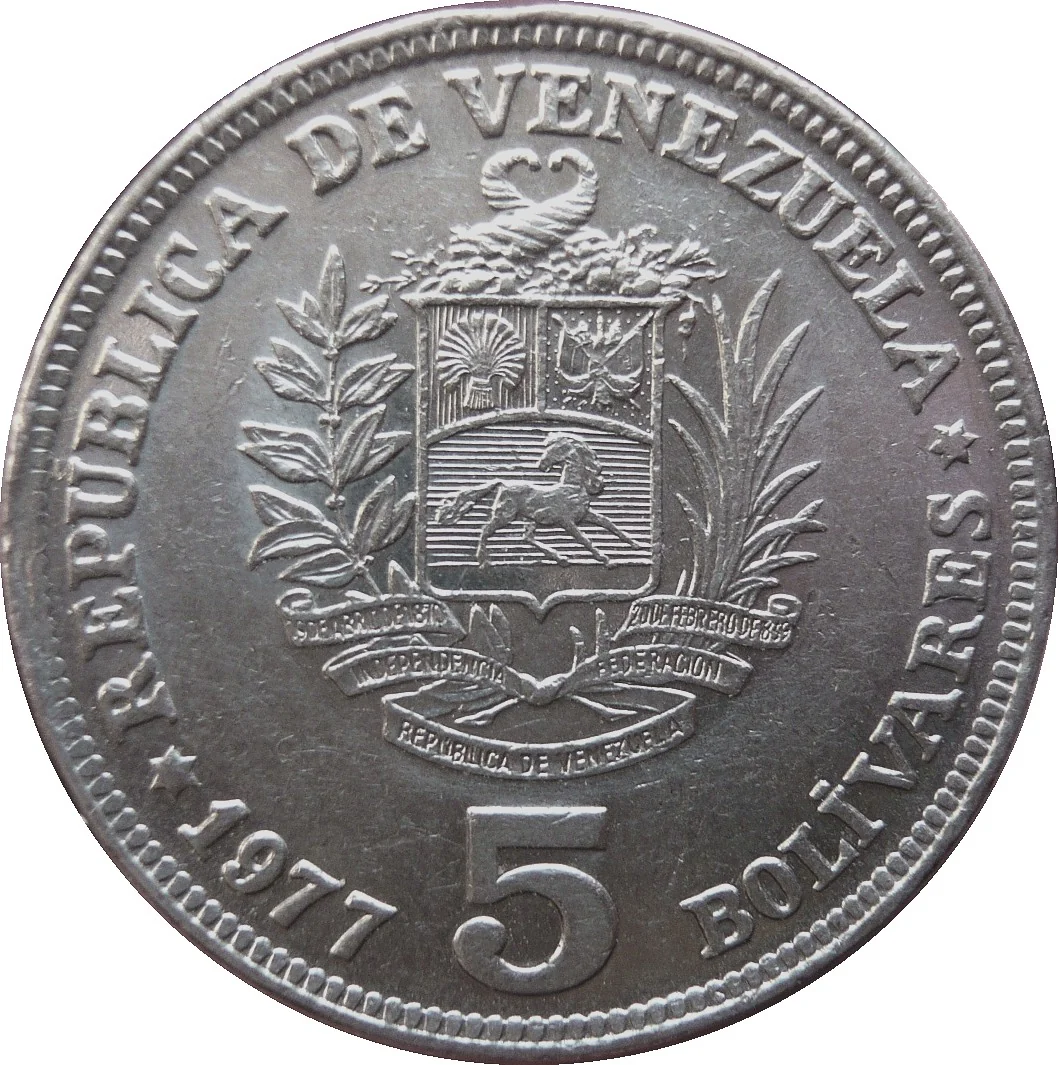
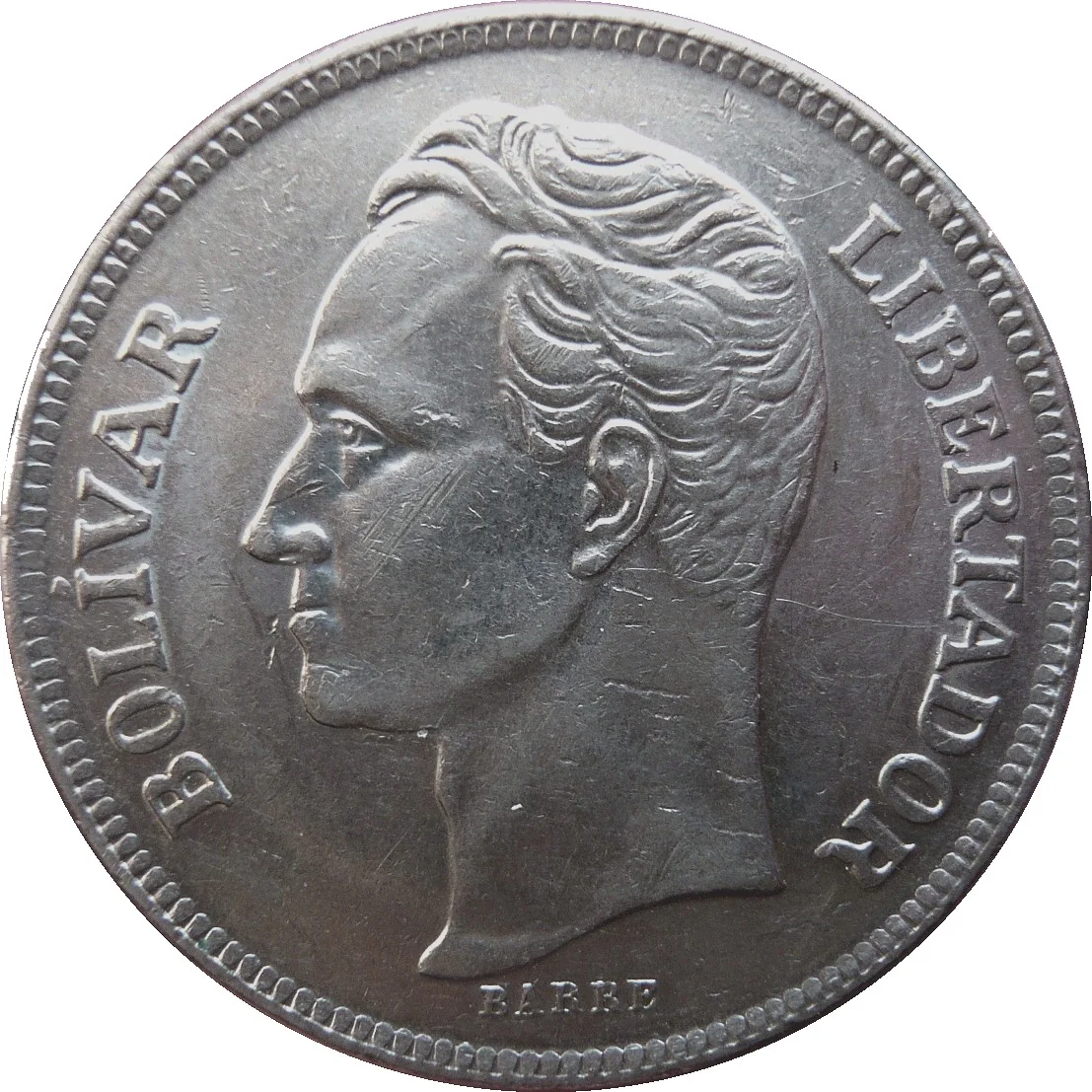
5 bolivars – Venezuela
Add to wishlist
Venezuela
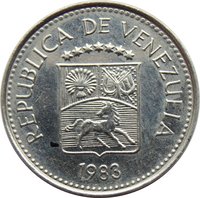
Obverse
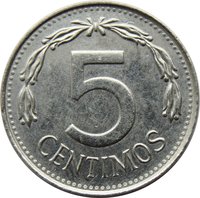
Reverse
Edge
Reeded
Categories
| Animal> Horse |
| Person> Military leader |
| Symbols> Coat of Arms |
| Symbol> Cornucopia |
| Person> Politician |
Mintings
| Year | Mint Mark | Mintage | Quality | Collection |
|---|---|---|---|---|
| 1977 | — | 60,000,000 | ||
| 1987 | — | — | Prooflike | |
| 1987 | — | 25,000,000 | ||
| 1988 | — | 20,000,000 |
Historical background
In 1977, Venezuela was in the final phase of its "oil boom" era, and the national currency, the bolívar, was considered one of the strongest and most stable in the world. Pegged at a fixed exchange rate of 4.30 bolívares to the US dollar since 1964, the bolívar was a symbol of national prosperity and economic maturity. This stability was underpinned by massive petroleum revenues, which flooded the country with foreign currency, allowed for substantial international reserves, and financed large-scale public spending and imports without the need for external borrowing. The economy was experiencing rapid growth, and the strong bolívar made international travel and goods affordable for a growing middle class.
This robust currency situation, however, masked profound structural vulnerabilities. The Venezuelan economy was overwhelmingly dependent on oil exports, which accounted for over 90% of foreign exchange earnings and roughly 70% of government revenue. The manufacturing and agricultural sectors had been largely neglected, a phenomenon known as "Dutch Disease," where the oil sector crowded out other industries. Consequently, the nation's wealth was not built on diversified productive capacity but on a volatile global commodity. The fixed exchange rate, while a mark of stability, also made non-oil exports uncompetitive and encouraged a heavy reliance on imported goods, from food to consumer products.
The backdrop of 1977, therefore, was one of apparent peak financial health that contained the seeds of future crisis. The government of President Carlos Andrés Pérez, riding the wave of high oil prices, continued expansive public spending and nationalized the iron and oil industries. Few foresaw that within a few years, a combination of falling oil prices, massive foreign debt accumulation, and persistent fiscal mismanagement would shatter the bolívar's stability. The fixed exchange rate would become unsustainable, leading to a devastating devaluation in 1983 (known as "Black Friday") that marked the definitive end of the strong bolívar era and triggered a long-term economic decline.
This robust currency situation, however, masked profound structural vulnerabilities. The Venezuelan economy was overwhelmingly dependent on oil exports, which accounted for over 90% of foreign exchange earnings and roughly 70% of government revenue. The manufacturing and agricultural sectors had been largely neglected, a phenomenon known as "Dutch Disease," where the oil sector crowded out other industries. Consequently, the nation's wealth was not built on diversified productive capacity but on a volatile global commodity. The fixed exchange rate, while a mark of stability, also made non-oil exports uncompetitive and encouraged a heavy reliance on imported goods, from food to consumer products.
The backdrop of 1977, therefore, was one of apparent peak financial health that contained the seeds of future crisis. The government of President Carlos Andrés Pérez, riding the wave of high oil prices, continued expansive public spending and nationalized the iron and oil industries. Few foresaw that within a few years, a combination of falling oil prices, massive foreign debt accumulation, and persistent fiscal mismanagement would shatter the bolívar's stability. The fixed exchange rate would become unsustainable, leading to a devastating devaluation in 1983 (known as "Black Friday") that marked the definitive end of the strong bolívar era and triggered a long-term economic decline.
Series: 1977 Venezuela circulation coins
🌱 Very Common