

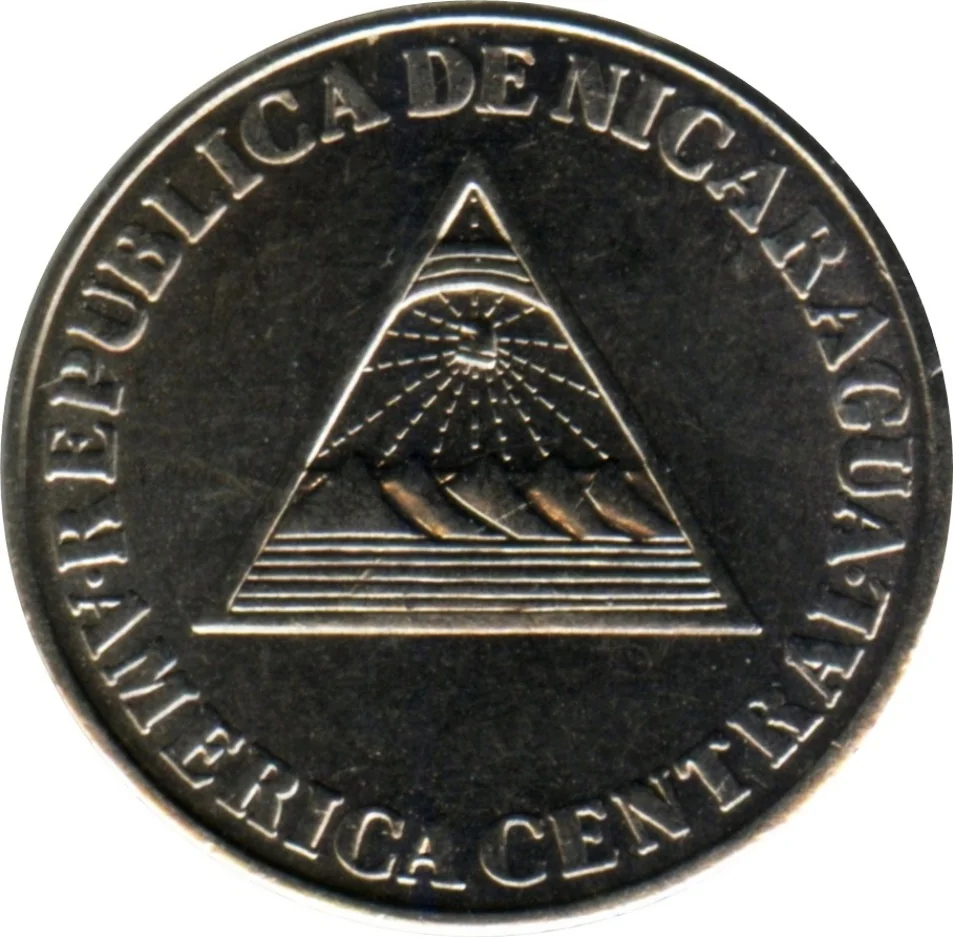
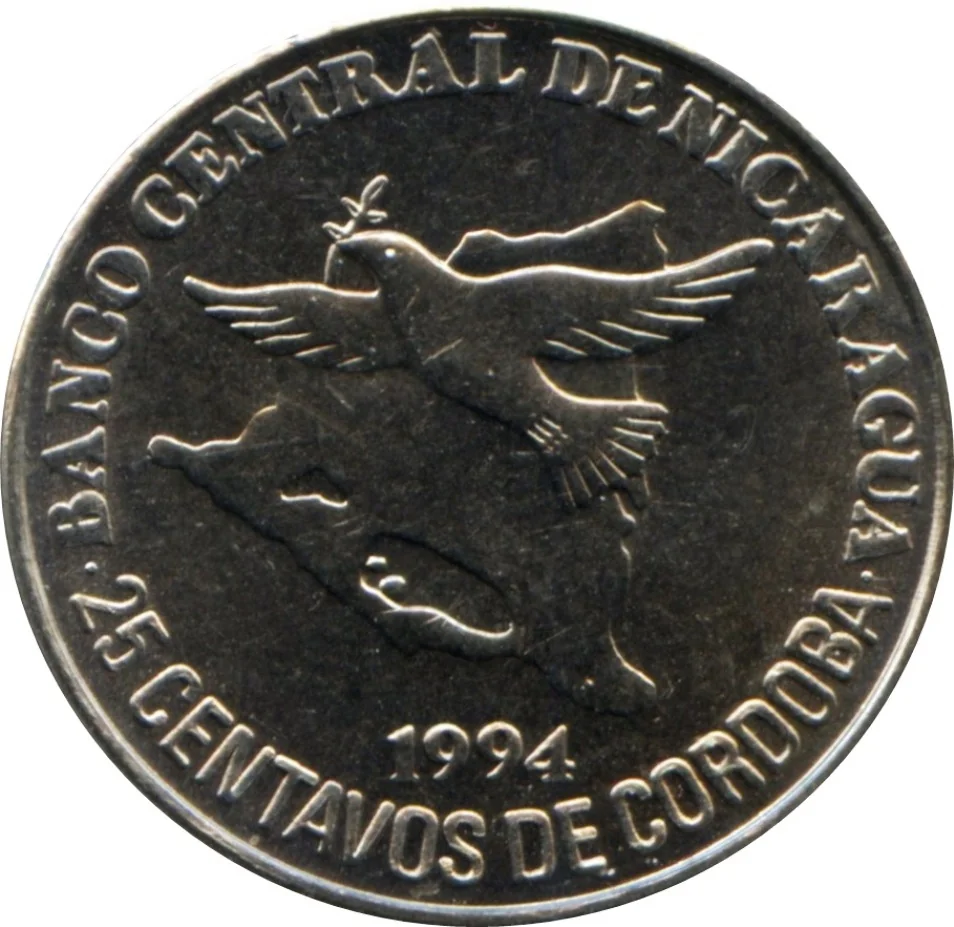
25 centavos de córdoba – Nicaragua
Add to wishlist
Nicaragua
Context
Year: 1994
Issuer: Nicaragua
Issuing organization: Central Bank of Nicaragua
Period:
(since 1854)
Currency:
(since 1991)
Total mintage: 2,500,000
Material
References
KM: #
Numista: #5773
Value
Exchange value: 0.25 NIO
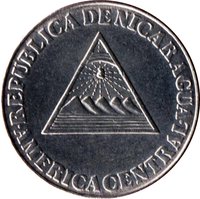
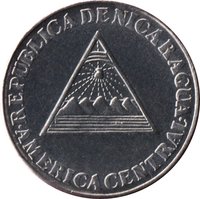
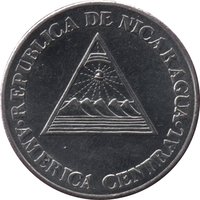
Obverse
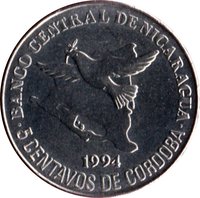
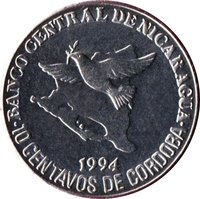
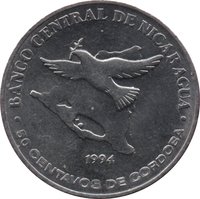
Reverse
Edge
Plain
Categories
| Animal> Bird |
| Symbols> Coat of Arms |
| Map |
Mintings
| Year | Mint Mark | Mintage | Quality | Collection |
|---|---|---|---|---|
| 1994 | — | 2,500,000 |
Historical background
In 1994, Nicaragua was in the early stages of a profound monetary transition following a decade of economic chaos and hyperinflation under the Sandinista government. The national currency, the córdoba, had become virtually worthless after hyperinflation peaked at over 13,000% in the late 1980s, destroying savings and formal economic activity. In response, the newly elected government of Violeta Chamorro (1990) implemented a stringent stabilization program, which included introducing a new, stable currency called the córdoba oro (gold córdoba) in 1990, pegged 1:1 to the US dollar to restore confidence.
By 1994, a dual-currency system was firmly entrenched in the Nicaraguan economy. The US dollar circulated widely alongside the córdoba oro, functioning as a parallel legal tender for major transactions, real estate, and savings, while córdobas were used for day-to-day purchases and salaries. This dollarization was both a symptom of past trauma and a pragmatic policy to curb inflation and attract foreign investment. The Central Bank maintained a tight, crawling peg exchange rate regime, allowing for minimal monthly devaluations of the córdoba against the dollar to maintain export competitiveness without triggering a loss of confidence.
The overall economic context in 1994 remained challenging. While hyperinflation had been tamed, the country was still grappling with the social costs of structural adjustment, including high unemployment and underemployment. The currency stability achieved by the peg came at the cost of high interest rates and limited monetary policy autonomy. Consequently, the financial system was shallow, and economic growth was modest, heavily dependent on foreign aid and remittances. The currency situation of 1994 thus reflected a fragile stability—a necessary anchor for recovery, but within an economy still struggling with deep-seated poverty and the long shadow of its turbulent past.
By 1994, a dual-currency system was firmly entrenched in the Nicaraguan economy. The US dollar circulated widely alongside the córdoba oro, functioning as a parallel legal tender for major transactions, real estate, and savings, while córdobas were used for day-to-day purchases and salaries. This dollarization was both a symptom of past trauma and a pragmatic policy to curb inflation and attract foreign investment. The Central Bank maintained a tight, crawling peg exchange rate regime, allowing for minimal monthly devaluations of the córdoba against the dollar to maintain export competitiveness without triggering a loss of confidence.
The overall economic context in 1994 remained challenging. While hyperinflation had been tamed, the country was still grappling with the social costs of structural adjustment, including high unemployment and underemployment. The currency stability achieved by the peg came at the cost of high interest rates and limited monetary policy autonomy. Consequently, the financial system was shallow, and economic growth was modest, heavily dependent on foreign aid and remittances. The currency situation of 1994 thus reflected a fragile stability—a necessary anchor for recovery, but within an economy still struggling with deep-seated poverty and the long shadow of its turbulent past.
Series: 1994 series
🌱 Common