

Chad
Context
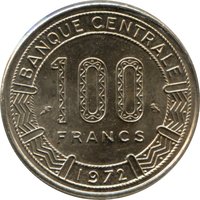
Years: 1971–1972
Issuer: Chad 
Issuing organization: Central Bank of Equatorial African States and Cameroon
Period:
(since 1960)
Currency:
(1961—1973)
Total mintage: 10,000,000
Material
References
KM: #Click to copy to clipboard2
Numista: #5767
Value
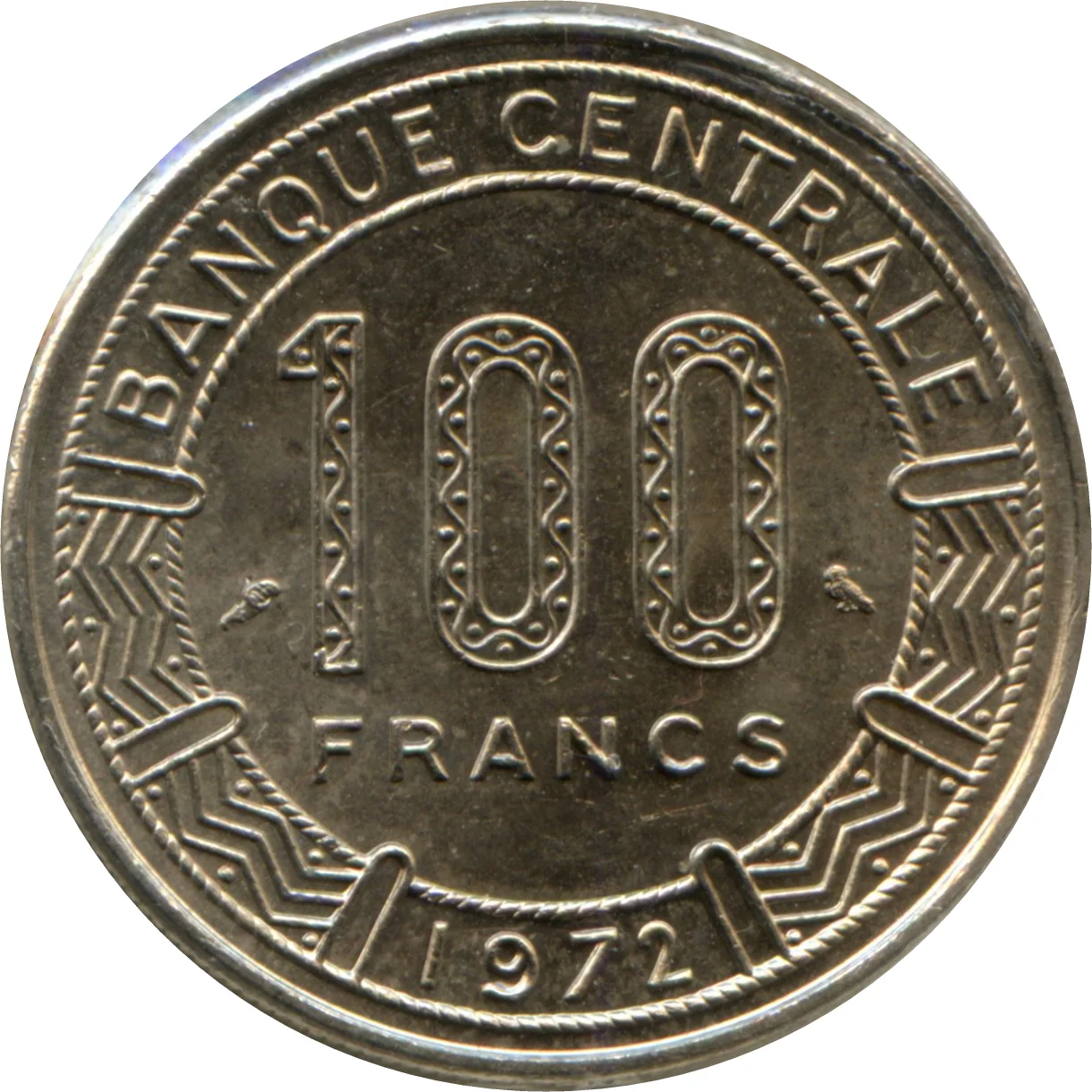
Exchange value: 100 FCFA
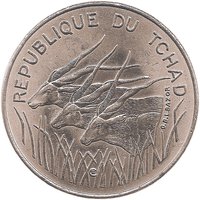
Obverse
Description:
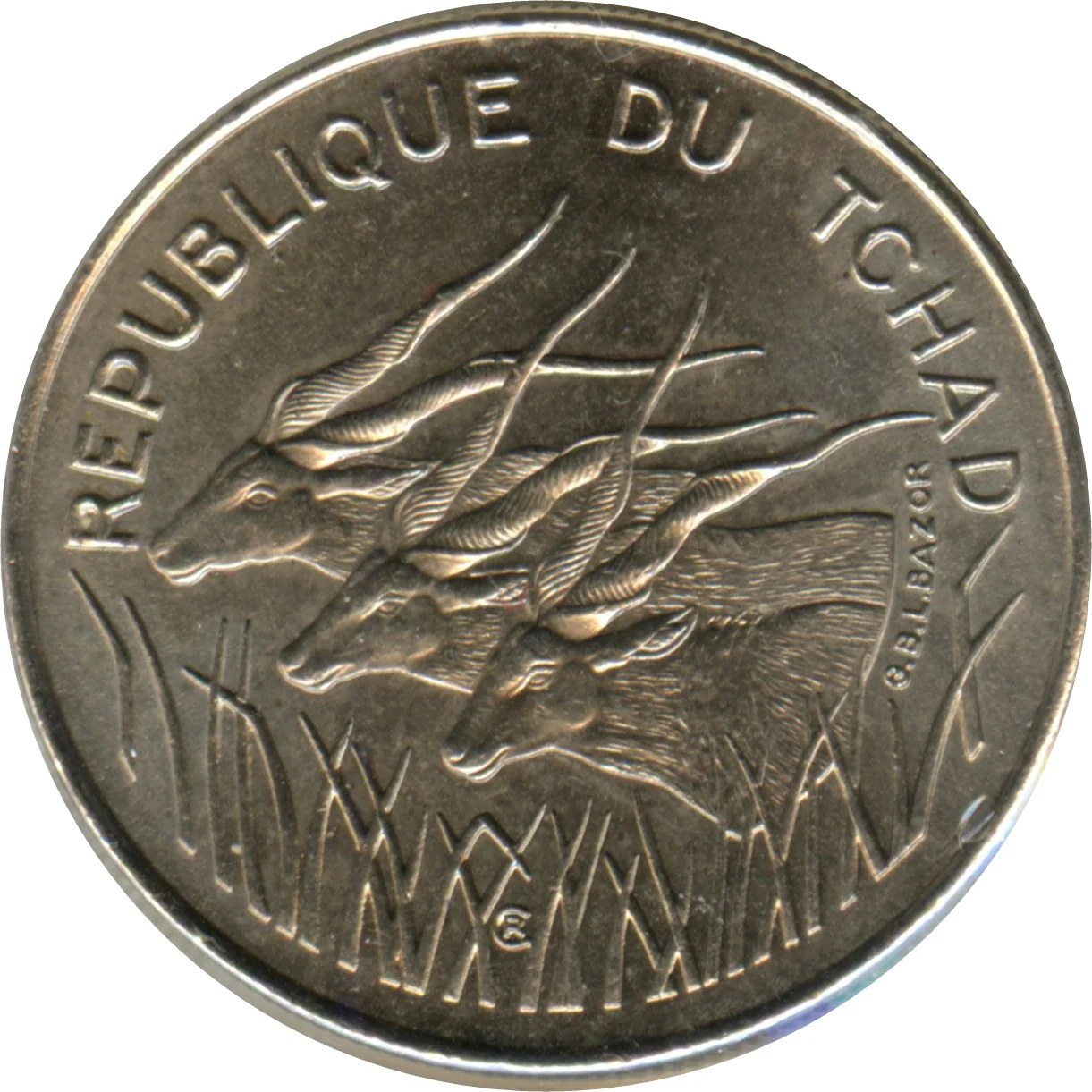
Three Giant Eland facing left.
Inscription:
REPUBLIQUE DU TCHAD
CR
G.B.L.BAZOR
CR
G.B.L.BAZOR
Translation:
REPUBLIC OF CHAD
CR
G.L.BAZOR
CR
G.L.BAZOR
Script: Latin
Language: French
Engraver: Lucien Georges Bazor
Reverse
Edge
Milled
Mints
| Name | Mark |
|---|---|
| Monnaie de Paris | — |
Mintings
| Year | Mint Mark | Mintage | Quality | Collection |
|---|---|---|---|---|
| 1971 | — | 5,000,000 | ||
| 1972 | — | 5,000,000 |
Historical background
In 1971, Chad's currency situation was intrinsically linked to its colonial past and regional monetary cooperation. As a member of the Central African Monetary Union (UMAC), Chad did not issue a sovereign national currency. Instead, it used the CFA franc, specifically the CFA franc BEAC (Banque des États de l'Afrique Centrale), which was pegged at a fixed rate to the French franc. This arrangement, established in the post-colonial era, guaranteed convertibility and monetary stability, with France backing the currency and requiring member states to deposit a portion of their foreign reserves with the French Treasury.
The primary economic context in 1971 was one of underdevelopment and heavy reliance on agriculture, particularly cotton, which accounted for the vast majority of export earnings. The fixed peg to the French franc provided advantages like low inflation and facilitated trade with France, the dominant economic partner. However, it also meant Chad's monetary policy was set externally by the Bank of Central African States (BEAC), limiting the government's ability to use currency adjustments as a tool for economic management. This system was often criticized for benefiting regional elites and export-oriented sectors more than fostering broad-based industrial development.
Politically, 1971 was a period of deepening autocracy under President François Tombalbaye, whose government was grappling with a growing civil conflict in the north. The currency regime, while stable, reflected a continuity of French economic influence. There were no significant currency reforms or devaluations in that specific year; the situation remained static within the broader CFA framework. The stability of the currency stood in stark contrast to the increasing political and social instability within the country, highlighting a disconnect between the managed monetary zone and Chad's internal fiscal challenges and security crisis.
The primary economic context in 1971 was one of underdevelopment and heavy reliance on agriculture, particularly cotton, which accounted for the vast majority of export earnings. The fixed peg to the French franc provided advantages like low inflation and facilitated trade with France, the dominant economic partner. However, it also meant Chad's monetary policy was set externally by the Bank of Central African States (BEAC), limiting the government's ability to use currency adjustments as a tool for economic management. This system was often criticized for benefiting regional elites and export-oriented sectors more than fostering broad-based industrial development.
Politically, 1971 was a period of deepening autocracy under President François Tombalbaye, whose government was grappling with a growing civil conflict in the north. The currency regime, while stable, reflected a continuity of French economic influence. There were no significant currency reforms or devaluations in that specific year; the situation remained static within the broader CFA framework. The stability of the currency stood in stark contrast to the increasing political and social instability within the country, highlighting a disconnect between the managed monetary zone and Chad's internal fiscal challenges and security crisis.
🌱 Common