

5 gourdes – Haiti
Add to wishlist
Haiti
Context
Material
Diameter: 28.05 mm
Weight: 9.1 g
Thickness: 2 mm
Shape: Equilateral curve heptagon
Technique: Milled
Alignment: Medal alignment
flip
References
KM: #
Numista: #5766
Value
Exchange value: 5 HTG
Obverse
Description:
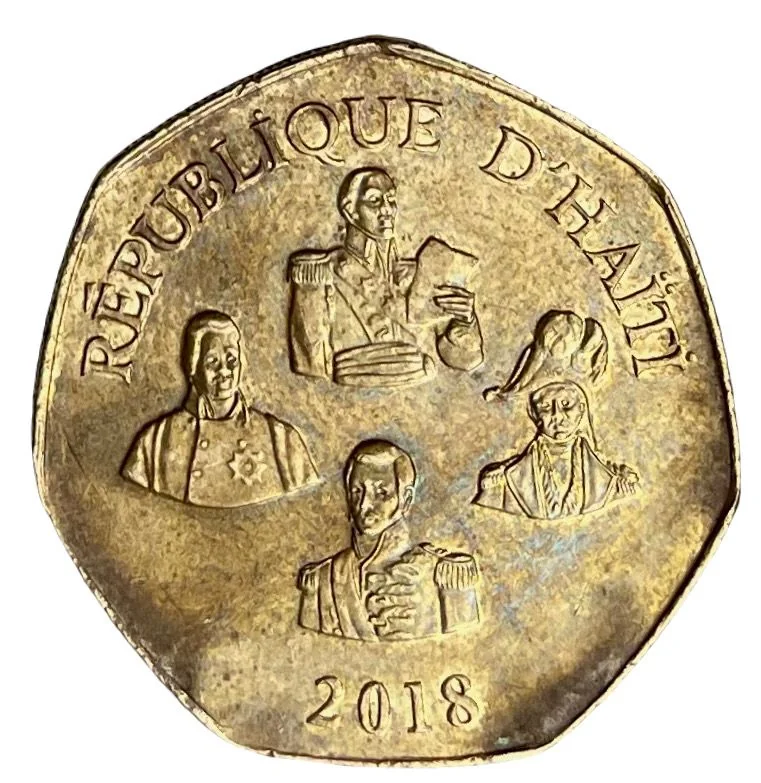
Four portraits in a circle: Toussaint Louverture (top), Henri Christophe (left), Jean-Jacques Dessalines (right), Alexandre Pétion (bottom). Date below.
Inscription:
RÉPUBLİQUE D'HAÏTİ
2018
2018
Translation:
Republic of Haiti
2018
2018
Script: Latin
Languages: Haitian Creole, French
Reverse
Edge
Reeded (with smooth corners)
Categories
| Event> Independence |
| Person> Politician |
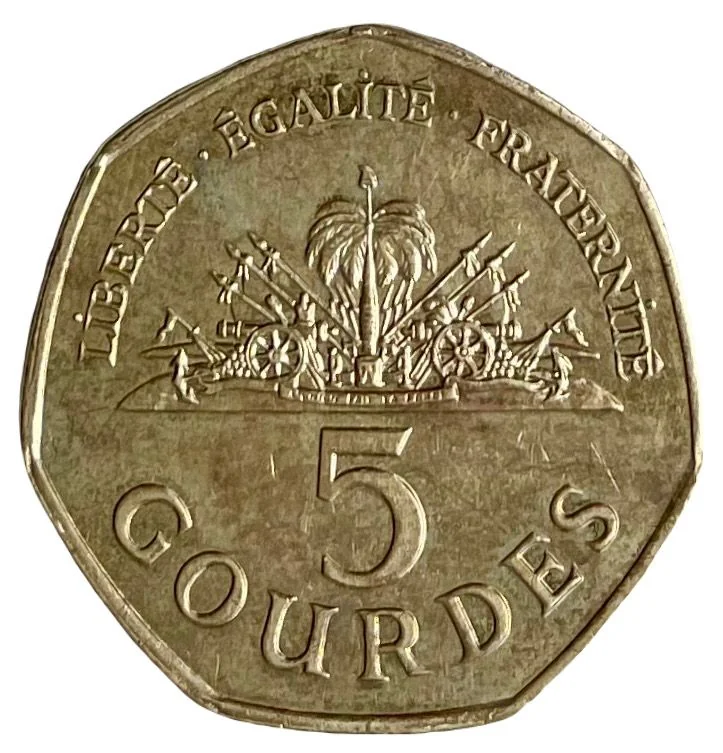
| Symbols> Coat of Arms |
Mints
| Name | Mark |
|---|---|
| Royal Mint | — |
Mintings
| Year | Mint Mark | Mintage | Quality | Collection |
|---|---|---|---|---|
| 1995 | — | — | ||
| 1998 | — | — | ||
| 2007 | — | — | ||
| 2011 | — | — | ||
| 2013 | — | — | ||
| 2018 | — | — | ||
| 2019 | — | — |
Historical background
In 1995, Haiti's currency situation was defined by profound instability and a heavy reliance on the U.S. dollar, set against a backdrop of political and economic crisis. The national currency, the gourde (HTG), was officially fixed to the U.S. dollar at a rate of 5 gourdes to $1, a peg established in 1912. However, this official rate was largely symbolic and used only for select government accounting. The real economy operated on a vastly different "parallel market" rate, which fluctuated based on scarcity and speculation, often trading between 15 to 20 gourdes per dollar. This created a dual-system where the vast majority of transactions, especially for imports and everyday commerce, occurred at the much weaker market rate, fueling inflation and eroding purchasing power.
The root causes of this monetary fragility were deeply intertwined with the nation's turbulent politics. The return of President Jean-Bertrand Aristide in October 1994, following a three-year military dictatorship, initiated a period of fragile democratic restoration under international protection. While this brought a measure of political hope, the economy was in ruins: state institutions were dysfunctional, tax collection was minimal, and productive capacity had collapsed. International aid, though pledged, was slow to materialize into tangible economic improvements for the population. Consequently, confidence in the gourde remained extremely low, leading to widespread dollarization where those who could hold savings and conduct major business in U.S. currency as a hedge against gourde depreciation.
Efforts to address the currency crisis were a key component of the structural adjustment programs advocated by the International Monetary Fund (IMF) and World Bank, which supported the new government. The central bank, the Bank of the Republic of Haiti (BRH), lacked effective monetary policy tools and was under pressure to unify the exchange rates and move toward a floating, market-determined gourde. However, in 1995, these reforms were in their early and contentious stages, hampered by political infighting, weak institutions, and social unrest. Thus, the currency situation remained a stark indicator of Haiti's broader challenges: a fractured economy, low confidence in state authority, and a profound dependency on the U.S. dollar for any semblance of financial stability.
The root causes of this monetary fragility were deeply intertwined with the nation's turbulent politics. The return of President Jean-Bertrand Aristide in October 1994, following a three-year military dictatorship, initiated a period of fragile democratic restoration under international protection. While this brought a measure of political hope, the economy was in ruins: state institutions were dysfunctional, tax collection was minimal, and productive capacity had collapsed. International aid, though pledged, was slow to materialize into tangible economic improvements for the population. Consequently, confidence in the gourde remained extremely low, leading to widespread dollarization where those who could hold savings and conduct major business in U.S. currency as a hedge against gourde depreciation.
Efforts to address the currency crisis were a key component of the structural adjustment programs advocated by the International Monetary Fund (IMF) and World Bank, which supported the new government. The central bank, the Bank of the Republic of Haiti (BRH), lacked effective monetary policy tools and was under pressure to unify the exchange rates and move toward a floating, market-determined gourde. However, in 1995, these reforms were in their early and contentious stages, hampered by political infighting, weak institutions, and social unrest. Thus, the currency situation remained a stark indicator of Haiti's broader challenges: a fractured economy, low confidence in state authority, and a profound dependency on the U.S. dollar for any semblance of financial stability.
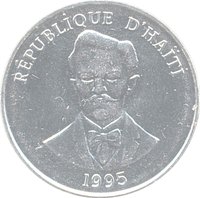
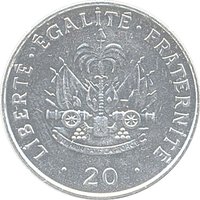
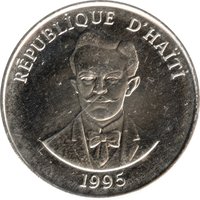
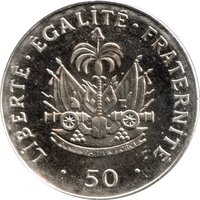
Series: 1995 Haiti circulation coins
🌱 Very Common