

1 Baiocco – Papal States
Vatican City
Context
Years: 1815–1816
Country: Vatican City 
Issuer: Papal States
Ruler: Pius VII
Currency:
(1534—1835)
Demonetized: Yes
Total mintage: 2,456,900
Material
References
KM: #Click to copy to clipboard1279
Numista: #57312
Obverse
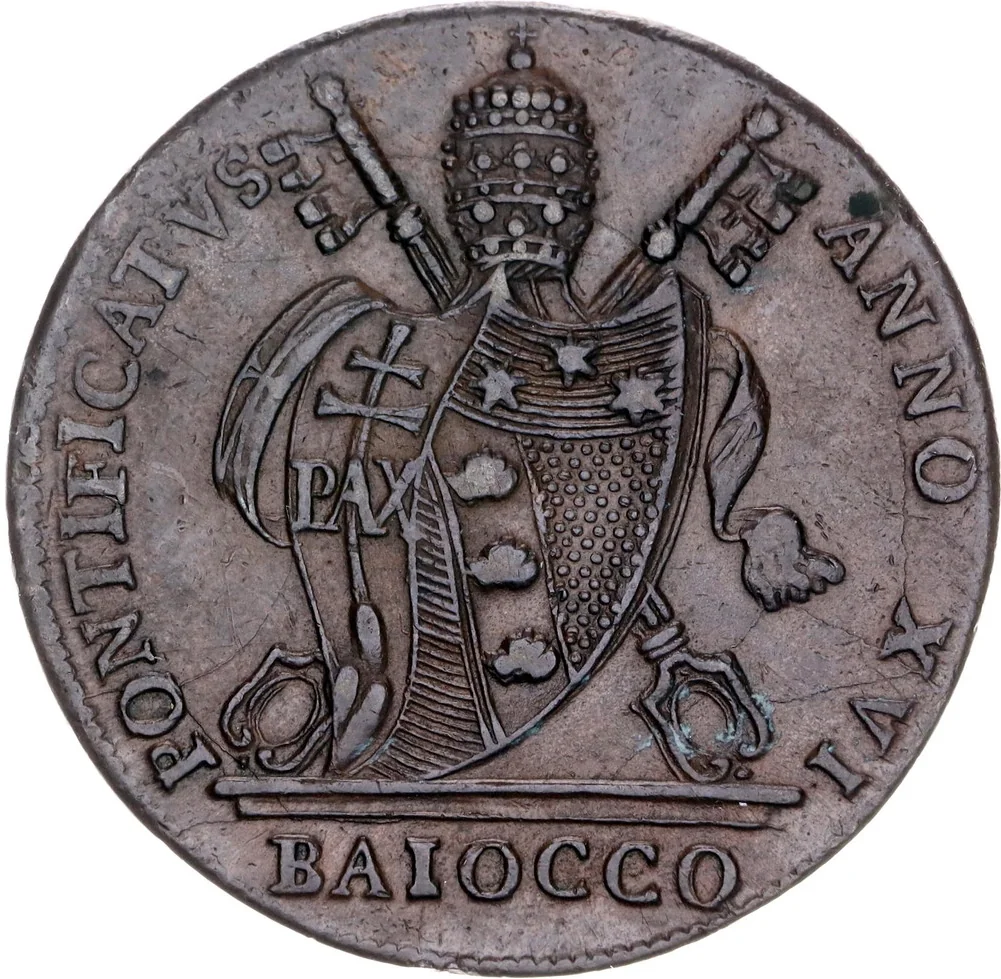
Description:
Legend encircles the Papal arms. Below, engravers' initials may appear. Exergue states value in letters.
Inscription:
PONTIFICATVS ANNO XVI
BAIOCCO
BAIOCCO
Script: Latin
Engravers: Giuseppe, Giovanni Pasinati
Reverse
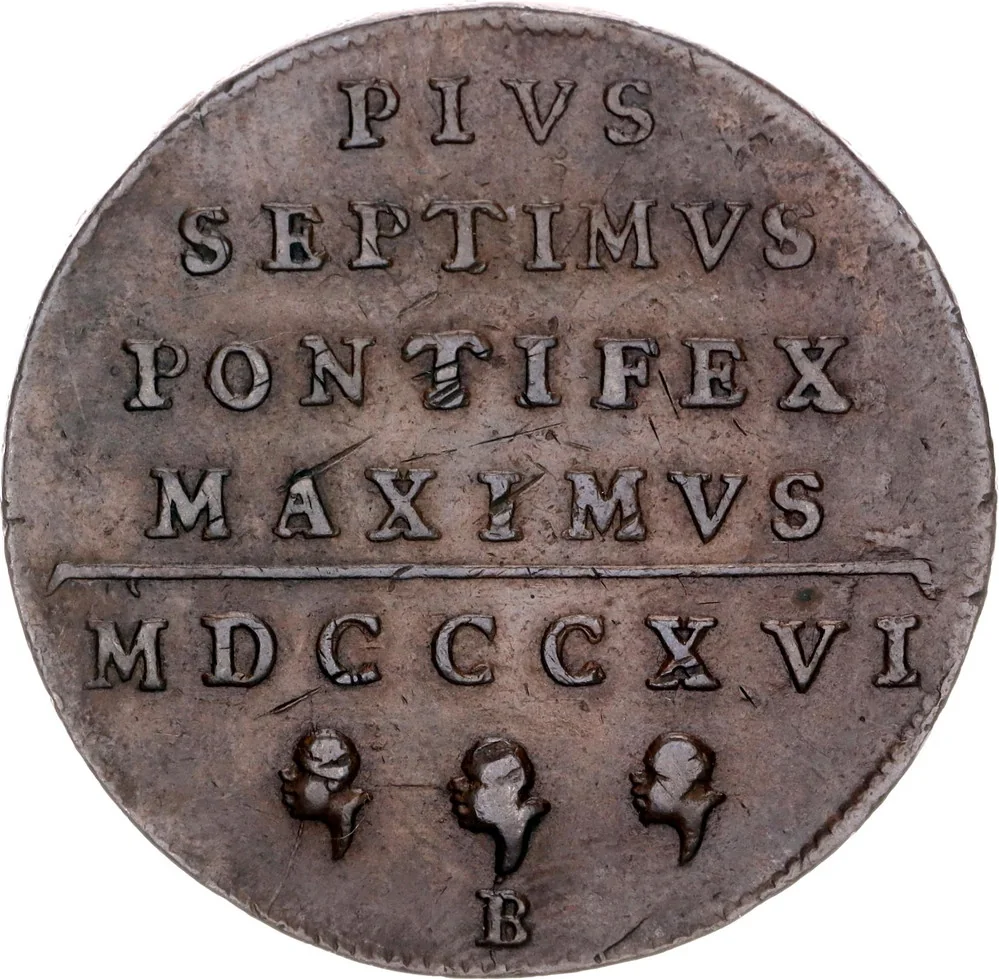
Description:
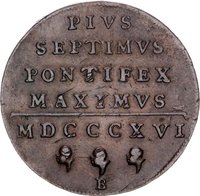
Inscription over three left-facing heads. Mintmark beneath.
Inscription:
PIVS
SEPTIMUS
PONTIFEX
MAXIMVS
MDCCCXVI
SEPTIMUS
PONTIFEX
MAXIMVS
MDCCCXVI
Translation:
Pius
Septimus
Pontifex
Maximus
1816
Septimus
Pontifex
Maximus
1816
Script: Latin
Language: Latin
Engravers: Giuseppe, Giovanni Pasinati
Edge
Plain
Categories
| Symbols> Coat of Arms |
| Symbol> Crown |
Historical background
Following the restoration of the Papal States in 1815 after the Napoleonic Wars, the currency situation was characterized by profound disarray and monetary plurality. The French occupation had swept away the old papal monetary system, replacing it with the franc, and left behind a legacy of severe debt and depleted treasuries. Upon return, Pope Pius VII faced a fragmented economic landscape where French coins, old papal issues from before 1796, and various regional and foreign currencies all circulated simultaneously, causing confusion and hindering trade.
The immediate papal response was conservative and aimed at reasserting sovereign control. In 1816, a monetary edict was issued to re-establish the scudo as the official unit of account, divided into 100 baiocchi. The government began minting new silver scudi and subsidiary coins, but these were insufficient in quantity to unify the monetary space. Crucially, the papal authorities did not demonetize the widely circulating French francs, granting them legal tender status at a fixed exchange rate. This created a de facto bimetallic system, but one reliant on the stability of foreign coinage.
Consequently, the post-1815 period was one of unstable transition rather than reform. The coexistence of multiple coinages, coupled with the state's chronic budgetary deficits and reliance on debased copper coinage for everyday transactions, led to persistent problems. Exchange rates between the various metals and coin types fluctuated, causing commercial inconvenience and facilitating arbitrage. This complex and fragile monetary regime, reflective of the broader administrative and economic challenges of the restored Papal States, would remain a point of contention until more forceful unification attempts later in the 19th century.
The immediate papal response was conservative and aimed at reasserting sovereign control. In 1816, a monetary edict was issued to re-establish the scudo as the official unit of account, divided into 100 baiocchi. The government began minting new silver scudi and subsidiary coins, but these were insufficient in quantity to unify the monetary space. Crucially, the papal authorities did not demonetize the widely circulating French francs, granting them legal tender status at a fixed exchange rate. This created a de facto bimetallic system, but one reliant on the stability of foreign coinage.
Consequently, the post-1815 period was one of unstable transition rather than reform. The coexistence of multiple coinages, coupled with the state's chronic budgetary deficits and reliance on debased copper coinage for everyday transactions, led to persistent problems. Exchange rates between the various metals and coin types fluctuated, causing commercial inconvenience and facilitating arbitrage. This complex and fragile monetary regime, reflective of the broader administrative and economic challenges of the restored Papal States, would remain a point of contention until more forceful unification attempts later in the 19th century.
⭐ Somewhat Rare