

100 francs – Comoro Islands
Add to wishlist
Context
Year: 2003
Issuer: Comoro Islands
Issuing organization: Central Bank of the Comoros
Period:
(since 2001)
Currency:
(since 1976)
Material
Diameter: 28.5 mm
Weight: 8 g
Thickness: 1.8 mm
Shape: Round
Composition: Copper-nickel
Magnetic: Yes
Technique: Milled
Alignment: Coin alignment
flip
References
KM: #
Numista: #57162
Value
Exchange value: 100 KMF
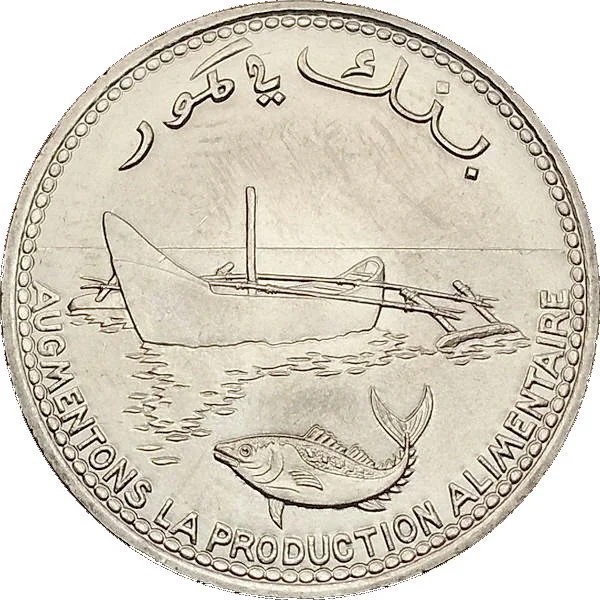
Obverse
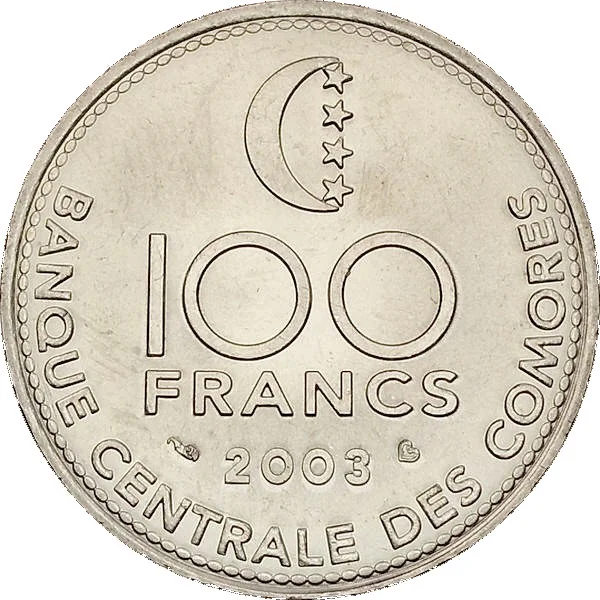
Reverse
Description:
Date within mintmarks
Inscription:
100
FRANCS
2003
BANQUE CENTRALE DES COMORES
FRANCS
2003
BANQUE CENTRALE DES COMORES
Script: Latin
Edge
Plain
Categories
| Animal> Fish |
| Transportation> Watercraft |
| Organization> FAO |
Mints
| Name | Mark |
|---|---|
| Monnaie de Paris | — |
Mintings
| Year | Mint Mark | Mintage | Quality | Collection |
|---|---|---|---|---|
| 2003 | — | — |
Historical background
In 2003, the currency situation in the Comoro Islands was defined by its continued use of the Comorian franc (KMF), which operated under a long-standing and strict monetary arrangement with France. Established in 1945 and later formalized, the Comorian franc was pegged to the French franc and, following France's adoption of the euro, became pegged to the euro in 1999 at a fixed rate of 491.96775 KMF to 1 euro. This peg was managed through an operations account held at the French Treasury, which guaranteed unlimited convertibility, providing critical monetary stability but also ceding control over independent monetary policy to the French authorities.
The economy in 2003 remained fragile, heavily reliant on exports of vanilla, cloves, and ylang-ylang, and vulnerable to global price shocks. The fixed peg provided advantages like low inflation and a stable environment for imports and debt servicing, but it also presented significant challenges. It limited the Central Bank of the Comoros' ability to devalue the currency to boost competitiveness, and the economy struggled with structural issues including a narrow production base, high unemployment, and widespread poverty. The rigidity of the exchange rate meant that adjusting to external economic shocks required difficult internal fiscal adjustments rather than monetary tools.
Overall, the 2003 currency framework was a double-edged sword: it offered a crucial anchor of stability for a small, vulnerable island nation, preventing the hyperinflation and volatility seen in some neighboring countries, but it simultaneously constrained economic policy options. This period underscored the Comoros' deep economic and institutional ties to France, a relationship that provided predictability for foreign transactions but did not in itself resolve the underlying developmental challenges facing the archipelago.
The economy in 2003 remained fragile, heavily reliant on exports of vanilla, cloves, and ylang-ylang, and vulnerable to global price shocks. The fixed peg provided advantages like low inflation and a stable environment for imports and debt servicing, but it also presented significant challenges. It limited the Central Bank of the Comoros' ability to devalue the currency to boost competitiveness, and the economy struggled with structural issues including a narrow production base, high unemployment, and widespread poverty. The rigidity of the exchange rate meant that adjusting to external economic shocks required difficult internal fiscal adjustments rather than monetary tools.
Overall, the 2003 currency framework was a double-edged sword: it offered a crucial anchor of stability for a small, vulnerable island nation, preventing the hyperinflation and volatility seen in some neighboring countries, but it simultaneously constrained economic policy options. This period underscored the Comoros' deep economic and institutional ties to France, a relationship that provided predictability for foreign transactions but did not in itself resolve the underlying developmental challenges facing the archipelago.
🌱 Fairly Common