

50 francs – Comoro Islands
Add to wishlist
Context
Years: 2013–2020
Issuer: Comoro Islands
Issuing organization: Central Bank of the Comoros
Period:
(since 2001)
Currency:
(since 1976)
Material
Diameter: 24 mm
Weight: 5.7 g
Thickness: 1.9 mm
Shape: Round
Composition: Stainless steel
Technique: Milled
Alignment: Coin alignment
flip
References
Numista: #57161
Value
Exchange value: 50 KMF
Obverse
Description:
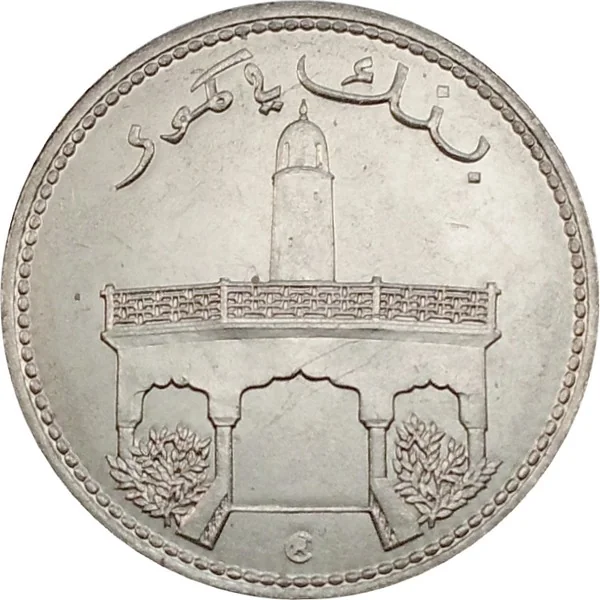
Badjanani Mosque, engraver's initials below.
Inscription:
بنك يا كمور
CR
CR
Translation:
Bank of Comoros
Engraver: Robert Cochet
Reverse
Description:
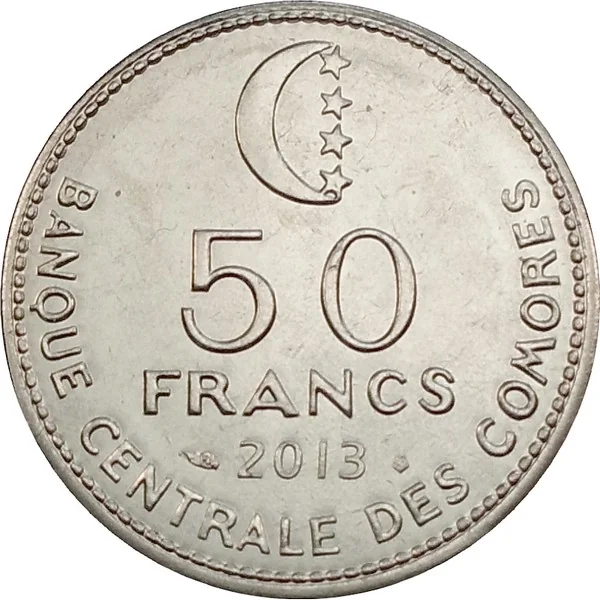
Center denomination, state insignia above, date below between mint and privy marks, issuer along rim.
Inscription:
50
FRANCS
2013
BANQUE CENTRALE DES COMORES
FRANCS
2013
BANQUE CENTRALE DES COMORES
Script: Latin
Edge
Reeded
Mints
| Name | Mark |
|---|---|
| Monnaie de Paris | — |
Mintings
| Year | Mint Mark | Mintage | Quality | Collection |
|---|---|---|---|---|
| 2013 | — | — | ||
| 2020 | — | — |
Historical background
In 2013, the currency situation in the Comoro Islands was defined by its use of the Comorian franc (KMF), which was—and remains—pegged to the euro at a fixed exchange rate of 491.96775 KMF to 1 EUR. This peg, established in 1999 with the introduction of the euro, provided a crucial anchor for monetary stability and low inflation. However, it also meant the archipelago's monetary policy was effectively outsourced to the European Central Bank, limiting local tools to respond to economic shocks and tying the health of the Comorian economy closely to the Eurozone.
The year saw the economy facing significant challenges, including persistent trade deficits, high public debt, and reliance on volatile exports like vanilla and cloves. While the euro peg fostered price stability, it also contributed to an overvalued currency, which hurt the competitiveness of Comorian exports and made imports relatively cheaper. This dynamic exacerbated the trade imbalance and put pressure on foreign exchange reserves, which were bolstered primarily by remittances from the large Comorian diaspora and foreign aid, rather than export earnings.
Overall, the 2013 currency framework offered stability in a nation with a fragile economic base, but it also highlighted structural vulnerabilities. The fixed exchange rate provided predictability for investors and for financing imports, yet it did not address underlying issues of low productivity and a narrow economic base. Consequently, discussions around economic policy often centered on the need for structural reforms to enhance competitiveness within the constraints of the unalterable currency peg, rather than on monetary policy adjustments.
The year saw the economy facing significant challenges, including persistent trade deficits, high public debt, and reliance on volatile exports like vanilla and cloves. While the euro peg fostered price stability, it also contributed to an overvalued currency, which hurt the competitiveness of Comorian exports and made imports relatively cheaper. This dynamic exacerbated the trade imbalance and put pressure on foreign exchange reserves, which were bolstered primarily by remittances from the large Comorian diaspora and foreign aid, rather than export earnings.
Overall, the 2013 currency framework offered stability in a nation with a fragile economic base, but it also highlighted structural vulnerabilities. The fixed exchange rate provided predictability for investors and for financing imports, yet it did not address underlying issues of low productivity and a narrow economic base. Consequently, discussions around economic policy often centered on the need for structural reforms to enhance competitiveness within the constraints of the unalterable currency peg, rather than on monetary policy adjustments.
🌱 Fairly Common