

1 Franc – Belgium
Belgium
Context
Years: 1950–1988
Issuer: Belgium 
Ruler: Baudouin I
Currency:
(1832—2001)
Demonetization: 22 March 1989
Total mintage: 753,780,000
Material
References
KM: #Click to copy to clipboard143.1
Numista: #571
Value
Exchange value: 1 BEF
Obverse
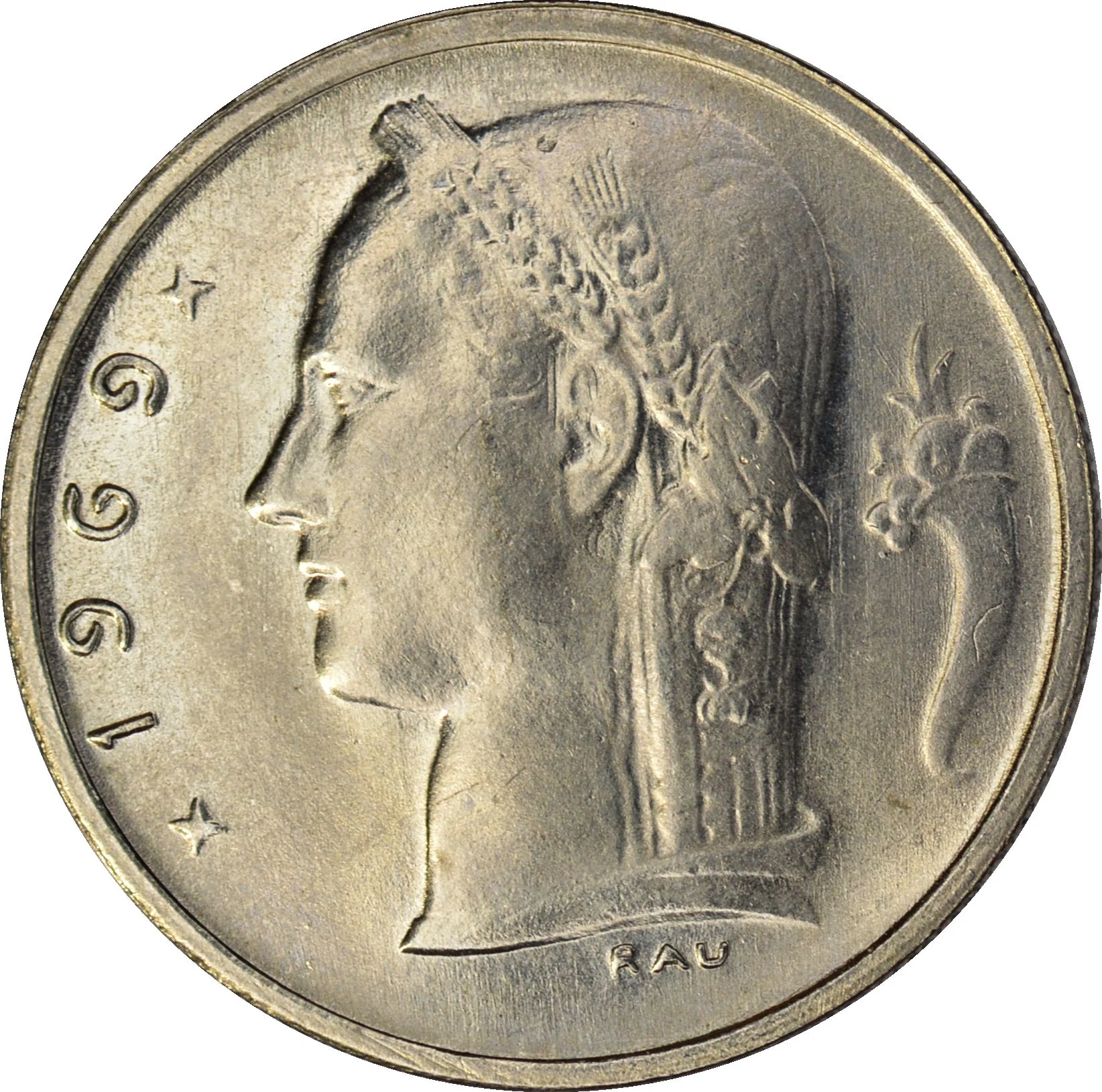
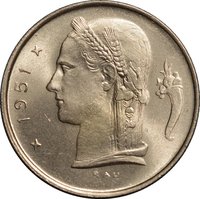
Description:
Ceres left, date left, cornucopia right, designer below.
Inscription:
✦ 1969 ✦
RAU
RAU
Script: Latin
Engraver: Marcel Rau
Reverse
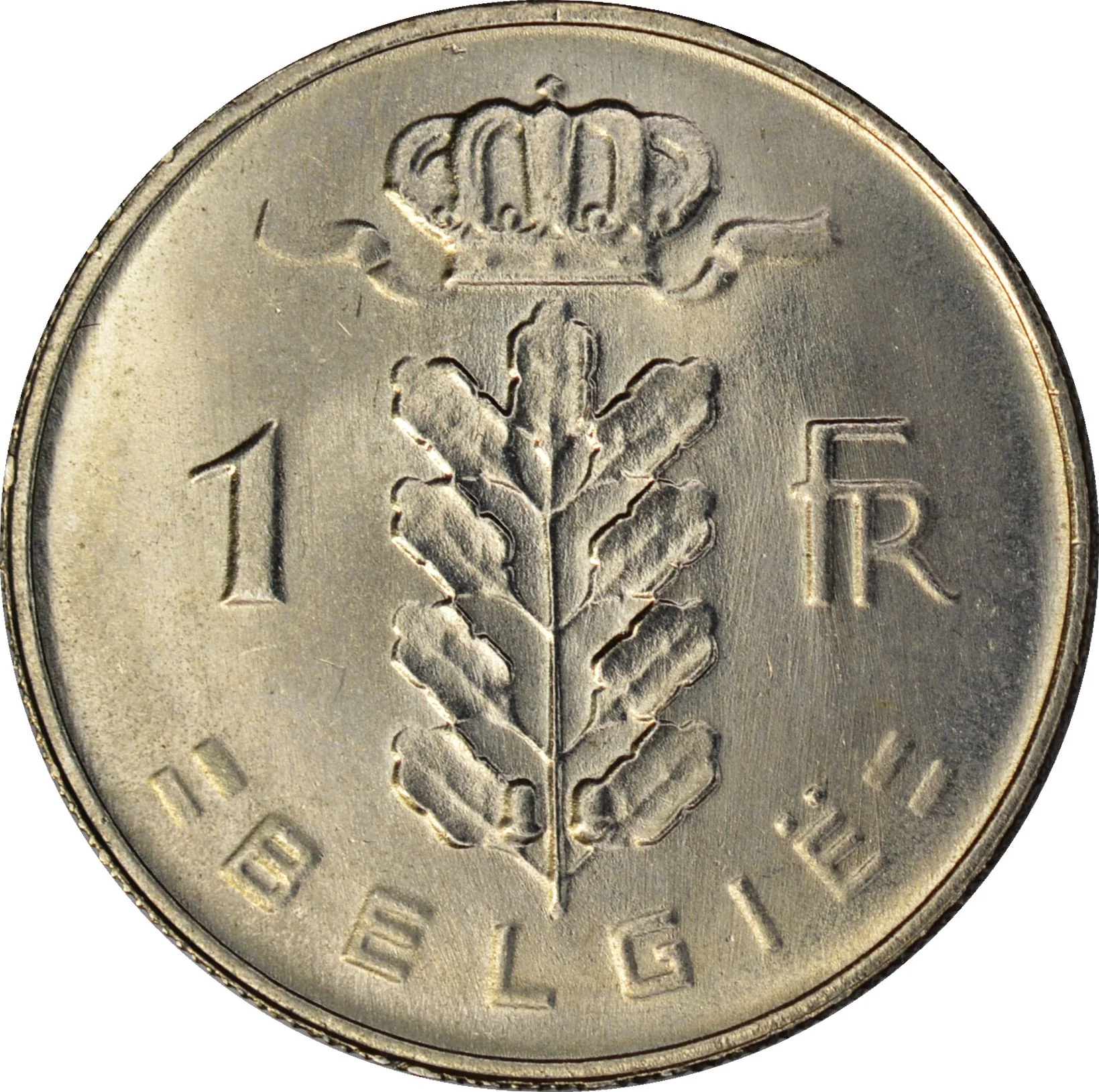
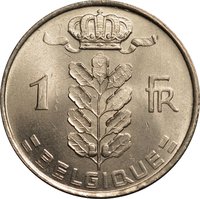
Description:
Crowned oak branch. Dutch legend below.
Inscription:
1 FR
= BELGIË =
= BELGIË =
Translation:
1 FRANC
= BELGIUM =
= BELGIUM =
Script: Latin
Engraver: Marcel Rau
Edge
Reeded
Categories
| Mythology |
| Symbol> Cornucopia |
Mints
| Name | Mark |
|---|---|
| Royal Mint of Belgium | — |
Mintings
| Year | Mint Mark | Mintage | Quality | Collection |
|---|---|---|---|---|
| 1950 | — | 10,000,000 | ||
| 1951 | — | — | ||
| 1952 | — | 49,145,000 | ||
| 1953 | — | 9,915,000 | ||
| 1954 | — | 4,940,000 | ||
| 1955 | — | 3,960,000 | ||
| 1956 | — | 10,035,000 | ||
| 1957 | — | 18,315,000 | ||
| 1958 | — | 17,365,000 | ||
| 1959 | — | 5,830,000 | ||
| 1960 | — | 5,555,000 | ||
| 1961 | — | 9,350,000 | ||
| 1962 | — | 10,720,000 | ||
| 1963 | — | 23,455,000 | ||
| 1964 | — | 7,430,000 | ||
| 1965 | — | 11,185,000 | ||
| 1966 | — | 20,990,000 | ||
| 1967 | — | 27,470,000 | ||
| 1968 | — | 8,165,000 | ||
| 1969 | — | 21,725,000 | ||
| 1970 | — | 35,730,000 | ||
| 1971 | — | 10,000,000 | ||
| 1972 | — | 35,000,000 | ||
| 1973 | — | 42,500,000 | ||
| 1974 | — | 30,000,000 | ||
| 1975 | — | 80,000,000 | ||
| 1976 | — | 18,000,000 | ||
| 1977 | — | 68,500,000 | ||
| 1978 | — | 47,500,000 | ||
| 1979 | — | 25,000,000 | ||
| 1980 | — | 66,500,000 | ||
| 1981 | — | 2,000,000 | ||
| 1988 | — | 17,500,000 |
Historical background
In 1950, Belgium’s currency situation was intrinsically linked to the country’s post-war economic reconstruction and its position within the nascent European monetary system. The Belgian franc, which had been devalued in 1949 as part of a wider European realignment following the British pound's devaluation, operated under the Bretton Woods system. This pegged it to the US dollar, providing stability but also imposing constraints. Domestically, the economy was recovering strongly, driven by exports from its industrial heartlands, yet monetary policy was carefully managed by the National Bank of Belgium to control inflation and rebuild foreign exchange reserves.
A defining feature of the period was Belgium’s leadership in European monetary cooperation. Alongside Switzerland, Belgium was a key founder of the European Payments Union (EPU), launched in 1950. This crucial mechanism allowed for the multilateral settlement of trade balances between European nations, overcoming the severe dollar shortages and bilateral trade barriers that plagued the post-war years. For a trading nation like Belgium, the EPU was vital, facilitating the smooth flow of payments for its critical coal, steel, and manufactured exports and accelerating economic integration with its neighbours.
However, this technical monetary stability existed against a backdrop of profound domestic political crisis: the "Royal Question" surrounding the return of King Leopold III. The deep national division, culminating in a referendum and his eventual abdication in 1951, created significant political uncertainty. While this turmoil did not trigger a currency crisis, it posed a background risk of social unrest and government instability, factors that central bankers and finance ministers of the era had to cautiously navigate while maintaining international confidence in the franc.
A defining feature of the period was Belgium’s leadership in European monetary cooperation. Alongside Switzerland, Belgium was a key founder of the European Payments Union (EPU), launched in 1950. This crucial mechanism allowed for the multilateral settlement of trade balances between European nations, overcoming the severe dollar shortages and bilateral trade barriers that plagued the post-war years. For a trading nation like Belgium, the EPU was vital, facilitating the smooth flow of payments for its critical coal, steel, and manufactured exports and accelerating economic integration with its neighbours.
However, this technical monetary stability existed against a backdrop of profound domestic political crisis: the "Royal Question" surrounding the return of King Leopold III. The deep national division, culminating in a referendum and his eventual abdication in 1951, created significant political uncertainty. While this turmoil did not trigger a currency crisis, it posed a background risk of social unrest and government instability, factors that central bankers and finance ministers of the era had to cautiously navigate while maintaining international confidence in the franc.
🌱 Very Common