

50 Centimes – Belgium
Belgium
Context
Years: 1952–2001
Issuer: Belgium 
Ruler: Baudouin I
Currency:
(1832—2001)
Demonetization: 28 February 2002
Total mintage: 293,290,000
Material
References
KM: #Click to copy to clipboard144
Numista: #1239
Value
Exchange value: 0.50 BEF
Obverse
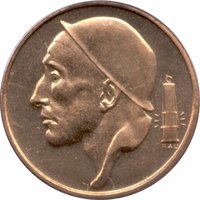
Description:
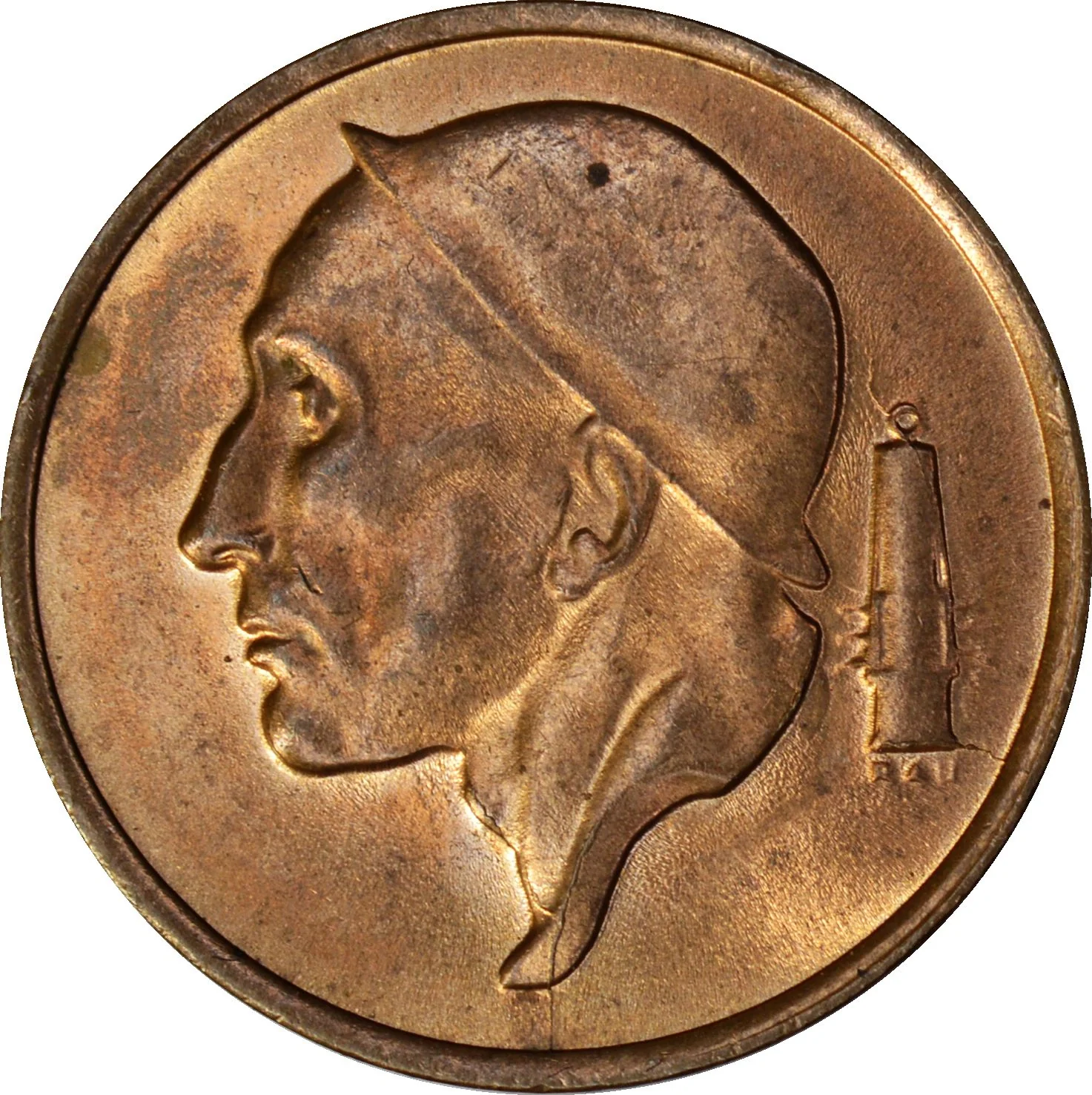
A miner, adapted from Constantin Meunier, faces left. A mining lamp is on the right, with the designer's name below.
Inscription:
RAU
Script: Latin
Engraver: Marcel Rau
Reverse
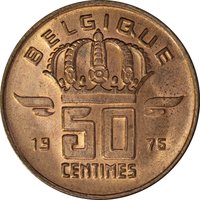
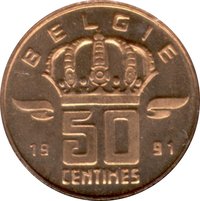
Description:
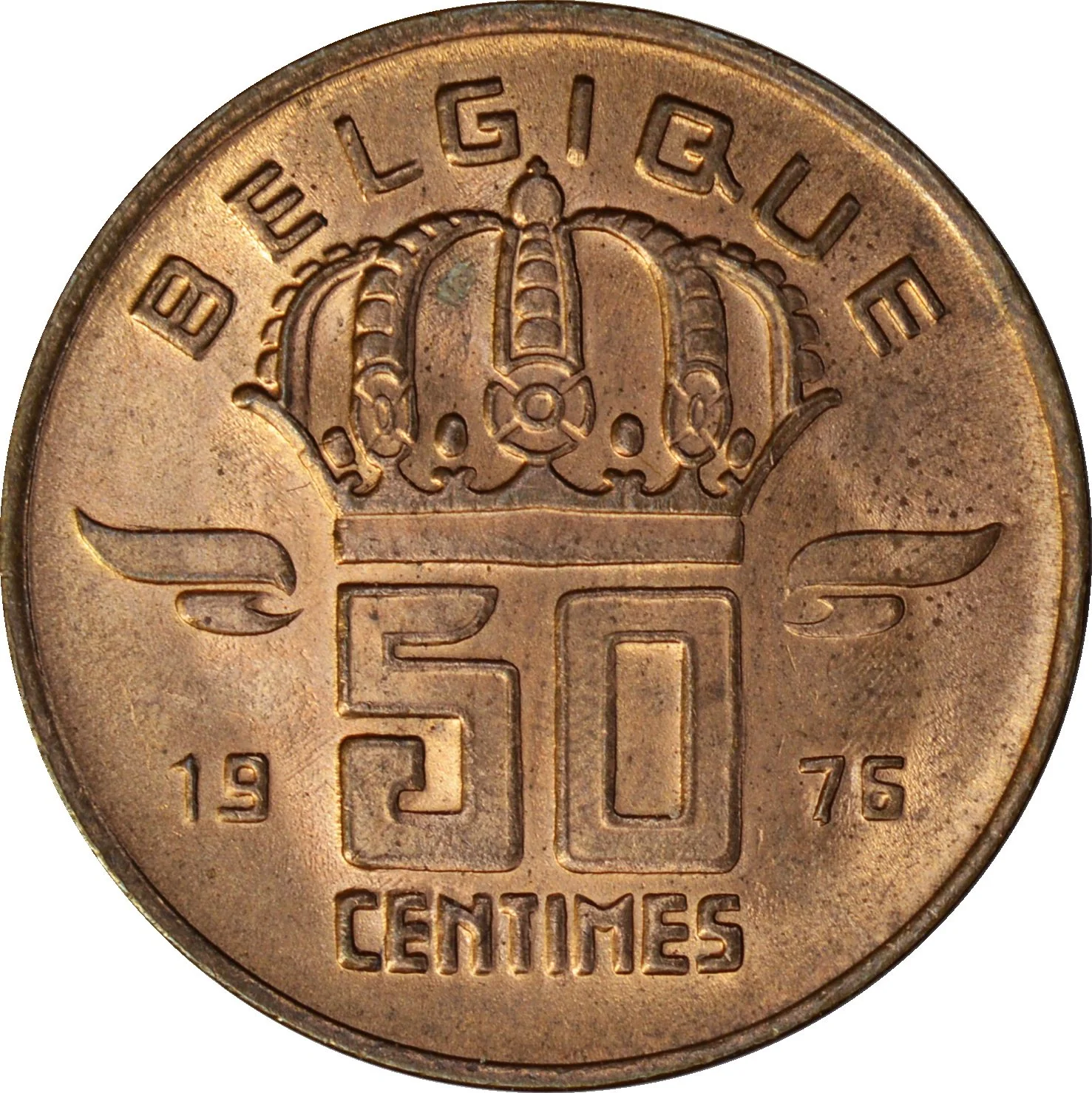
Face value with crowned portrait. French legend above.
Inscription:
BELGIQUE
1991 50
CENTIMES
1991 50
CENTIMES
Translation:
Belgium
1991 50
Centimes
1991 50
Centimes
Script: Latin
Language: French
Engraver: Marcel Rau
Edge
Plain
Mints
| Name | Mark |
|---|---|
| Royal Mint of Belgium | — |
Mintings
| Year | Mint Mark | Mintage | Quality | Collection |
|---|---|---|---|---|
| 1952 | — | 3,520,000 | ||
| 1953 | — | 22,620,000 | ||
| 1955 | — | 29,160,000 | ||
| 1958 | — | 9,750,000 | ||
| 1959 | — | — | ||
| 1962 | — | 6,160,000 | ||
| 1964 | — | 5,860,000 | ||
| 1965 | — | 10,320,000 | ||
| 1966 | — | 11,040,000 | ||
| 1967 | — | 7,200,000 | ||
| 1968 | — | 2,000,000 | ||
| 1969 | — | 10,000,000 | ||
| 1970 | — | 16,000,000 | ||
| 1971 | — | 1,250,000 | ||
| 1972 | — | 3,000,000 | ||
| 1973 | — | 3,000,000 | ||
| 1974 | — | 5,000,000 | ||
| 1975 | — | 7,000,000 | ||
| 1976 | — | 8,000,000 | ||
| 1977 | — | 13,000,000 | ||
| 1978 | — | 2,500,000 | ||
| 1979 | — | 20,000,000 | ||
| 1980 | — | 20,000,000 | ||
| 1980 | — | — | In sets | |
| 1981 | — | 2,000,000 | ||
| 1981 | — | — | In sets | |
| 1982 | — | 7,000,000 | ||
| 1983 | — | 14,000,000 | ||
| 1985 | — | 6,000,000 | ||
| 1987 | — | 9,000,000 | ||
| 1988 | — | 4,500,000 | ||
| 1989 | — | 60,000 | In sets | |
| 1990 | — | 60,000 | In sets | |
| 1991 | — | 6,000,000 | ||
| 1992 | — | 7,000,000 | ||
| 1993 | — | 10,000,000 | ||
| 1994 | — | — | ||
| 1995 | — | 60,000 | In sets | |
| 1996 | — | 11,000,000 | ||
| 1997 | — | 60,000 | In sets | |
| 1998 | — | — | ||
| 1999 | — | 60,000 | In sets | |
| 1999 | — | 5,000 | Proof | |
| 2000 | — | 60,000 | In sets | |
| 2000 | — | 5,000 | Proof | |
| 2001 | — | 35,000 | In sets | |
| 2001 | — | 5,000 | Proof |
Historical background
In 1952, Belgium's currency situation was firmly embedded within the post-World War II European framework of the Belgian-Luxembourg Economic Union (BLEU) and the Bretton Woods system. The nation operated on a dual-currency basis with Luxembourg, sharing the Belgian franc (BEF), which was pegged at a fixed rate to the US dollar as per the Bretton Woods agreements. This provided much-needed stability after the monetary chaos of the war and immediate post-war period, which had included a major devaluation in 1949 aligning with other European currencies against the dollar to boost exports.
Domestically, the Belgian franc was relatively strong, supported by the country's rapid industrial recovery and its pivotal role as a founding member of the European Coal and Steel Community (ECSC). Belgium's economy, with its significant colonial revenues from the Belgian Congo and a robust export sector, enjoyed a favorable balance of payments. This strength was reflected in the country's substantial gold reserves, which bolstered confidence in the currency. However, this overall stability was carefully managed by the National Bank of Belgium, which had to balance supporting reconstruction, controlling inflation, and maintaining the fixed exchange rate.
Nevertheless, underlying tensions existed. The fixed parity required continuous intervention and strict monetary discipline. Furthermore, the costs of reconstruction, social programs, and the looming question of the Congo's future financial relationship created long-term fiscal pressures. Thus, while the currency scene in 1952 appeared stable and confident on the surface, it was a managed stability dependent on sustained economic performance and the broader stability of the international Bretton Woods order, within which Belgium was a committed and active participant.
Domestically, the Belgian franc was relatively strong, supported by the country's rapid industrial recovery and its pivotal role as a founding member of the European Coal and Steel Community (ECSC). Belgium's economy, with its significant colonial revenues from the Belgian Congo and a robust export sector, enjoyed a favorable balance of payments. This strength was reflected in the country's substantial gold reserves, which bolstered confidence in the currency. However, this overall stability was carefully managed by the National Bank of Belgium, which had to balance supporting reconstruction, controlling inflation, and maintaining the fixed exchange rate.
Nevertheless, underlying tensions existed. The fixed parity required continuous intervention and strict monetary discipline. Furthermore, the costs of reconstruction, social programs, and the looming question of the Congo's future financial relationship created long-term fiscal pressures. Thus, while the currency scene in 1952 appeared stable and confident on the surface, it was a managed stability dependent on sustained economic performance and the broader stability of the international Bretton Woods order, within which Belgium was a committed and active participant.
🌱 Very Common