

10 soldi – Ligurian Republic
Add to wishlist
Italy
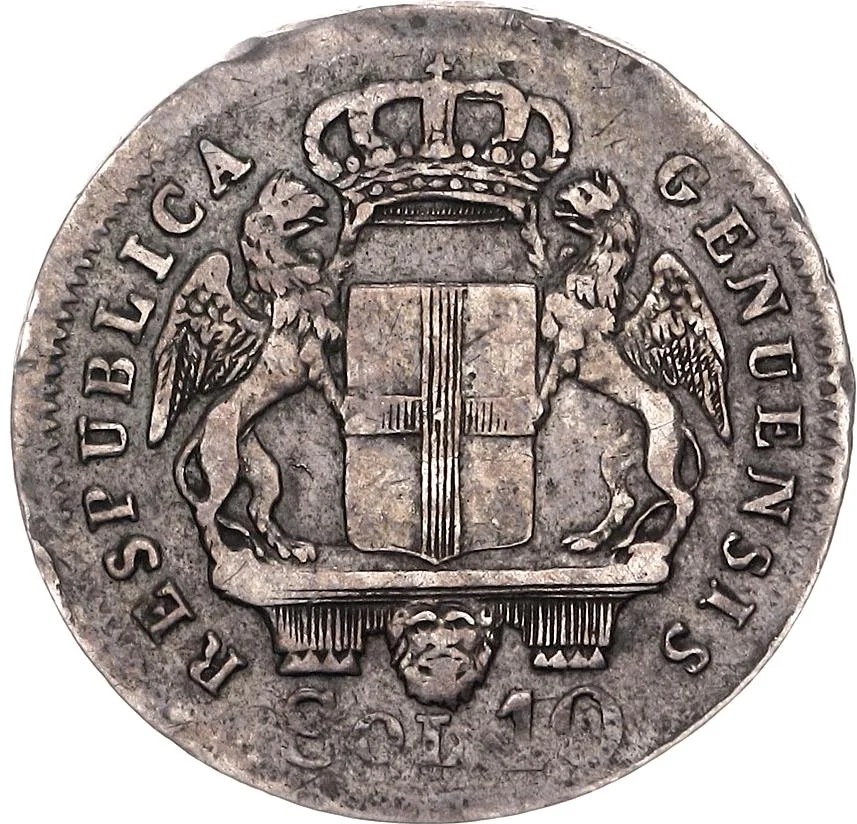
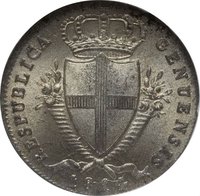
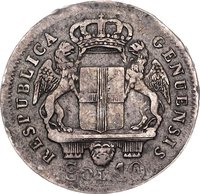
Obverse
Description:
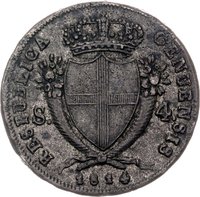
Crowned rectangular shield with griffin supporters, on a base featuring a lion head, above the value.
Inscription:
RESPUBLICA GENUENSIS
SOL.10
SOL.10
Script: Latin
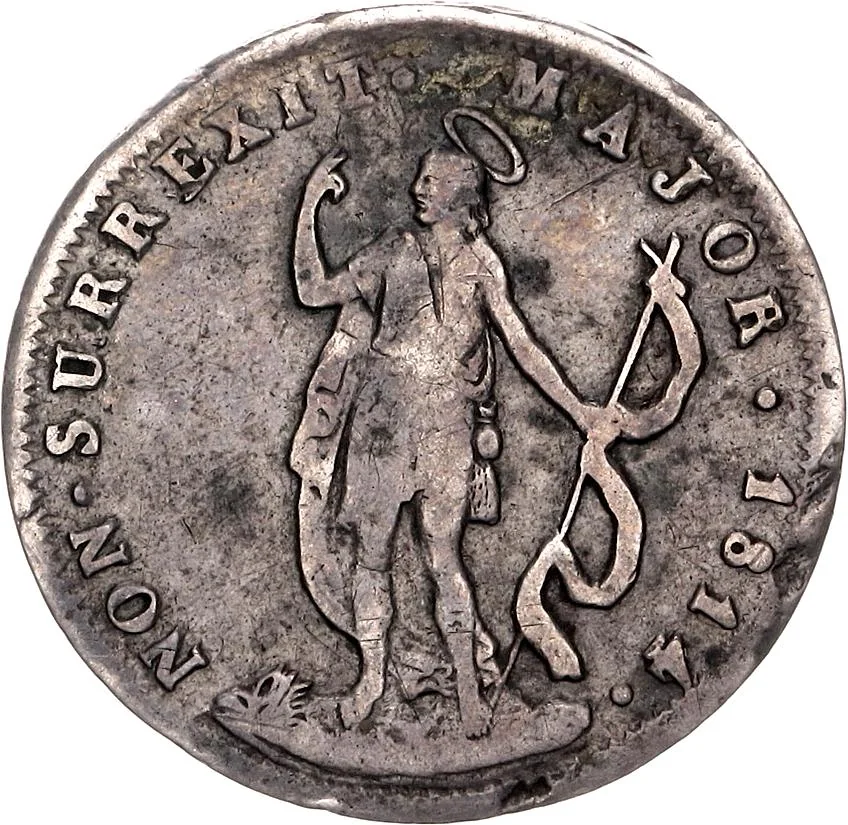
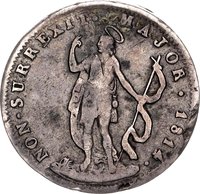
Reverse
Description:
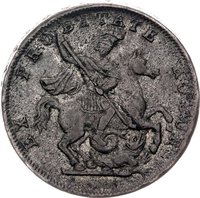
Saint John the Baptist blessing with his right hand, holding a cross with a banner in his left.
Inscription:
NON.SURREXIT.MAJOR.1814.
Script: Latin
Edge
Plain
Mints
| Name | Mark |
|---|---|
| Genoa | — |
Mintings
| Year | Mint Mark | Mintage | Quality | Collection |
|---|---|---|---|---|
| 1814 | — | — |
Historical background
The Ligurian Republic, a French client state established by Napoleon in 1797, was dissolved in 1805 and formally annexed into the French Empire. Consequently, by 1814, the currency situation in the region was entirely that of metropolitan France. The official circulating medium was the French Franc, divided into 100 centimes, with coins minted under imperial authority. This integration meant that Ligurian commerce and finance were tied directly to the French monetary system, which had been strained by years of Napoleonic warfare, leading to inflationary pressures and a reliance on paper assignats and metal coinage of varying scarcity.
The political collapse of French rule in April 1814, following the fall of Napoleon, created immediate monetary uncertainty. While the Franc remained in physical circulation, its legal and future status was thrown into doubt as the territory entered a brief period of provisional government under British and Sardinian influence. The sudden absence of the central French authority raised practical concerns about the supply of small change and the legitimacy of existing coinage, while merchants and banks grappled with the question of what would replace the Franc as the region's political fate was decided at the Congress of Vienna.
Ultimately, the decision to annex the former republic to the Kingdom of Sardinia-Piedmont in 1815 dictated the monetary resolution. A period of transition followed, where the French Franc would have circulated alongside the Sardinian Lira (of which 1 Franc was roughly equal to 1.05 Lire), leading to the complexities of a dual-currency system. The formal integration into the Sardinian monetary system was a gradual process, finalized by the mid-1820s, closing the chapter on the Ligurian Republic's final, fleeting connection to the French economic sphere.
The political collapse of French rule in April 1814, following the fall of Napoleon, created immediate monetary uncertainty. While the Franc remained in physical circulation, its legal and future status was thrown into doubt as the territory entered a brief period of provisional government under British and Sardinian influence. The sudden absence of the central French authority raised practical concerns about the supply of small change and the legitimacy of existing coinage, while merchants and banks grappled with the question of what would replace the Franc as the region's political fate was decided at the Congress of Vienna.
Ultimately, the decision to annex the former republic to the Kingdom of Sardinia-Piedmont in 1815 dictated the monetary resolution. A period of transition followed, where the French Franc would have circulated alongside the Sardinian Lira (of which 1 Franc was roughly equal to 1.05 Lire), leading to the complexities of a dual-currency system. The formal integration into the Sardinian monetary system was a gradual process, finalized by the mid-1820s, closing the chapter on the Ligurian Republic's final, fleeting connection to the French economic sphere.
💎 Very Rare