

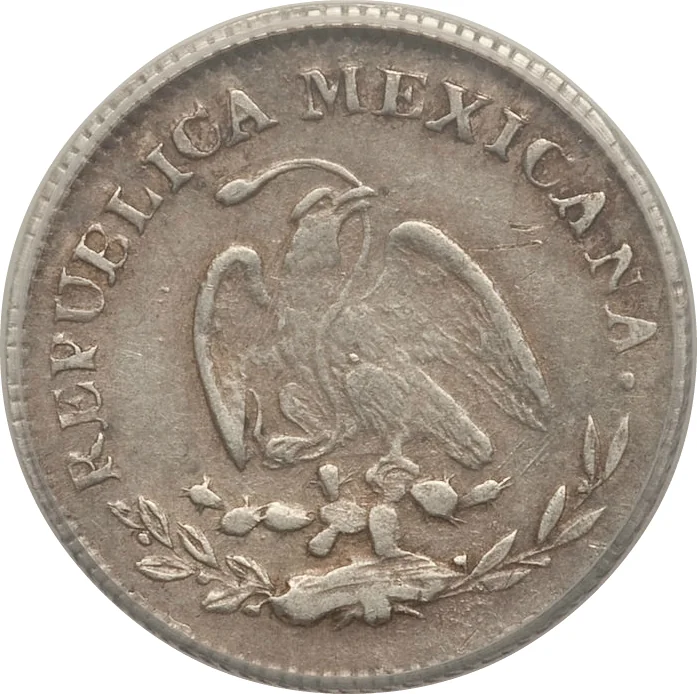
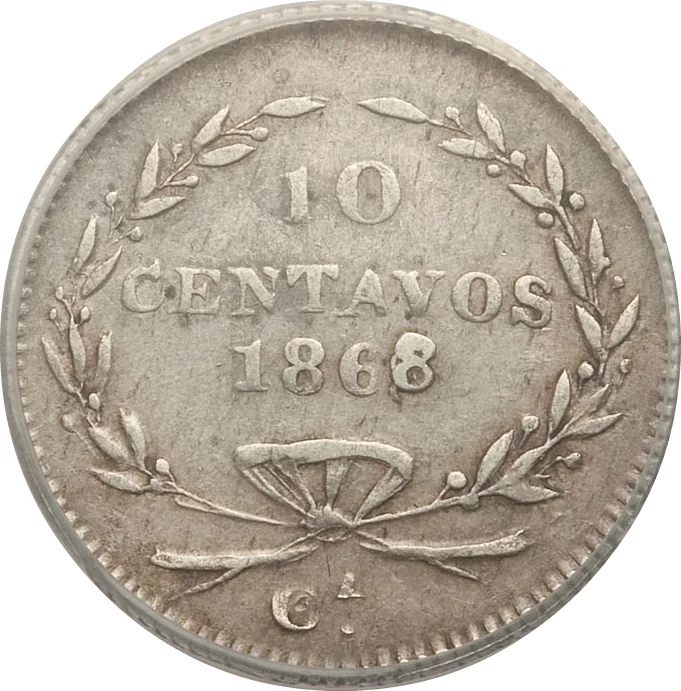
10 centavos – Mexico
Add to wishlist
Mexico
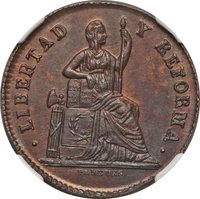
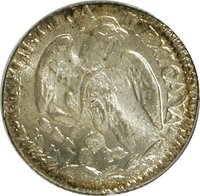
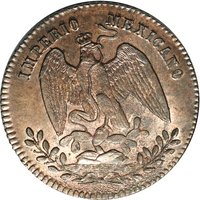
Obverse
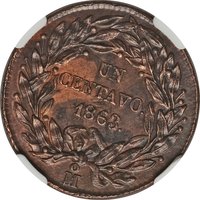
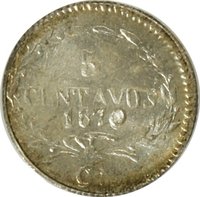
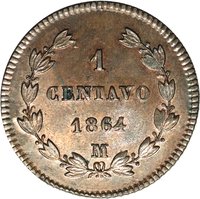
Reverse
Description:
Value and date inside wreath, mint mark below. Known mints: Chihuahua (Ca) and San Luis Potosí (SLP).
Inscription:
10
CENTAVOS
1863
S.L.P.
CENTAVOS
1863
S.L.P.
Script: Latin
Edge
Diagonal reeding.
Legend:
/ / / / / / / / / / / / / / / /
Mintings
| Year | Mint Mark | Mintage | Quality | Collection |
|---|---|---|---|---|
| 1863 | SLP | — | ||
| 1868 | Ca | — | ||
| 1869 | Ca | 15,000 | ||
| 1870 | Ca | 17,000 |
Historical background
In 1863, Mexico's currency situation was chaotic and deeply intertwined with the nation's political instability. The country was embroiled in the French Intervention (1861-1867), with forces of the Second French Empire occupying Mexico City and installing Archduke Maximilian of Austria as Emperor. This created a dual-power struggle between the imperial government backed by France and the republican government of Benito Juárez, which operated from various locations in the north. Consequently, there was no single, authoritative monetary authority, leading to a proliferation of competing currencies that undermined economic confidence.
The monetary landscape was a complex patchwork of coinage. The primary official currency remained the silver peso, but its circulation was disrupted by war. Both the imperial and republican governments issued their own paper money to finance their military campaigns, but these notes were largely discredited and circulated at a steep discount. Furthermore, decades of earlier instability had left in circulation a vast array of coins from different eras and regions, including cut or countermarked coins, as well as foreign currencies like Spanish colonial reales, U.S. dollars, and British sovereigns, which were often preferred for significant transactions due to their reliable metallic content.
This fragmentation resulted in severe economic hardship. The lack of a uniform, trusted currency stifled commerce, fueled rampant inflation (especially for paper notes), and created a barter economy in many areas. The fundamental problem was a crisis of sovereignty; until the conflict for national control was resolved, establishing a stable and unified monetary system was impossible. The currency chaos of 1863 thus stands as a direct reflection of the war-torn state of the nation itself.
The monetary landscape was a complex patchwork of coinage. The primary official currency remained the silver peso, but its circulation was disrupted by war. Both the imperial and republican governments issued their own paper money to finance their military campaigns, but these notes were largely discredited and circulated at a steep discount. Furthermore, decades of earlier instability had left in circulation a vast array of coins from different eras and regions, including cut or countermarked coins, as well as foreign currencies like Spanish colonial reales, U.S. dollars, and British sovereigns, which were often preferred for significant transactions due to their reliable metallic content.
This fragmentation resulted in severe economic hardship. The lack of a uniform, trusted currency stifled commerce, fueled rampant inflation (especially for paper notes), and created a barter economy in many areas. The fundamental problem was a crisis of sovereignty; until the conflict for national control was resolved, establishing a stable and unified monetary system was impossible. The currency chaos of 1863 thus stands as a direct reflection of the war-torn state of the nation itself.
💎 Extremely Rare