




Obverse
Description:
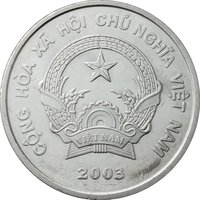
The emblem of North Vietnam (DRV).
Inscription:
VIỆT NAM
Translation:
Viet Nam
Script: Latin
Language: Vietnamese
Reverse
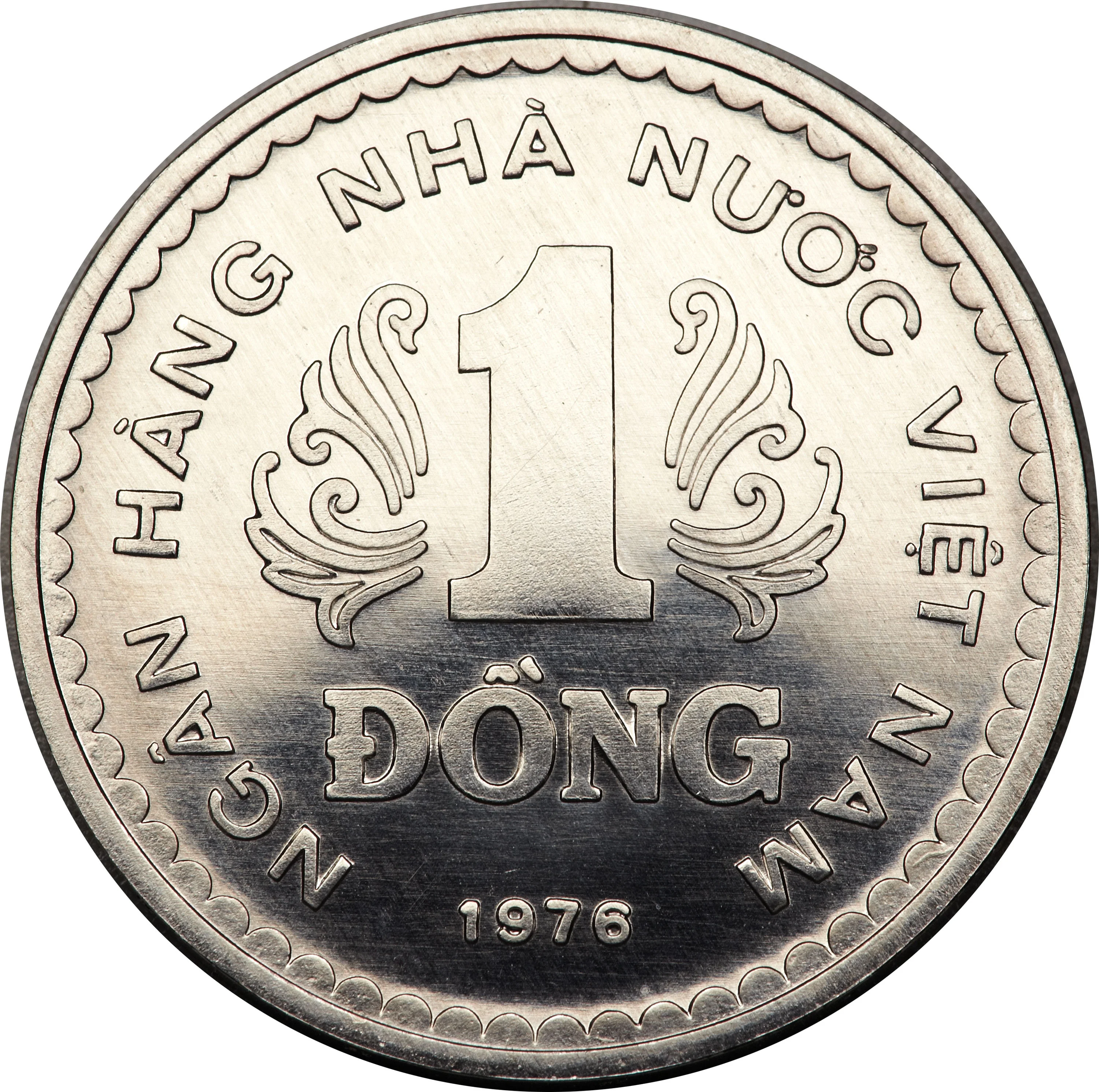
Description:
Legendary face value.
Inscription:
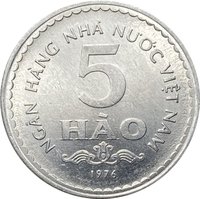
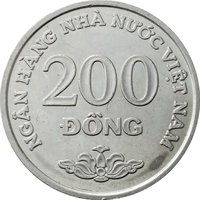
NGÂN HÀNG NHÀ NƯỚC VIỆT NAM
1
ÐỒNG
1976
1
ÐỒNG
1976
Translation:
STATE BANK OF VIETNAM
ONE
DONG
1976
ONE
DONG
1976
Script: Latin
Language: Vietnamese
Edge
Smooth with 13 six-pointed stars.
Legend:
* * * * * * * * * * * * *
Categories
| Symbols> Coat of Arms |
Mints
| Name | Mark |
|---|---|
| Berlin | — |
Mintings
| Year | Mint Mark | Mintage | Quality | Collection |
|---|---|---|---|---|
| 1976 | — | — |
Historical background
Following the reunification of Vietnam in 1976, the new Socialist Republic faced the immense challenge of merging two distinct and damaged economic systems. In the North, the đồng issued by the State Bank of Vietnam was a stable but strictly controlled currency within a centrally planned economy. In the South, the "liberation đồng" had circulated alongside the old South Vietnamese piastre, an economy marked by inflation and a history of U.S. dollar dependence. The immediate post-war priority was not immediate monetary reform but stabilization and the collection of the disparate currencies in circulation, particularly in the South, to establish preliminary control.
The official currency unification came with the issuance of a new national đồng (VND) in 1978, but the groundwork and decisive policies were laid from 1976. The government implemented a complex, politically charged exchange. Holders of the old Southern piastre saw their savings dramatically devalued, while those with "liberation đồng" received more favorable rates, a move that effectively penalized the former commercial class of the South. This was not merely an economic technicality but a profound socio-political tool to dismantle the old Southern financial system and enforce the new socialist model.
Consequently, the 1976-78 period was characterized by severe monetary contraction and the suppression of market activity. The sudden reduction in money supply, combined with the inefficiencies of the planned economy and the costs of reconstruction, led to widespread shortages, a thriving black market, and the beginnings of the hyperinflation that would cripple Vietnam throughout the 1980s. Thus, the currency situation at reunification was the first decisive step toward a unified command economy, one that initially created severe hardship and highlighted the deep structural challenges of merging two Vietnams.
The official currency unification came with the issuance of a new national đồng (VND) in 1978, but the groundwork and decisive policies were laid from 1976. The government implemented a complex, politically charged exchange. Holders of the old Southern piastre saw their savings dramatically devalued, while those with "liberation đồng" received more favorable rates, a move that effectively penalized the former commercial class of the South. This was not merely an economic technicality but a profound socio-political tool to dismantle the old Southern financial system and enforce the new socialist model.
Consequently, the 1976-78 period was characterized by severe monetary contraction and the suppression of market activity. The sudden reduction in money supply, combined with the inefficiencies of the planned economy and the costs of reconstruction, led to widespread shortages, a thriving black market, and the beginnings of the hyperinflation that would cripple Vietnam throughout the 1980s. Thus, the currency situation at reunification was the first decisive step toward a unified command economy, one that initially created severe hardship and highlighted the deep structural challenges of merging two Vietnams.



🌱 Common