


Obverse
Description:
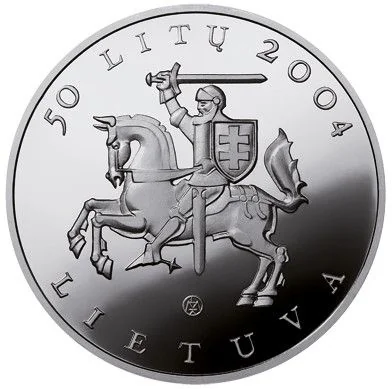
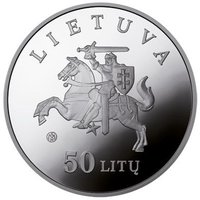
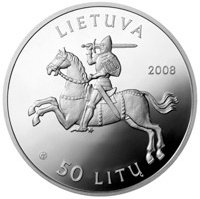
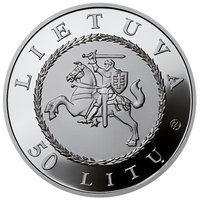
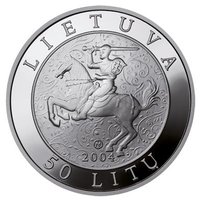
The obverse features the Vytis, encircled by the inscriptions LIETUVA, 50 litas, 2004, and the Lithuanian Mint mark.
Inscription:
50 LITŲ 2004
LMK
LIETUVA
LMK
LIETUVA
Translation:
Fifty Litas 2004
LMK
Lithuania
LMK
Lithuania
Script: Latin
Language: Lithuanian
Designers: Marius Zavadskis, Rytas Jonas Belevičius
Reverse
Description:
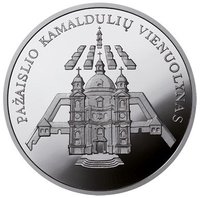
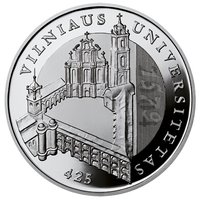
The reverse features the Pažaislis Camaldolese Monastery.
Inscription:
PAŽAISLIO KAMALDULIŲ VIENUOLYNAS
Translation:
Pažaislis Camaldolese Monastery
Script: Latin
Language: Lithuanian
Designers: Marius Zavadskis, Rytas Jonas Belevičius
Edge
Lettered
Legend:
ISTORIJOS IR ARCHITEKTŪROS PAMINKLAI
Translation:
Historical and Architectural Monuments
Language: Lithuanian
Categories
| Object> Cold weapons |
| Animal> Horse |
| Building> Religious building |
| Symbols> Coat of Arms |
Mints
| Name | Mark |
|---|---|
| Lithuanian Mint | (LMK) |
Mintings
| Year | Mint Mark | Mintage | Quality | Collection |
|---|---|---|---|---|
| 2004 | LMK | 1,500 | Proof |
Historical background
In 2004, Lithuania's currency situation was defined by its strategic commitment to European integration. The country operated under a currency board arrangement, established in 1994 to ensure monetary stability after a period of hyperinflation. This system rigidly fixed the Lithuanian litas (LTL) first to the U.S. dollar and, from February 2002, to the euro at a rate of 3.4528 LTL to €1. The currency board provided crucial credibility and low inflation, but it also meant Lithuania had relinquished independent control over its monetary policy, as the money supply was directly tied to foreign reserve holdings.
This fixed exchange rate was a cornerstone of Lithuania's economic policy, explicitly designed as a transitional mechanism toward its ultimate goal: adopting the euro. The year 2004 was pivotal, as Lithuania gained membership in both NATO and the European Union on 1 May. EU accession automatically included the country in the European Exchange Rate Mechanism (ERM II), the mandatory "waiting room" for euro adoption. Entry into ERM II required Lithuania to maintain the existing euro peg without severe tensions for a minimum of two years while also converging with the EU's economic criteria, including targets for inflation, interest rates, and public finances.
However, a significant challenge emerged almost immediately. In 2004, Lithuania, along with other Baltic states, experienced rapidly rising inflation, driven by EU accession-fueled growth, wage increases, and rising oil prices. This surge risked breaching the EU's Maastricht criterion on price stability, which required that the inflation rate not exceed by more than 1.5 percentage points the average of the three best-performing EU member states. Consequently, despite a successful ERM II entry, the European Commission and the European Central Bank assessed in 2004-2005 that Lithuania was not yet ready for euro adoption, delaying its initial target date of 2007. Thus, 2004 was a year of both achievement and new economic constraints, setting the stage for a prolonged period of convergence before the eventual euro changeover in 2015.
This fixed exchange rate was a cornerstone of Lithuania's economic policy, explicitly designed as a transitional mechanism toward its ultimate goal: adopting the euro. The year 2004 was pivotal, as Lithuania gained membership in both NATO and the European Union on 1 May. EU accession automatically included the country in the European Exchange Rate Mechanism (ERM II), the mandatory "waiting room" for euro adoption. Entry into ERM II required Lithuania to maintain the existing euro peg without severe tensions for a minimum of two years while also converging with the EU's economic criteria, including targets for inflation, interest rates, and public finances.
However, a significant challenge emerged almost immediately. In 2004, Lithuania, along with other Baltic states, experienced rapidly rising inflation, driven by EU accession-fueled growth, wage increases, and rising oil prices. This surge risked breaching the EU's Maastricht criterion on price stability, which required that the inflation rate not exceed by more than 1.5 percentage points the average of the three best-performing EU member states. Consequently, despite a successful ERM II entry, the European Commission and the European Central Bank assessed in 2004-2005 that Lithuania was not yet ready for euro adoption, delaying its initial target date of 2007. Thus, 2004 was a year of both achievement and new economic constraints, setting the stage for a prolonged period of convergence before the eventual euro changeover in 2015.
✨ Legendary