

50 Pence – Guernsey
Context
Years: 1969–1971
Country: British Crown dependencies
Issuer: Guernsey
Ruler: Elizabeth II
Currency:
(since 1971)
Demonetized: Yes
Total mintage: 410,000
Material
Diameter: 30 mm
Weight: 13.5 g
Shape: Equilateral curve heptagon
Composition: Copper-nickel
Technique: Milled
Alignment: Medal alignment
flip
References
KM: #Click to copy to clipboard25
Numista: #5638
Value
Exchange value: 0.50 GGP
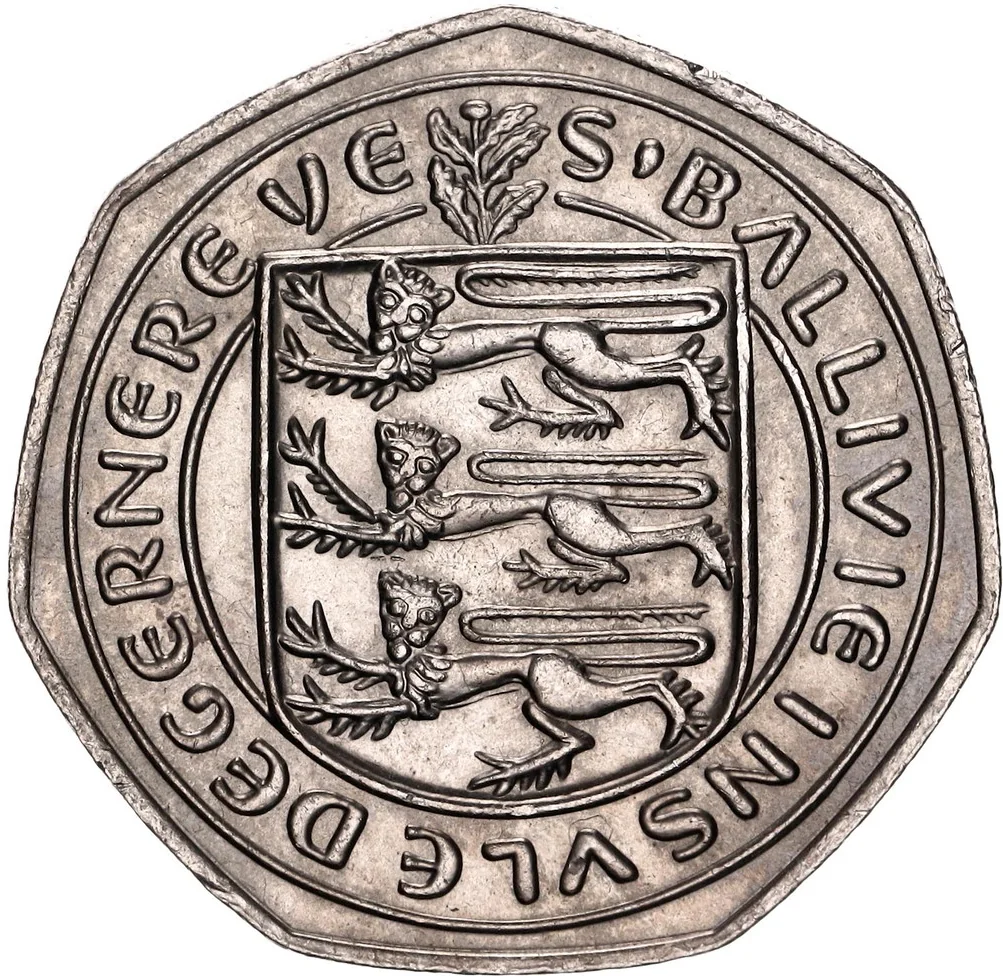
Obverse
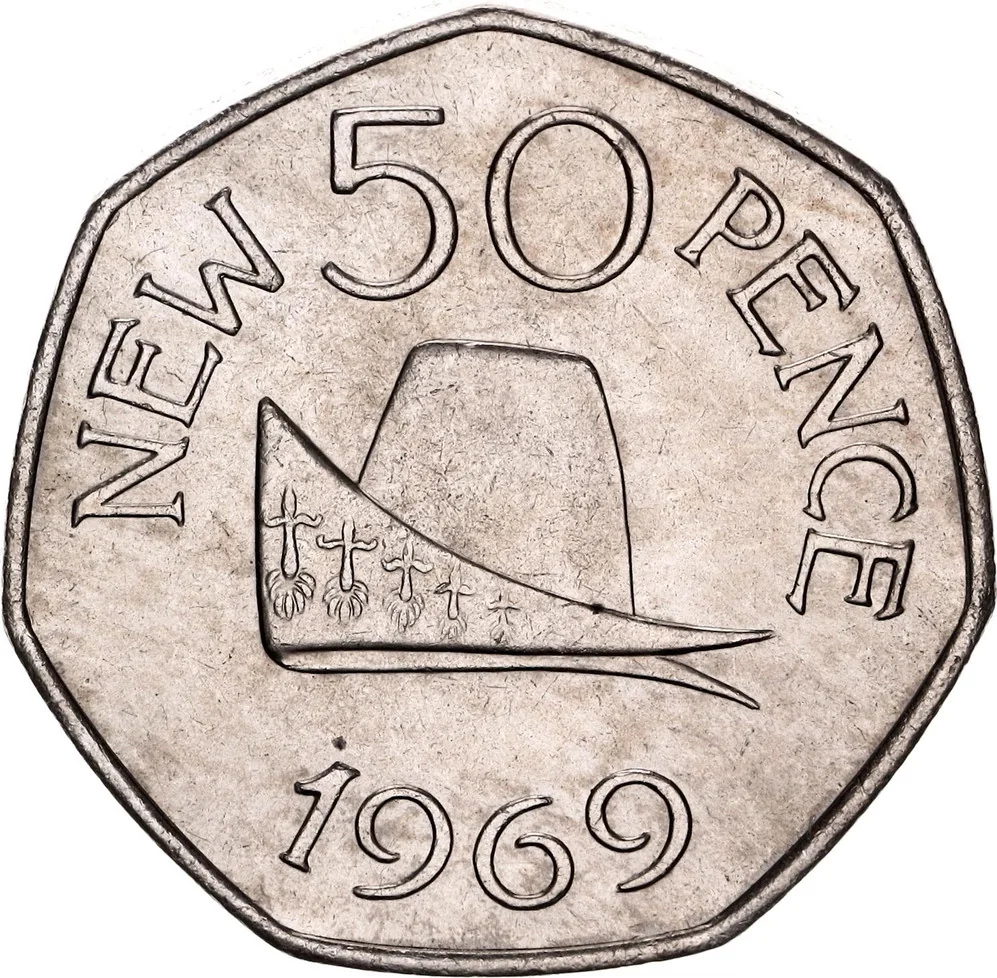
Reverse
Description:
Normandy ducal coronet
Inscription:
NEW 50 PENCE
1969
1969
Script: Latin
Engraver: Anthony Wagner
Edge
Plain
Mints
| Name | Mark |
|---|---|
| Royal Mint (Tower Hill) | — |
Mintings
| Year | Mint Mark | Mintage | Quality | Collection |
|---|---|---|---|---|
| 1969 | — | 200,000 | ||
| 1970 | — | 200,000 | ||
| 1971 | — | 10,000 | Proof |
Historical background
In 1969, the currency situation in Guernsey was defined by its long-standing and practical reliance on British sterling. As a British Crown Dependency, Guernsey did not issue its own independent currency but instead used Bank of England notes as its official legal tender. However, to meet local needs and assert a degree of fiscal identity, the States of Guernsey had already introduced its own, locally issued pound notes, which were in circulation alongside UK currency at a strict 1:1 parity. These Guernsey notes were not legal tender in the United Kingdom, but sterling was fully accepted in the Bailiwick.
This period was one of stability but also of transition within the wider sterling area. The UK's decimalisation process was underway, scheduled for 1971 (Decimal Day), and Guernsey was preparing to follow suit. In 1969, the island's authorities were planning for this significant change, which would require the design and issuance of new decimal coins and notes. The existing pre-decimal system of pounds, shillings, and pence, using British coinage and local paper money, was still fully operational, but the groundwork for a decimal currency under the States' own control was being laid.
Therefore, the background for 1969 is not one of crisis but of careful administrative preparation. The currency system functioned smoothly on the bedrock of sterling, yet the island was proactively managing its own monetary instruments within that framework. The year represented the calm before a planned numismatic change, with Guernsey poised to modernise its coinage while maintaining its core principles of parity with sterling and the right to issue its own distinct, but Sterling Area, currency.
This period was one of stability but also of transition within the wider sterling area. The UK's decimalisation process was underway, scheduled for 1971 (Decimal Day), and Guernsey was preparing to follow suit. In 1969, the island's authorities were planning for this significant change, which would require the design and issuance of new decimal coins and notes. The existing pre-decimal system of pounds, shillings, and pence, using British coinage and local paper money, was still fully operational, but the groundwork for a decimal currency under the States' own control was being laid.
Therefore, the background for 1969 is not one of crisis but of careful administrative preparation. The currency system functioned smoothly on the bedrock of sterling, yet the island was proactively managing its own monetary instruments within that framework. The year represented the calm before a planned numismatic change, with Guernsey poised to modernise its coinage while maintaining its core principles of parity with sterling and the right to issue its own distinct, but Sterling Area, currency.
🌱 Common