

10 Cash – Hupeh Province
China
Context
Years: 1902–1905
Country: China 
Issuer: Hupeh Province
Ruler: Guangxu
Currency:
(1895—1949)
Demonetized: Yes
Total mintage: 4,475,000
Material
References
Y: #Click to copy to clipboard122
Numista: #5604
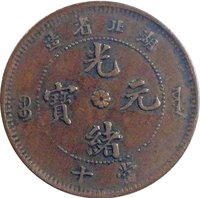
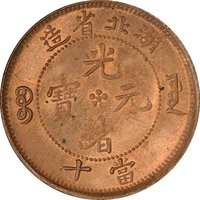
Obverse
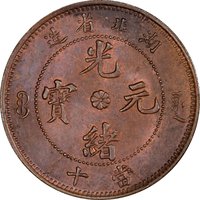
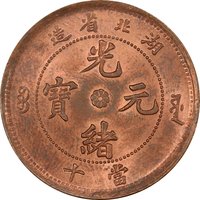
Description:
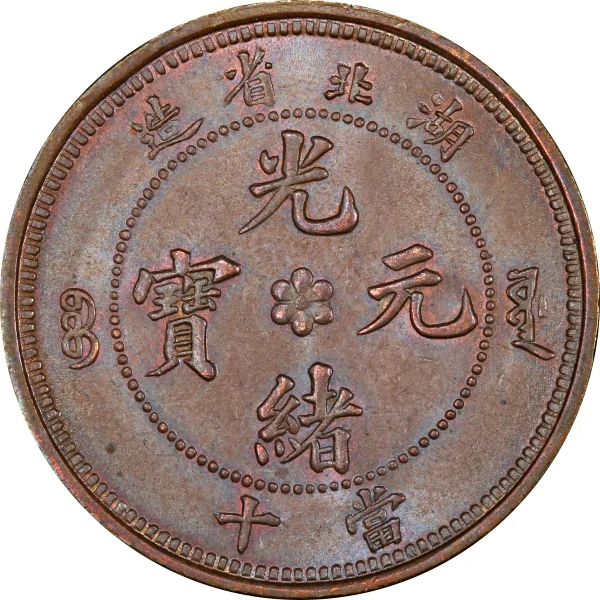
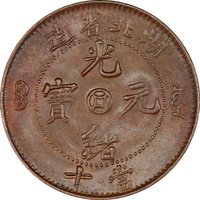
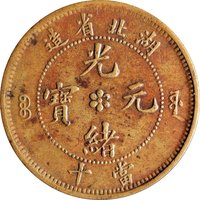
Four Chinese characters read vertically, right to left, centered on a flower, with Manchu text on both sides and additional Chinese text above and below.
Inscription:
造省北湖
ᠪᠣᠣ ᠶᡠᠸᠠᠨ
光
寶元
緒
十當
ᠪᠣᠣ ᠶᡠᠸᠠᠨ
光
寶元
緒
十當
Translation:
Board of Revenue, Northern Lake
Guangxu
Treasure
Ten Cash
Guangxu
Treasure
Ten Cash
Scripts: Chinese, Mongolian / Manchu
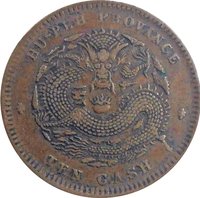
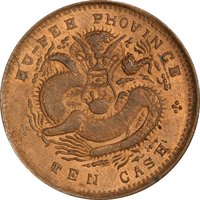
Reverse
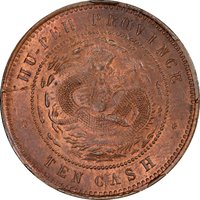
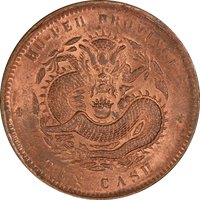
Description:
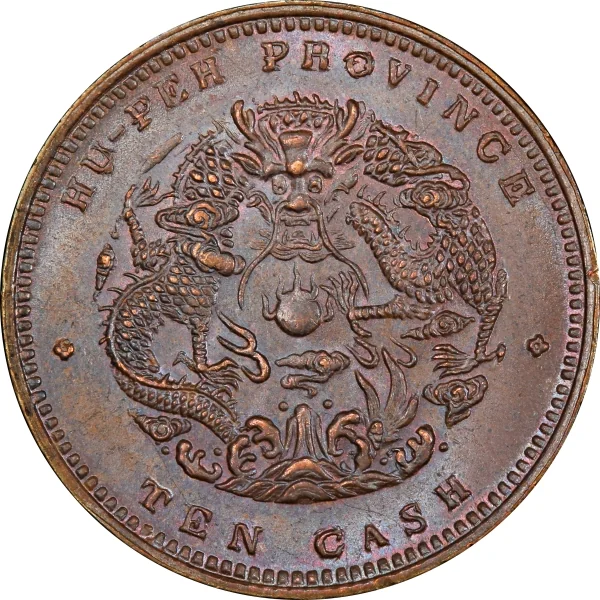
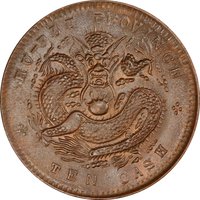
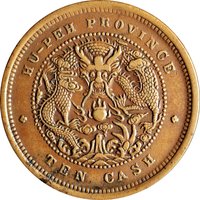
Dragon and pearl above a mountain, encircled by English text.
Inscription:
HU-PEH PROVINCE
TEN CASH
TEN CASH
Script: Latin
Edge
Plain
Mintings
| Year | Mint Mark | Mintage | Quality | Collection |
|---|---|---|---|---|
| — | — | 4,475,000 |
Historical background
In 1902, the currency situation in Hubei (then romanized as Hupeh) Province was a complex and chaotic reflection of China's late Qing dynasty monetary system, characterized by a debilitating multiplicity of currencies. The province operated without a unified standard, circulating a confusing mix of silver sycee (measured in taels), foreign silver dollars (primarily Mexican and British trade dollars), and a vast array of copper cash coins, both genuine and debased. This fragmentation caused severe complications for daily commerce, as exchange rates between silver and copper, and between different types of silver, fluctuated constantly, creating uncertainty and facilitating exploitation by money changers.
A significant factor in this instability was the provincial mint at Wuchang, one of China's most modern. Established under Governor-General Zhang Zhidong in the 1890s, it produced Hubei's own silver dollar and copper coinage in an attempt to standardize currency and assert provincial sovereignty. However, its output could not keep pace with demand, and the new machine-struck coins entered a market already saturated with older, irregular forms of money. Furthermore, the quality and silver content of even official provincial coinage was sometimes suspect, undermining public trust.
This monetary disarray had profound economic and social consequences. It hampered inter-regional trade, complicated tax collection (as taxes were often demanded in silver while peasants earned in copper), and burdened the common people with hidden transaction costs. The situation in Hubei was a microcosm of a national crisis, highlighting the Qing government's weakening control over the economy and its inability to implement a unified monetary reform, a failure that would contribute to the dynasty's eventual collapse.
A significant factor in this instability was the provincial mint at Wuchang, one of China's most modern. Established under Governor-General Zhang Zhidong in the 1890s, it produced Hubei's own silver dollar and copper coinage in an attempt to standardize currency and assert provincial sovereignty. However, its output could not keep pace with demand, and the new machine-struck coins entered a market already saturated with older, irregular forms of money. Furthermore, the quality and silver content of even official provincial coinage was sometimes suspect, undermining public trust.
This monetary disarray had profound economic and social consequences. It hampered inter-regional trade, complicated tax collection (as taxes were often demanded in silver while peasants earned in copper), and burdened the common people with hidden transaction costs. The situation in Hubei was a microcosm of a national crisis, highlighting the Qing government's weakening control over the economy and its inability to implement a unified monetary reform, a failure that would contribute to the dynasty's eventual collapse.
🌱 Common