

25 Francs Guinéens – Guinea
Guinea
Context
Material
Diameter: 27 mm
Weight: 7.9 g
Thickness: 2 mm
Shape: Round
Composition: Aluminium bronze
Standard: Silver quarter ounce
Magnetic: No
Technique: Milled
Alignment: Medal alignment
flip
References
KM: #Click to copy to clipboard3
Numista: #5599
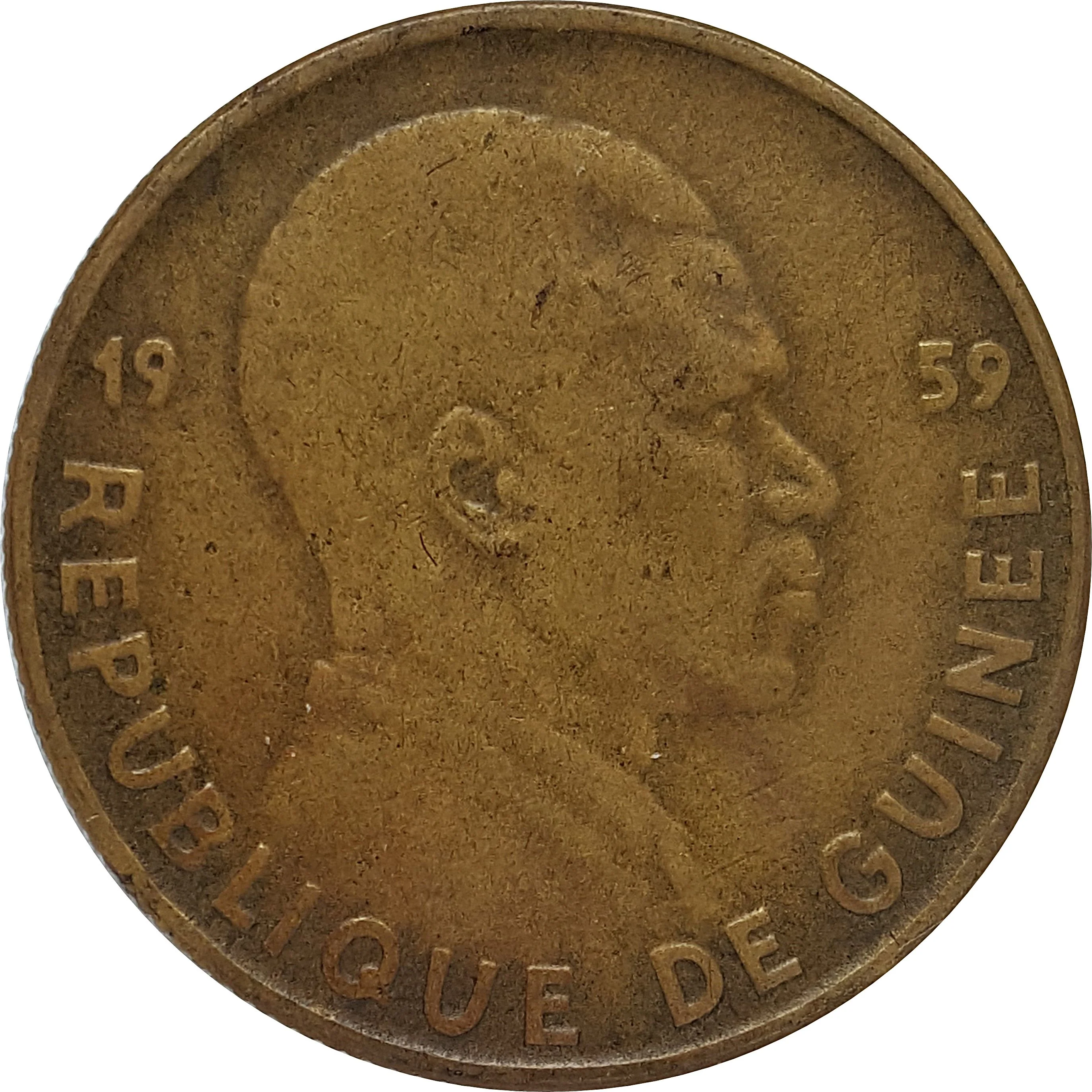
Obverse
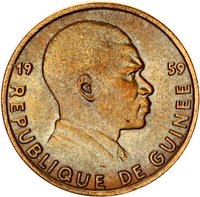
Description:
Bust right, date flanking.
Inscription:
19 59
REPUBLIQUE DE GUINEE
REPUBLIQUE DE GUINEE
Translation:
REPUBLIC OF GUINEA
Script: Latin
Language: French
Engraver: Paul Vincze
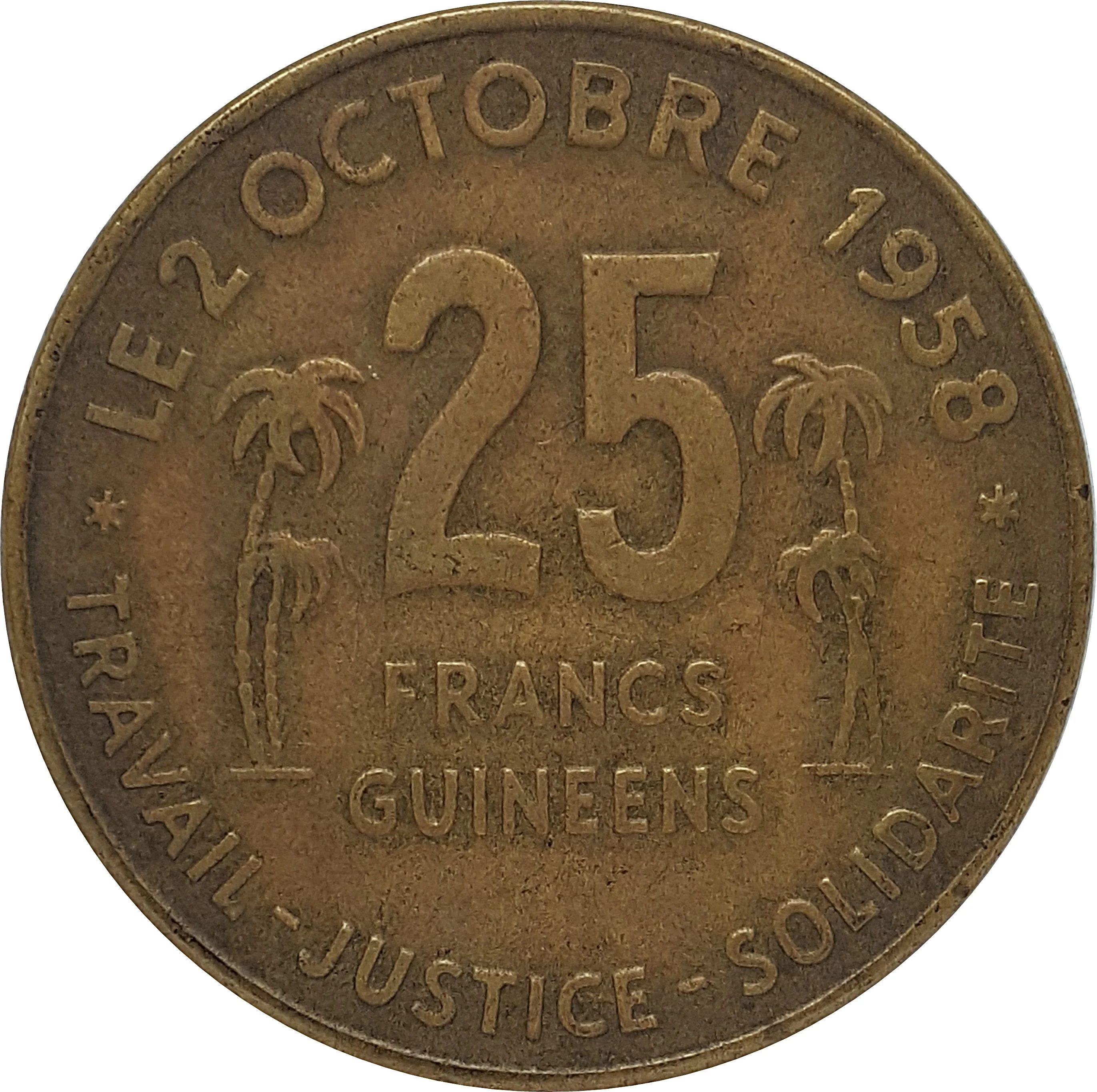
Reverse
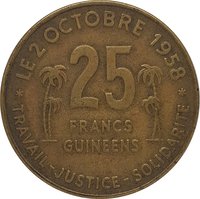
Description:
Denomination flanked by palms.
Inscription:
LE 2 OCTOBRE 1958
TRAVAIL-JUSTICE-SOLIDARITÉ
25
FRANCS
GUINEENS
TRAVAIL-JUSTICE-SOLIDARITÉ
25
FRANCS
GUINEENS
Translation:
On the 2nd of October 1958
Work-Justice-Solidarity
25
Francs
Guinean
Work-Justice-Solidarity
25
Francs
Guinean
Script: Latin
Language: French
Engraver: Paul Vincze
Edge
Reeded
Categories
| Person> Politician |
| Plant> Tree |
Mints
| Name | Mark |
|---|---|
| Kremnica | — |
Mintings
| Year | Mint Mark | Mintage | Quality | Collection |
|---|---|---|---|---|
| 1959 | — | — |
Historical background
In 1959, Guinea stood as a newly independent nation following its historic "No" vote in the 1958 French constitutional referendum, which led to an immediate and complete break with France. This political rupture had profound and immediate monetary consequences. Upon independence, France withdrew all administrative and financial support, including the removal of the colonial currency, the CFA franc, from circulation. This left Guinea without a central bank, foreign reserves, or a functioning monetary system, creating an urgent vacuum that threatened the country's economic stability from its very first day.
President Sékou Touré's government moved swiftly to assert monetary sovereignty as a cornerstone of its revolutionary agenda. In March 1960, it established the Banque Centrale de la République de Guinée and introduced Guinea's first national currency, the Guinean franc (GNF). The 1959 period was thus one of intense preparation for this launch, involving the logistical planning for printing new banknotes and coins, and the politically charged process of designing currency symbols that rejected colonial imagery in favor of national motifs like the foyer (a traditional cooking hut).
The context for this monetary creation was one of severe economic strain and isolation. France's withdrawal and a subsequent embargo by Western nations meant Guinea had to rapidly forge new economic partnerships, primarily with Eastern Bloc countries like the Soviet Union and Czechoslovakia, which provided technical assistance for printing the initial currency. Therefore, the currency situation in 1959 was defined by the tense transition from a severed colonial monetary system to the planned birth of a national currency, an act deeply intertwined with Guinea's political defiance and its pursuit of autarky amidst significant external pressure.
President Sékou Touré's government moved swiftly to assert monetary sovereignty as a cornerstone of its revolutionary agenda. In March 1960, it established the Banque Centrale de la République de Guinée and introduced Guinea's first national currency, the Guinean franc (GNF). The 1959 period was thus one of intense preparation for this launch, involving the logistical planning for printing new banknotes and coins, and the politically charged process of designing currency symbols that rejected colonial imagery in favor of national motifs like the foyer (a traditional cooking hut).
The context for this monetary creation was one of severe economic strain and isolation. France's withdrawal and a subsequent embargo by Western nations meant Guinea had to rapidly forge new economic partnerships, primarily with Eastern Bloc countries like the Soviet Union and Czechoslovakia, which provided technical assistance for printing the initial currency. Therefore, the currency situation in 1959 was defined by the tense transition from a severed colonial monetary system to the planned birth of a national currency, an act deeply intertwined with Guinea's political defiance and its pursuit of autarky amidst significant external pressure.
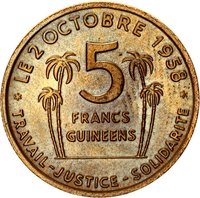
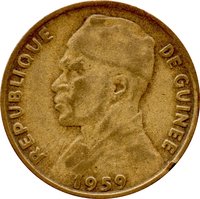
Series: 1959 Guinea circulation coins
🌟 Uncommon