

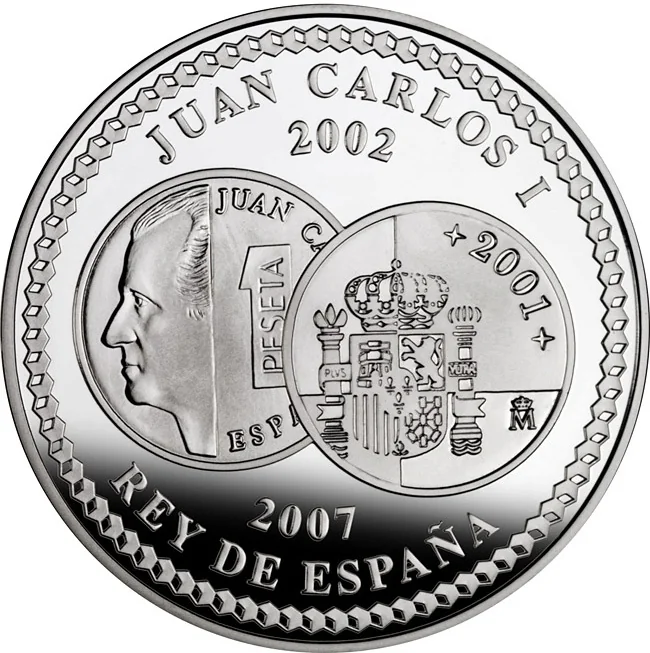
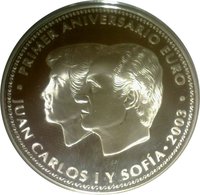
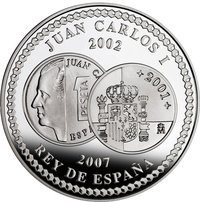
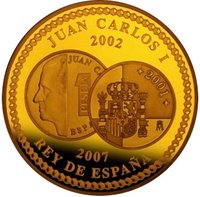
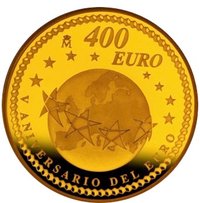
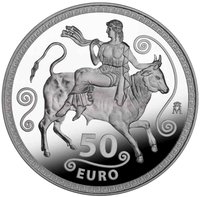
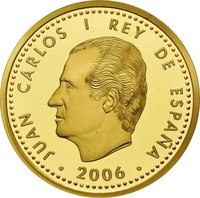
Obverse
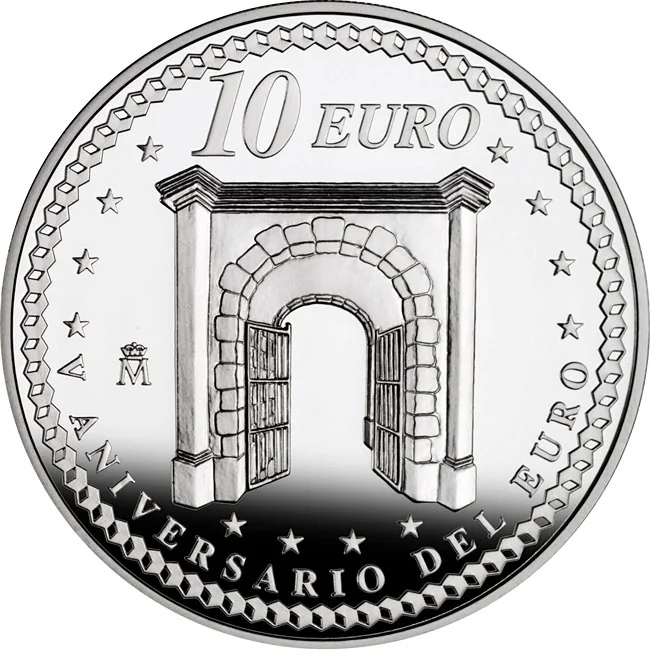
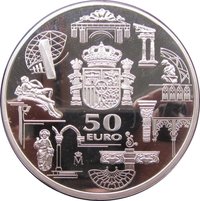
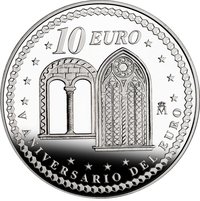
Reverse
Edge
Reeded
Categories
| Currency> Coin depiction |
Mints
| Name | Mark |
|---|---|
| Royal Mint of Madrid | (M) |
Mintings
| Year | Mint Mark | Mintage | Quality | Collection |
|---|---|---|---|---|
| 2007 | M | 12,000 | Proof |
Historical background
In 2007, Spain was nearing the peak of a prolonged economic boom, largely fueled by a massive property bubble and cheap credit, all underpinned by its membership in the Eurozone. Having adopted the euro in 1999, Spain relinquished control of its monetary policy to the European Central Bank (ECB). This meant interest rates were set for the entire Eurozone, and for Spain, these rates were historically low compared to its pre-euro era. This environment facilitated a decade of extraordinary growth, with credit flowing easily into construction and real estate, driving up private debt and housing prices to unsustainable levels.
The single currency masked growing imbalances within the Spanish economy. While the euro eliminated exchange rate risk for foreign investors, it also removed a traditional adjustment mechanism. In the past, peseta devaluation could have restored competitiveness as Spain's inflation and unit labor costs rose faster than in core Eurozone nations like Germany. Instead, trapped in a "one-size-fits-all" monetary policy, Spain lost export competitiveness and developed a large current account deficit, relying on continuous foreign capital inflows to finance its growth model. The currency situation was thus paradoxical: the stability and credibility of the euro enabled the boom, but its rigid structure prevented corrective measures and left the economy acutely vulnerable to a sudden stop in financing.
By late 2007, the global financial tremors from the US subprime crisis began to expose these fault lines. The era of easy credit abruptly ended, causing the property bubble to deflate and revealing the overexposure of Spanish banks and savings institutions (cajas) to toxic real estate assets. While the euro itself remained strong, the internal economic crisis deepened, transitioning from a financial crisis to a full-blown sovereign debt crisis by 2010, as markets questioned Spain's ability to manage its debts without the tools of an independent central bank. The currency union, initially a driver of prosperity, became a straitjacket as Spain faced a severe recession and soaring unemployment with limited policy tools at its disposal.
The single currency masked growing imbalances within the Spanish economy. While the euro eliminated exchange rate risk for foreign investors, it also removed a traditional adjustment mechanism. In the past, peseta devaluation could have restored competitiveness as Spain's inflation and unit labor costs rose faster than in core Eurozone nations like Germany. Instead, trapped in a "one-size-fits-all" monetary policy, Spain lost export competitiveness and developed a large current account deficit, relying on continuous foreign capital inflows to finance its growth model. The currency situation was thus paradoxical: the stability and credibility of the euro enabled the boom, but its rigid structure prevented corrective measures and left the economy acutely vulnerable to a sudden stop in financing.
By late 2007, the global financial tremors from the US subprime crisis began to expose these fault lines. The era of easy credit abruptly ended, causing the property bubble to deflate and revealing the overexposure of Spanish banks and savings institutions (cajas) to toxic real estate assets. While the euro itself remained strong, the internal economic crisis deepened, transitioning from a financial crisis to a full-blown sovereign debt crisis by 2010, as markets questioned Spain's ability to manage its debts without the tools of an independent central bank. The currency union, initially a driver of prosperity, became a straitjacket as Spain faced a severe recession and soaring unemployment with limited policy tools at its disposal.
Series: Euro Coinage


✨ Legendary