

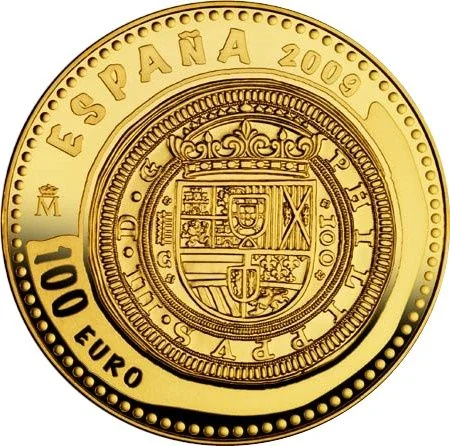



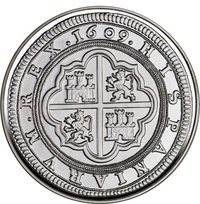
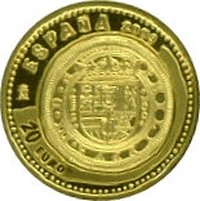
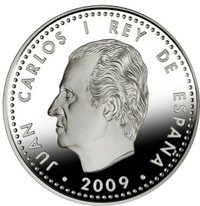
Obverse
Reverse
Edge
Reeded
Categories
| Symbol> Cross |
| Symbols> Coat of Arms |
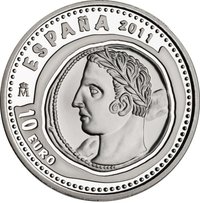
| Currency> Coin depiction |
| Symbol> Wreath |
Mints
| Name | Mark |
|---|---|
| Royal Mint of Madrid | (M) |
Mintings
| Year | Mint Mark | Mintage | Quality | Collection |
|---|---|---|---|---|
| 2009 | M | 6,000 | Proof |
Historical background
In 2009, Spain was in the throes of a profound economic crisis, but its currency situation was uniquely defined by its membership in the Eurozone. Having adopted the euro in 1999, Spain no longer controlled its own monetary policy or currency valuation. This meant it could not devalue its currency to regain competitiveness, a traditional tool for countries facing severe economic shocks. Instead, it was bound by the European Central Bank's (ECB) one-size-fits-all interest rate policy, which was often set with the broader Eurozone economy in mind, not Spain's specific deteriorating conditions.
The core of Spain's problem was the bursting of a massive domestic housing bubble, which led to a deep banking crisis and a collapse in construction and related industries. Unemployment soared to over 18% by year's end, and the public deficit ballooned as tax revenues plummeted and social spending rose. While the euro provided stability and prevented a currency collapse, it also locked Spain into a painful internal devaluation process. The country was forced to restore competitiveness not through exchange rate adjustment, but through politically difficult and socially painful domestic wage cuts and structural reforms to reduce its large current account deficit.
Consequently, 2009 marked the beginning of intense market pressure on Spanish sovereign debt, as investors feared the cost of bank bailouts and recession would overwhelm public finances. While not a currency crisis in the traditional sense, it was a crisis within a currency union. The situation exposed the vulnerabilities of a shared currency without full fiscal union, setting the stage for the broader Eurozone sovereign debt crisis that would fully erupt in 2010 and eventually force Spain to seek a European bailout for its banking sector in 2012.
The core of Spain's problem was the bursting of a massive domestic housing bubble, which led to a deep banking crisis and a collapse in construction and related industries. Unemployment soared to over 18% by year's end, and the public deficit ballooned as tax revenues plummeted and social spending rose. While the euro provided stability and prevented a currency collapse, it also locked Spain into a painful internal devaluation process. The country was forced to restore competitiveness not through exchange rate adjustment, but through politically difficult and socially painful domestic wage cuts and structural reforms to reduce its large current account deficit.
Consequently, 2009 marked the beginning of intense market pressure on Spanish sovereign debt, as investors feared the cost of bank bailouts and recession would overwhelm public finances. While not a currency crisis in the traditional sense, it was a crisis within a currency union. The situation exposed the vulnerabilities of a shared currency without full fiscal union, setting the stage for the broader Eurozone sovereign debt crisis that would fully erupt in 2010 and eventually force Spain to seek a European bailout for its banking sector in 2012.
Series: Numismatic Jewels





✨ Legendary