

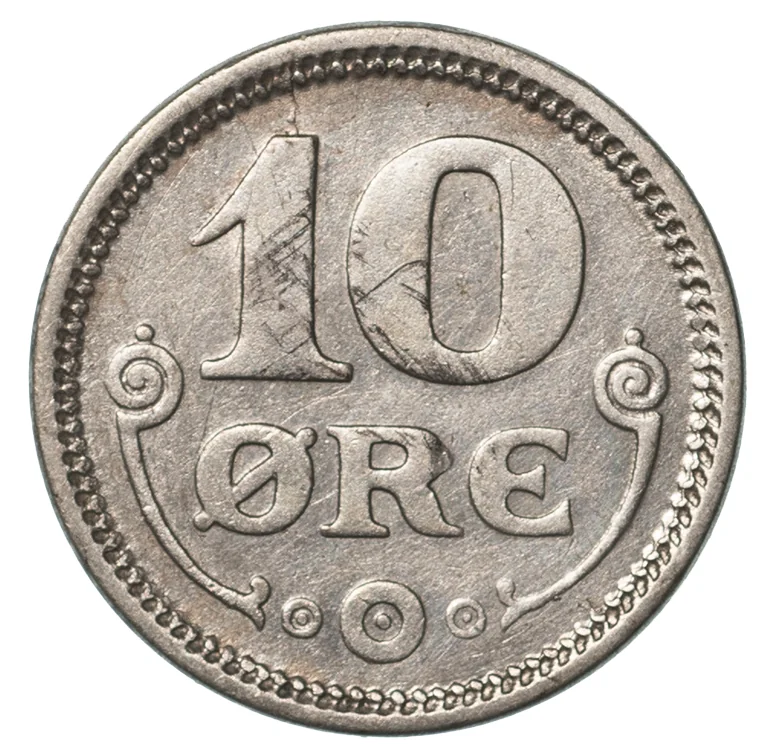
10 Øre – Denmark
Denmark
Context
Years: 1914–1919
Issuer: Denmark 
Ruler: Christian X
Currency:
(since 1873)
Demonetization: 30 June 1989
Total mintage: 26,971,000
Material
References
KM: #Click to copy to clipboard818
Numista: #5568
Value
Exchange value: 0.10 DKK = $0.02
Obverse
Description:
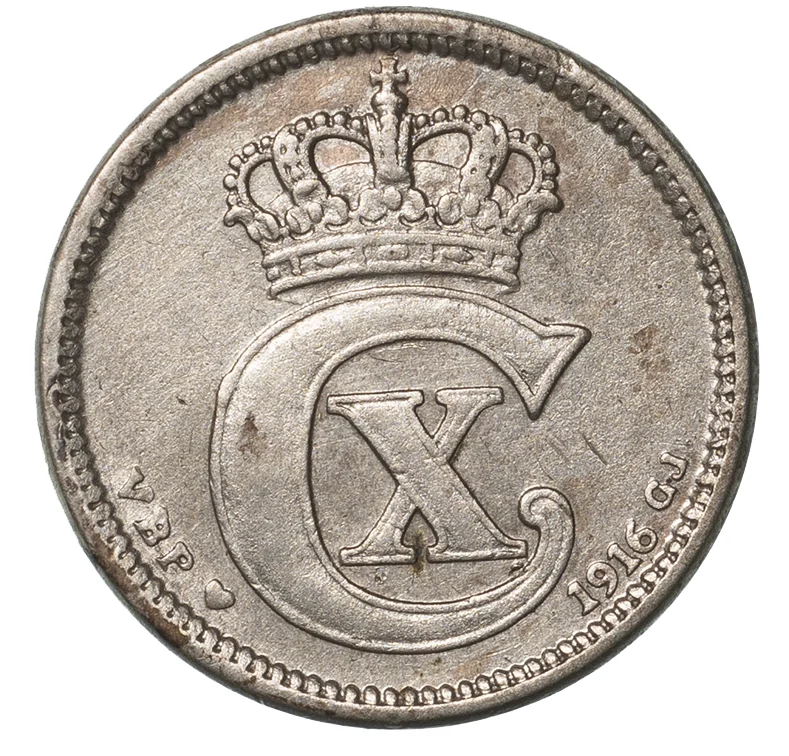
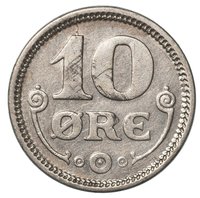
Monogram of King Christian X of Denmark (1912–1947).
Inscription:
CX
HCN ♥ 1919 GJ
HCN ♥ 1919 GJ
Translation:
HCN ♥ 1919 GJ
Script: Latin
Engraver: Knud Gunnar Jensen
Edge
Plain
Mints
| Name | Mark |
|---|---|
| Royal Danish Mint | — |
Mintings
| Year | Mint Mark | Mintage | Quality | Collection |
|---|---|---|---|---|
| 1914 | VBP♥;GJ | 2,128,000 | ||
| 1915 | VBP♥;GJ | 915,000 | ||
| 1916 | VBP♥;GJ | 2,699,000 | ||
| 1917 | VBP♥;GJ | 6,003,000 | ||
| 1918 | VBP♥;GJ | 5,042,000 | ||
| 1919 | HCN♥;GJ | 10,184,000 |
Historical background
In 1914, Denmark was part of the Scandinavian Monetary Union (SMU), established in 1873 with Sweden and joined by Norway in 1875. This union created a fixed exchange rate system where the Danish krone, Swedish krona, and Norwegian krone were all defined by the same gold standard and were legally accepted as means of payment across all three countries. The system functioned smoothly for decades, facilitating trade and economic stability by effectively creating a single currency area in Scandinavia, with Danish coins circulating freely in Sweden and vice versa.
The outbreak of World War I in August 1914 triggered an immediate financial crisis across Europe. Like other nations, Denmark faced a sudden surge in demand for gold and hard currency, leading to a severe liquidity shortage. To prevent a run on its gold reserves and the collapse of its banking system, the Danish government swiftly suspended the gold standard on August 2, 1914. This decisive action made the Danish krone an inconvertible paper currency, meaning it could no longer be freely exchanged for gold. While this protected the nation's reserves, it also technically broke the core principle of the Scandinavian Monetary Union.
Consequently, the pre-war currency situation was fundamentally and permanently altered. The suspension of gold convertibility ended the automatic fixed exchange rate mechanism within the SMU. Although the union was not formally dissolved until later, its practical function ceased in 1914. Denmark, now with a managed paper currency, entered a period of controlled finance, with the Nationalbanken gaining greater authority to manage the money supply and exchange rates in response to the turbulent wartime economy, marking the end of a forty-year era of monetary integration.
The outbreak of World War I in August 1914 triggered an immediate financial crisis across Europe. Like other nations, Denmark faced a sudden surge in demand for gold and hard currency, leading to a severe liquidity shortage. To prevent a run on its gold reserves and the collapse of its banking system, the Danish government swiftly suspended the gold standard on August 2, 1914. This decisive action made the Danish krone an inconvertible paper currency, meaning it could no longer be freely exchanged for gold. While this protected the nation's reserves, it also technically broke the core principle of the Scandinavian Monetary Union.
Consequently, the pre-war currency situation was fundamentally and permanently altered. The suspension of gold convertibility ended the automatic fixed exchange rate mechanism within the SMU. Although the union was not formally dissolved until later, its practical function ceased in 1914. Denmark, now with a managed paper currency, entered a period of controlled finance, with the Nationalbanken gaining greater authority to manage the money supply and exchange rates in response to the turbulent wartime economy, marking the end of a forty-year era of monetary integration.
🌱 Common