

1 Cent – Newfoundland
Canada
Context
Years: 1913–1936
Country: Canada 
Issuer: Newfoundland
Ruler: George V
Currency:
(1865—1949)
Total mintage: 2,304,534
Material
References
KM: #Click to copy to clipboard16
Numista: #1006
Value
Exchange value: 0.01 NFD
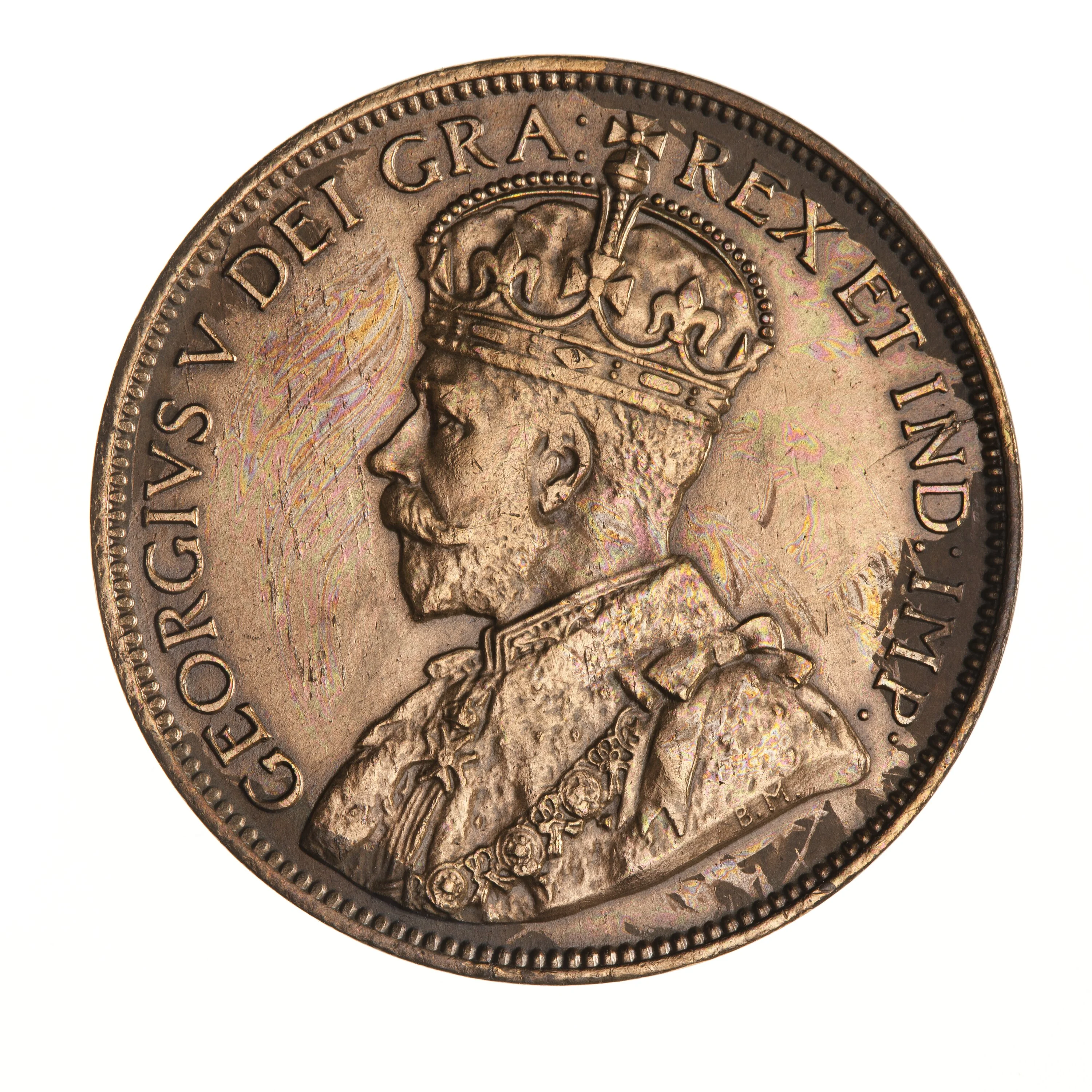
Obverse
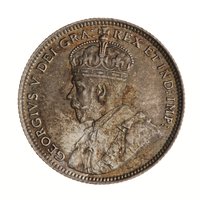
Description:
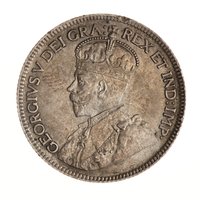
King George V, crowned, facing left.
Inscription:
GEORGIVS V DEI GRA: REX ET IND: IMP:
Translation:
George V by the Grace of God: King and Emperor of India.
Script: Latin
Language: Latin
Engraver: Edgar Bertram MacKennal
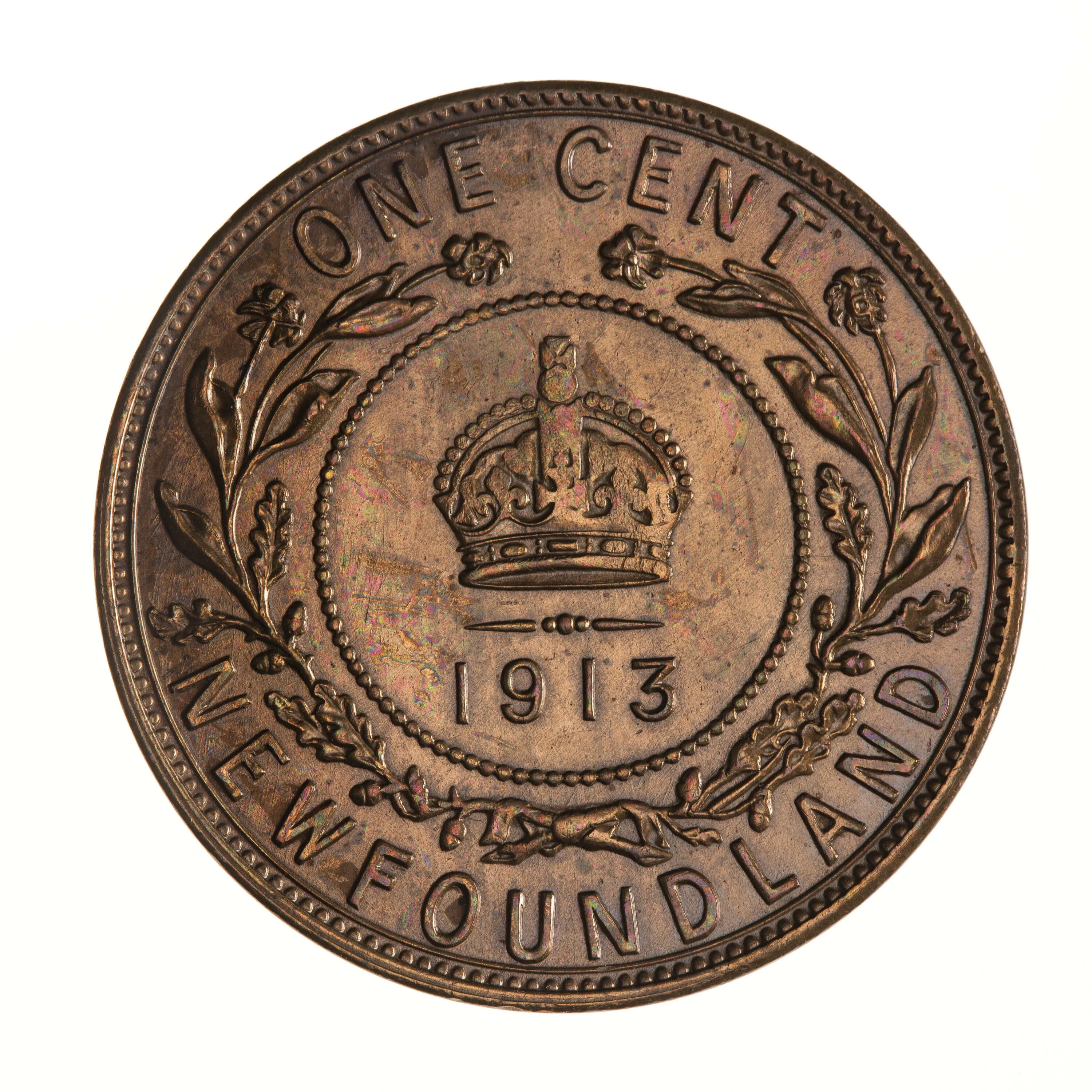
Reverse
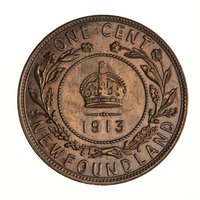
Description:
A garland of the island's emblematic purple pitcher plants and oak leaves encircles the Royal Crown and the year of issue.
Inscription:
ONE CENT
1936
NEWFOUNDLAND
1936
NEWFOUNDLAND
Script: Latin
Engraver: Horace Morehen
Edge
Plain
Mints
| Name | Mark |
|---|---|
| Royal Mint (Tower Hill) | — |
| Royal Canadian Mint of Ottawa | C |
Mintings
Historical background
In 1913, Newfoundland was a self-governing British Dominion with its own currency, a situation rooted in its history as a fishing colony and its establishment of a local legislature in 1832. The official currency was the Newfoundland dollar, pegged at par with the Canadian dollar and the U.S. dollar under a gold exchange standard. However, in practice, a complex mix of coins and banknotes circulated. British sovereigns and half-sovereigns were legal tender, and Spanish and Portuguese gold coins from earlier trade still held value, while Canadian and U.S. banknotes were widely accepted and commonly used in everyday commerce, especially near the coast.
This monetary environment was a reflection of the island's economic ties and vulnerabilities. Newfoundland's economy was heavily dependent on the export of salt cod, with markets in Europe, the Caribbean, and Brazil, and imports coming largely from Canada, the United Kingdom, and the United States. The circulation of multiple currencies facilitated this international trade but also highlighted a lack of strong central banking. The government issued its own notes and coins, but several private commercial banks also issued their own banknotes, leading to a fragmented system where the public's confidence in paper money could be uneven.
Beneath this seemingly stable 1913 picture lay significant fiscal pressures that would soon prove catastrophic. The government, led by Prime Minister Edward Morris, was engaged in ambitious and expensive railway and development projects, funded by heavy borrowing on London money markets. While not yet a crisis in 1913, the territory's public debt was rising sharply, and its economy remained dangerously undiversified. Within a year, the outbreak of World War I would disrupt global trade, and by the 1930s, the collapse of the fish trade and the burden of debt would lead to the suspension of responsible government and a commission of administration, with the currency question ultimately resolved by confederation with Canada in 1949.
This monetary environment was a reflection of the island's economic ties and vulnerabilities. Newfoundland's economy was heavily dependent on the export of salt cod, with markets in Europe, the Caribbean, and Brazil, and imports coming largely from Canada, the United Kingdom, and the United States. The circulation of multiple currencies facilitated this international trade but also highlighted a lack of strong central banking. The government issued its own notes and coins, but several private commercial banks also issued their own banknotes, leading to a fragmented system where the public's confidence in paper money could be uneven.
Beneath this seemingly stable 1913 picture lay significant fiscal pressures that would soon prove catastrophic. The government, led by Prime Minister Edward Morris, was engaged in ambitious and expensive railway and development projects, funded by heavy borrowing on London money markets. While not yet a crisis in 1913, the territory's public debt was rising sharply, and its economy remained dangerously undiversified. Within a year, the outbreak of World War I would disrupt global trade, and by the 1930s, the collapse of the fish trade and the burden of debt would lead to the suspension of responsible government and a commission of administration, with the currency question ultimately resolved by confederation with Canada in 1949.
🌱 Common