

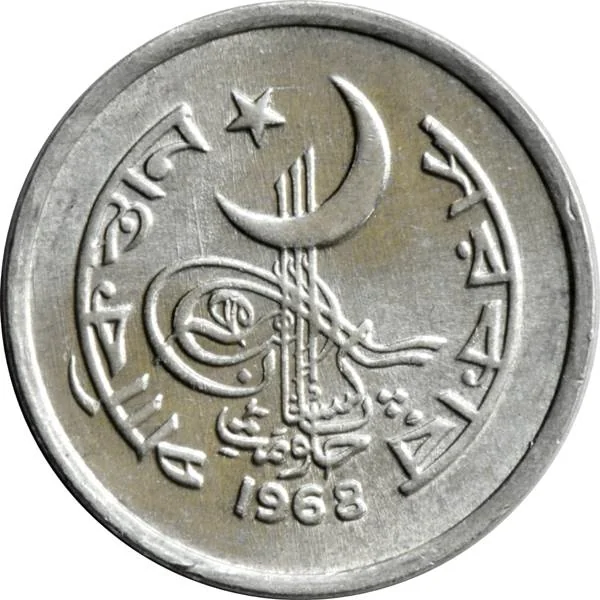

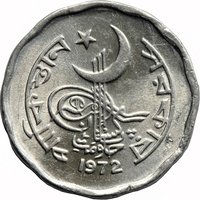
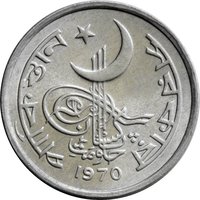
Obverse
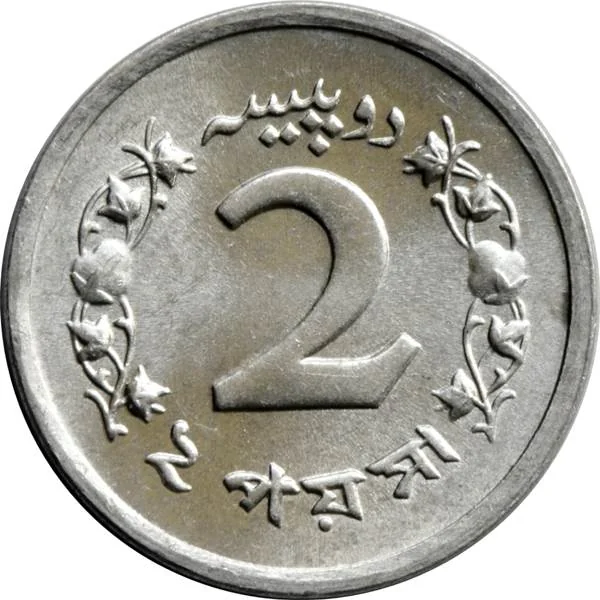
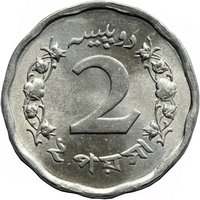
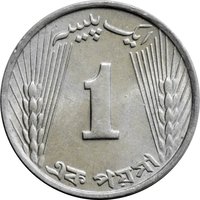
Reverse
Edge
Plain
Mintings
| Year | Mint Mark | Mintage | Quality | Collection |
|---|---|---|---|---|
| 1966 | — | 11,940,000 | ||
| 1967 | — | 73,970,000 | ||
| 1968 | — | 56,570,000 |
Historical background
In 1966, Pakistan's currency situation was characterized by relative stability under a fixed exchange rate regime, pegged to the British Pound Sterling as part of the Bretton Woods system. The Pakistani rupee, managed by the State Bank of Pakistan, was officially valued at 4.76 rupees to one U.S. dollar, a parity established in 1955. This period followed a decade of significant industrialization and economic growth during the Ayub Khan era, which bolstered foreign exchange reserves through increased exports, particularly of jute and cotton textiles, and substantial inflows of foreign aid.
However, underlying pressures were beginning to strain this stability. The economic model, while successful in generating growth, led to rising income inequality and regional disparities. More critically for the currency, the cost of the 1965 war with India had imposed a heavy burden on the economy, leading to increased defense spending and a disruption of trade. While the immediate devaluation would not occur until 1971, the war's aftermath in 1966 marked the start of a gradual erosion in the country's fiscal and external account position, setting the stage for future balance of payments difficulties.
Furthermore, Pakistan's currency was still a unified legal tender across both East and West Pakistan in 1966. The economic and political discontent in East Pakistan, which stemmed from grievances over the allocation of foreign exchange and development resources, was intensifying. This centralization of monetary policy and foreign exchange allocation in West Pakistan became a significant point of contention, contributing to the regional tensions that would eventually lead to the creation of Bangladesh in 1971 and the subsequent division of the currency.
However, underlying pressures were beginning to strain this stability. The economic model, while successful in generating growth, led to rising income inequality and regional disparities. More critically for the currency, the cost of the 1965 war with India had imposed a heavy burden on the economy, leading to increased defense spending and a disruption of trade. While the immediate devaluation would not occur until 1971, the war's aftermath in 1966 marked the start of a gradual erosion in the country's fiscal and external account position, setting the stage for future balance of payments difficulties.
Furthermore, Pakistan's currency was still a unified legal tender across both East and West Pakistan in 1966. The economic and political discontent in East Pakistan, which stemmed from grievances over the allocation of foreign exchange and development resources, was intensifying. This centralization of monetary policy and foreign exchange allocation in West Pakistan became a significant point of contention, contributing to the regional tensions that would eventually lead to the creation of Bangladesh in 1971 and the subsequent division of the currency.
🌱 Common