

10 Francs CFA – Central African States
Context
Years: 1965–1972
Issuer: Central African States
Issuing organization: Central Bank of Equatorial African States and Cameroon
Currency:
(1961—1973)
Total mintage: 32,000,000
Material
Diameter: 23.5 mm
Weight: 4 g
Thickness: 1.3 mm
Shape: Round
Composition: Aluminium-nickel-bronze
Technique: Milled
Alignment: Coin alignment
flip
References
KM: #Click to copy to clipboard2a
Numista: #10059
Value
Exchange value: 10 FCFA
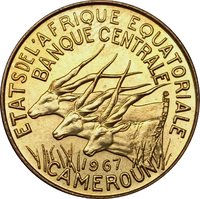
Obverse
Description:
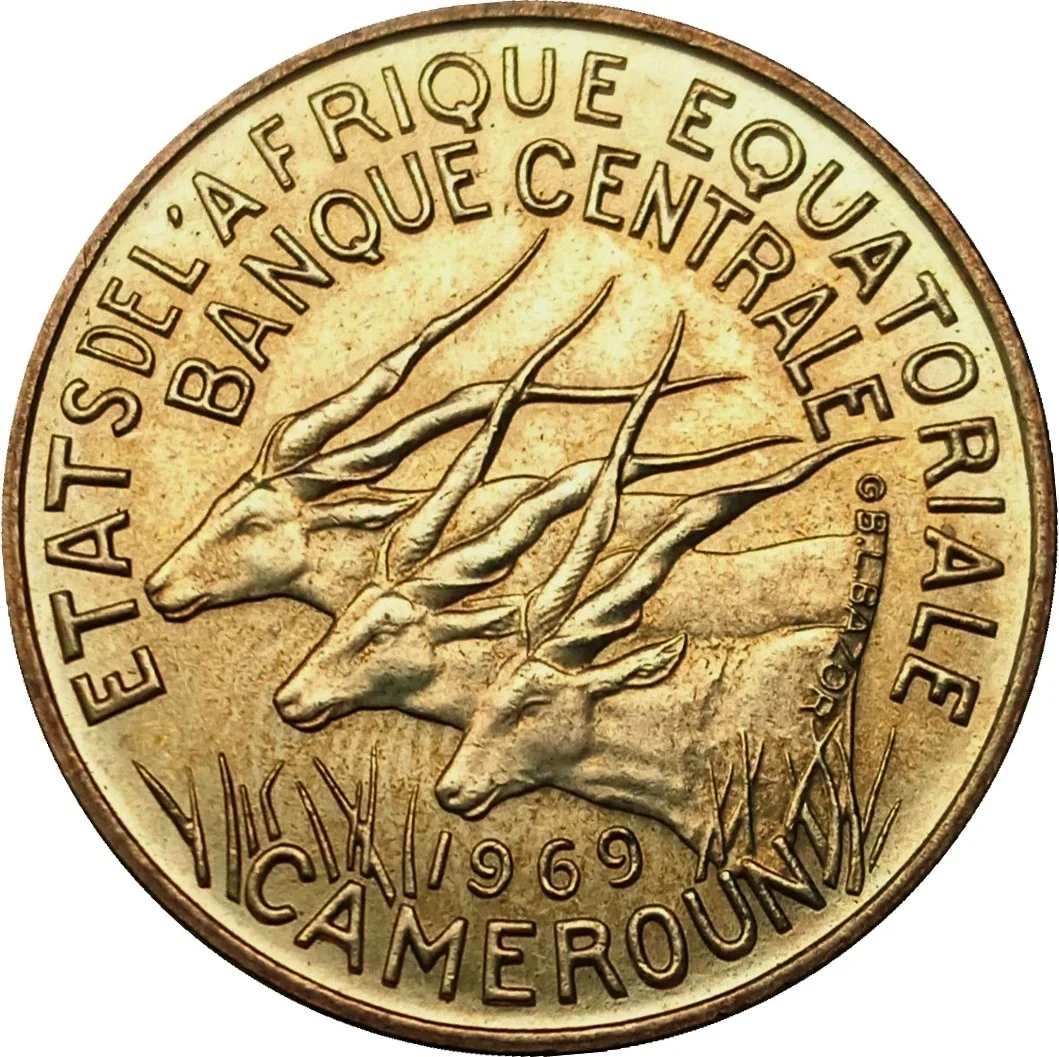
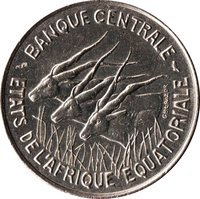
Three giant elands remain.
Inscription:
ETATS DE L'AFRIQUE EQUATORIALE
BANQUE CENTRALE
G.B.L.BAZOR
1969
CAMEROUN
BANQUE CENTRALE
G.B.L.BAZOR
1969
CAMEROUN
Translation:
States of Equatorial Africa
Central Bank
G.B.L.BAZOR
1969
Cameroon
Central Bank
G.B.L.BAZOR
1969
Cameroon
Script: Latin
Language: French
Engravers: Gabriel Bernard, Lucien Bazor
Reverse
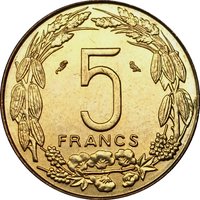
Description:
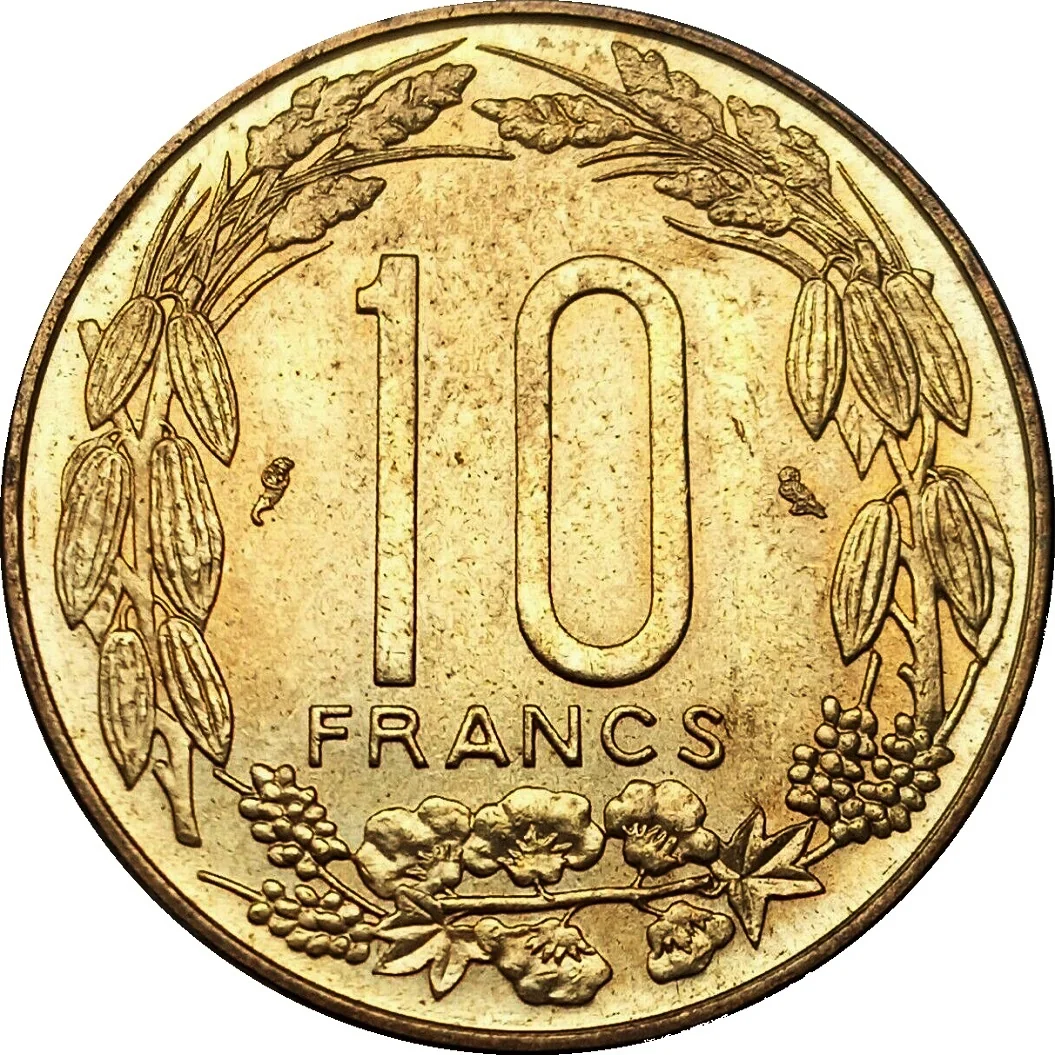
Wreath of major Cameroonian crops: cotton, coffee, cocoa, and grains.
Inscription:
10
FRANCS
FRANCS
Script: Latin
Engravers: Gabriel Bernard, Lucien Bazor
Edge
Plain
Categories
| Agriculture |
| Symbol> Wreath |
Mints
| Name | Mark |
|---|---|
| Monnaie de Paris | — |
Mintings
| Year | Mint Mark | Mintage | Quality | Collection |
|---|---|---|---|---|
| 1965 | — | 7,000,000 | ||
| 1967 | — | 10,000,000 | ||
| 1969 | — | 10,000,000 | ||
| 1972 | — | 5,000,000 |
Historical background
In 1965, the currency situation in the Central African States was defined by the newly established Central African CFA franc (XAF), which had been created just five years prior. This currency was issued by the Banque Centrale des États de l'Afrique Équatoriale et du Cameroun (BCEAEC), serving the former French Equatorial Africa territories: Chad, the Central African Republic, the Republic of the Congo, and Gabon, along with Cameroon. The system was a direct legacy of colonial monetary policy, designed to ensure stability and facilitate continued economic integration with France through the CFA franc zone.
The key feature of the arrangement was the fixed parity and guarantee provided by the French Treasury. The CFA franc was pegged at 1 CFA franc = 0.02 French francs (or 50 CFA francs = 1 French franc). This peg was backed by an operating account held in Paris, which required member states to deposit a significant portion of their foreign exchange reserves with France, in return for an unlimited convertibility guarantee. This provided monetary stability and low inflation for the member states but also meant they had surrendered direct control over their monetary policy and external reserves to a foreign power.
Politically and economically, 1965 fell within a period of early post-independence, where these nations were grappling with the dual objectives of sovereign economic management and the practical benefits of a stable, shared currency. While the system facilitated regional trade and attracted some French investment, it was also a point of contention for emerging nationalist sentiments, which viewed the fixed parity and French oversight as a limitation on financial sovereignty and a symbol of continued Françafrique influence. Thus, the currency situation was one of institutionalized stability, but also a foundational element in the ongoing debate about economic dependency and regional cooperation in Central Africa.
The key feature of the arrangement was the fixed parity and guarantee provided by the French Treasury. The CFA franc was pegged at 1 CFA franc = 0.02 French francs (or 50 CFA francs = 1 French franc). This peg was backed by an operating account held in Paris, which required member states to deposit a significant portion of their foreign exchange reserves with France, in return for an unlimited convertibility guarantee. This provided monetary stability and low inflation for the member states but also meant they had surrendered direct control over their monetary policy and external reserves to a foreign power.
Politically and economically, 1965 fell within a period of early post-independence, where these nations were grappling with the dual objectives of sovereign economic management and the practical benefits of a stable, shared currency. While the system facilitated regional trade and attracted some French investment, it was also a point of contention for emerging nationalist sentiments, which viewed the fixed parity and French oversight as a limitation on financial sovereignty and a symbol of continued Françafrique influence. Thus, the currency situation was one of institutionalized stability, but also a foundational element in the ongoing debate about economic dependency and regional cooperation in Central Africa.
🌱 Very Common