

200 Shillings – Uganda
Uganda
Context
Years: 1998–2003
Issuer: Uganda 
Issuing organization: Bank of Uganda
Period:
(since 1962)
Currency:
(since 1987)
Material
Diameter: 24.9 mm
Weight: 8.05 g
Thickness: 2.05 mm
Shape: Round
Composition: Copper-nickel
Magnetic: No
Technique: Milled
Alignment: Medal alignment
flip
References
KM: #Click to copy to clipboard68
Numista: #5553
Value
Exchange value: 200 UGX
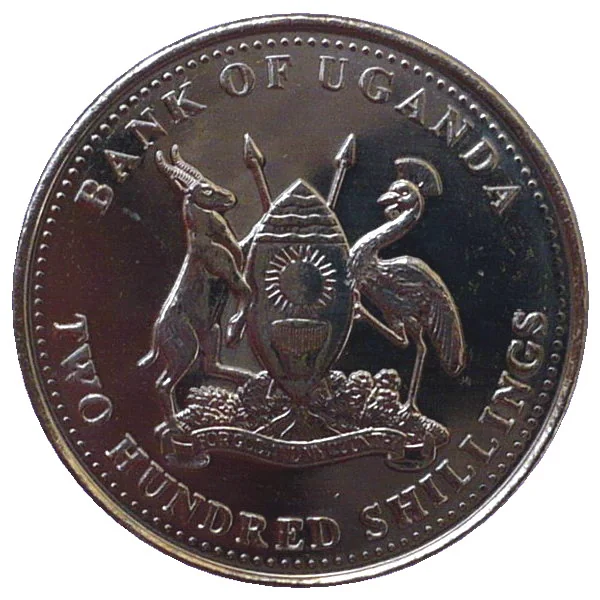
Obverse
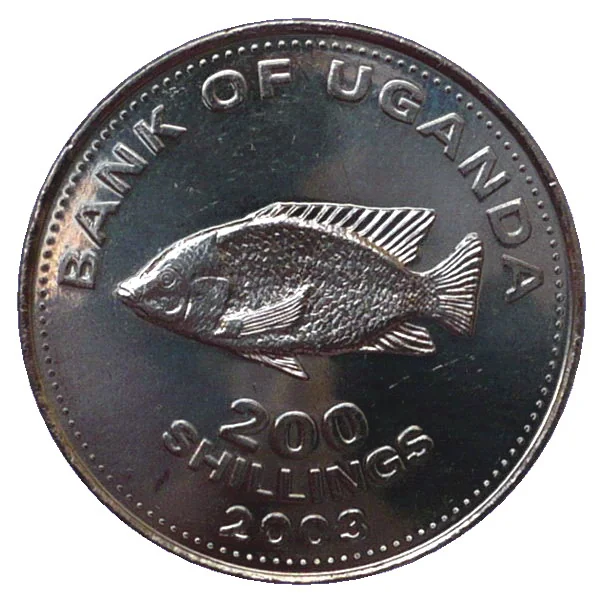
Reverse
Description:
Cichlid facing left.
Inscription:
BANK OF UGANDA
200
SHILLINGS
2003
200
SHILLINGS
2003
Script: Latin
Engraver: Stan Witten
Edge
Plain
Categories
| Animal> Fish |
| Symbols> Coat of Arms |
Mints
| Name | Mark |
|---|---|
| Royal Canadian Mint of Winnipeg | — |
Mintings
| Year | Mint Mark | Mintage | Quality | Collection |
|---|---|---|---|---|
| 1998 | — | — | ||
| 2003 | — | — |
Historical background
In 1998, Uganda's currency situation was characterized by a period of relative stability and cautious optimism under the guidance of the Bank of Uganda, a significant achievement following a decade of profound economic turmoil. The Ugandan shilling (UGX) operated under a managed float exchange rate regime, where its value was determined by market forces within an interbank market, but with the central bank intervening to smooth out excessive volatility. This system, established after the liberalization reforms of the early 1990s, had succeeded in curbing the rampant hyperinflation of the late 1980s, with inflation reduced to single digits by 1998. The shilling experienced a gradual and controlled depreciation against major currencies like the US dollar, a trend considered manageable and reflective of underlying economic fundamentals rather than a loss of confidence.
This stability was underpinned by Uganda's ongoing engagement with international financial institutions, notably the IMF's Poverty Reduction and Growth Facility (PRGF). Continued structural adjustment programs encouraged fiscal discipline, promoted export growth (primarily from coffee, which was recovering from a price crash in the late 80s/early 90s), and attracted foreign investment. Consequently, foreign exchange reserves were being slowly rebuilt, providing a buffer for the shilling. However, the economy remained vulnerable to external shocks, particularly fluctuations in global coffee prices and the lingering economic impact of Uganda's involvement in the conflict in the Democratic Republic of the Congo, which began in 1998 and imposed a significant fiscal burden.
Despite macroeconomic progress, challenges persisted at a structural level. The formal foreign exchange market was still developing, with a gap existing between the official interbank rate and rates in the informal market. Dollarization, though declining, remained a feature of the economy, as some businesses and individuals still held savings in foreign currency as a hedge against potential future instability. Furthermore, the benefits of currency stability were not evenly distributed, with rural areas and populations less integrated into the formal banking system experiencing limited direct impact. Thus, 1998 represented a year of consolidated stability for the Ugandan shilling, but within a context of fragile, post-reform recovery and ongoing structural vulnerabilities.
This stability was underpinned by Uganda's ongoing engagement with international financial institutions, notably the IMF's Poverty Reduction and Growth Facility (PRGF). Continued structural adjustment programs encouraged fiscal discipline, promoted export growth (primarily from coffee, which was recovering from a price crash in the late 80s/early 90s), and attracted foreign investment. Consequently, foreign exchange reserves were being slowly rebuilt, providing a buffer for the shilling. However, the economy remained vulnerable to external shocks, particularly fluctuations in global coffee prices and the lingering economic impact of Uganda's involvement in the conflict in the Democratic Republic of the Congo, which began in 1998 and imposed a significant fiscal burden.
Despite macroeconomic progress, challenges persisted at a structural level. The formal foreign exchange market was still developing, with a gap existing between the official interbank rate and rates in the informal market. Dollarization, though declining, remained a feature of the economy, as some businesses and individuals still held savings in foreign currency as a hedge against potential future instability. Furthermore, the benefits of currency stability were not evenly distributed, with rural areas and populations less integrated into the formal banking system experiencing limited direct impact. Thus, 1998 represented a year of consolidated stability for the Ugandan shilling, but within a context of fragile, post-reform recovery and ongoing structural vulnerabilities.
Series: 1998 series
🌱 Very Common