

5 drachmai – Greece
Add to wishlist
Greece
Context
Years: 1976–1980
Issuer: Greece
Period:
(since 1974)
Currency:
(1954—2001)
Demonetization: 28 February 2002
Total mintage: 136,312,000
Material
References
KM: #
Numista: #554
Value
Exchange value: 5 GRD
Inflation-adjusted value: 241.66 GRD
Obverse
Description:
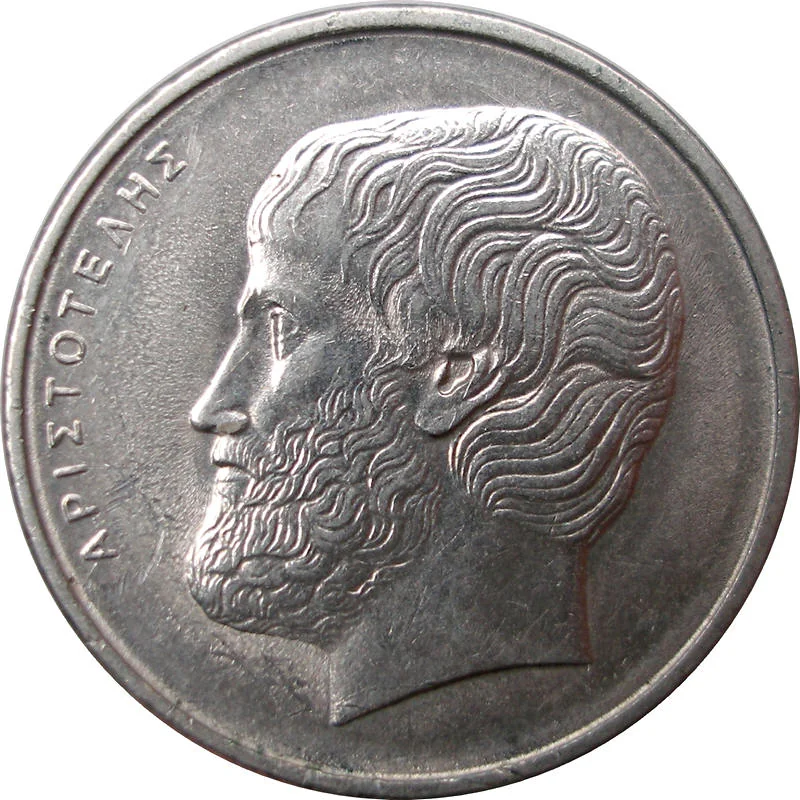
Aristotle (384–322 BC), Greek philosopher, scientist, student of Plato, and teacher of Alexander the Great. The Encyclopædia Britannica calls him "the first genuine scientist in history."
Inscription:
ΑΡΙΣΤΟΤΕΛΗΣ
Translation:
Aristoteles
Script: Greek
Language: Ancient Greek
Engraver: Th. Papagiannis
Reverse
Description:
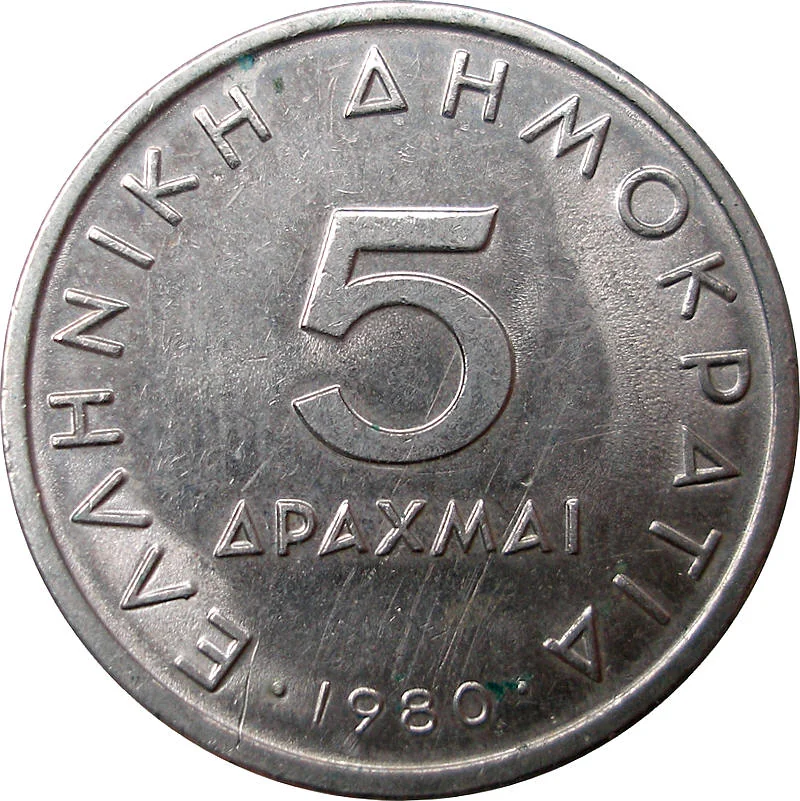
Denomination and date below.
Inscription:
ΕΛΛΗΝΙΚΗ ΔΗΜΟΚΡΑΤΙΑ
5 ΔΡΑΧΜΑΙ
• 1980 •
5 ΔΡΑΧΜΑΙ
• 1980 •
Translation:
HELLENIC REPUBLIC
5 DRACHMAS
• 1980 •
5 DRACHMAS
• 1980 •
Script: Greek
Language: Greek
Engraver: Th. Papagiannis
Edge
Plain
Categories
| Person> Philosopher |
Mints
| Name | Mark |
|---|---|
| National Mint of the Bank of Greece | — |
Mintings
| Year | Mint Mark | Mintage | Quality | Collection |
|---|---|---|---|---|
| 1976 | — | 85,187,000 | ||
| 1978 | — | 17,404,000 | ||
| 1978 | — | 20,000 | Proof | |
| 1980 | — | 33,701,000 |
Historical background
In 1976, Greece was navigating a complex currency situation shaped by its post-dictatorship political transition and broader economic instability. The country was still using the drachma, a currency with a long history but one that had suffered from chronic devaluation and high inflation, exacerbated by the 1973 oil crisis and domestic political turmoil following the fall of the military junta in 1974. The government of Prime Minister Konstantinos Karamanlis, focused on stabilizing the economy and pursuing European integration, faced the challenge of managing a currency that lacked credibility in international markets and was subject to strict capital controls to prevent flight.
A pivotal event of that year was the major devaluation of the drachma by 15% in January 1976. This was a deliberate policy move, agreed with the International Monetary Fund (IMF), aimed at addressing Greece's widening trade deficit and boosting the competitiveness of its exports, particularly in agriculture and shipping. The devaluation was part of a broader austerity package intended to correct macroeconomic imbalances, but it also immediately increased the cost of imports, contributing to domestic inflationary pressures that eroded purchasing power.
This currency environment occurred within the critical context of Greece's formal application for membership in the European Economic Community (EEC) in June 1975. A key long-term objective for the Greek state was to align its economy with European partners, which implied a future need for greater drachma stability and, ultimately, participation in a European exchange rate mechanism. Therefore, the 1976 devaluation was a painful but calculated short-term adjustment, with the hope of achieving longer-term economic stability and securing Greece's path toward European integration, which would fundamentally reshape its monetary future decades later.
A pivotal event of that year was the major devaluation of the drachma by 15% in January 1976. This was a deliberate policy move, agreed with the International Monetary Fund (IMF), aimed at addressing Greece's widening trade deficit and boosting the competitiveness of its exports, particularly in agriculture and shipping. The devaluation was part of a broader austerity package intended to correct macroeconomic imbalances, but it also immediately increased the cost of imports, contributing to domestic inflationary pressures that eroded purchasing power.
This currency environment occurred within the critical context of Greece's formal application for membership in the European Economic Community (EEC) in June 1975. A key long-term objective for the Greek state was to align its economy with European partners, which implied a future need for greater drachma stability and, ultimately, participation in a European exchange rate mechanism. Therefore, the 1976 devaluation was a painful but calculated short-term adjustment, with the hope of achieving longer-term economic stability and securing Greece's path toward European integration, which would fundamentally reshape its monetary future decades later.
Series: 1976 Greece circulation coins
🌱 Very Common