

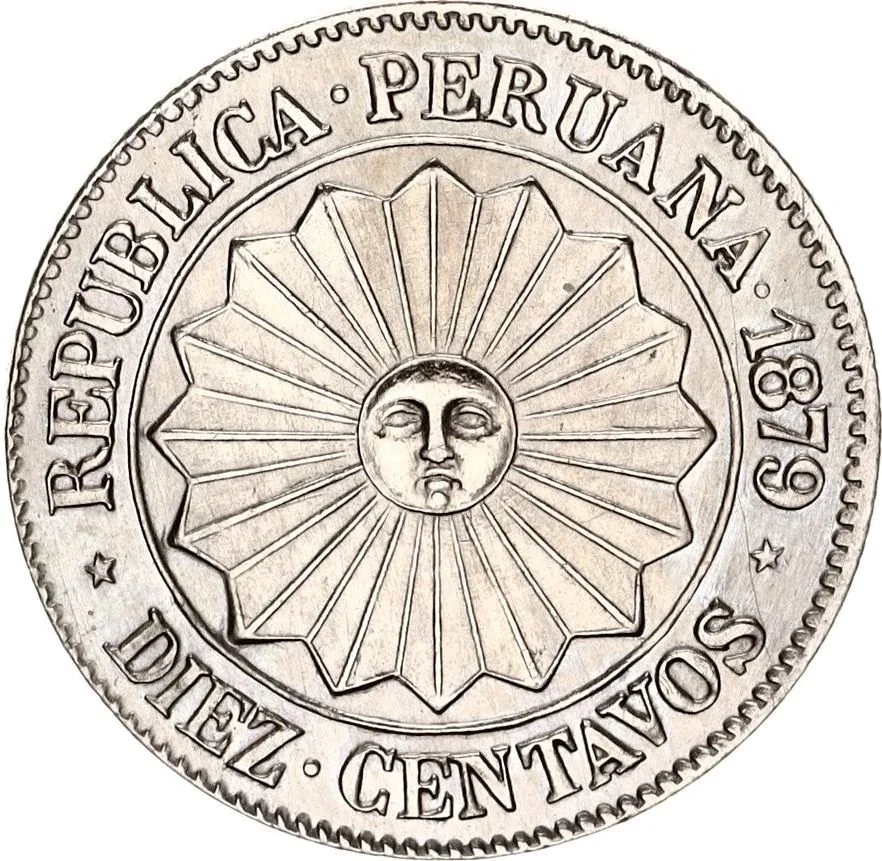
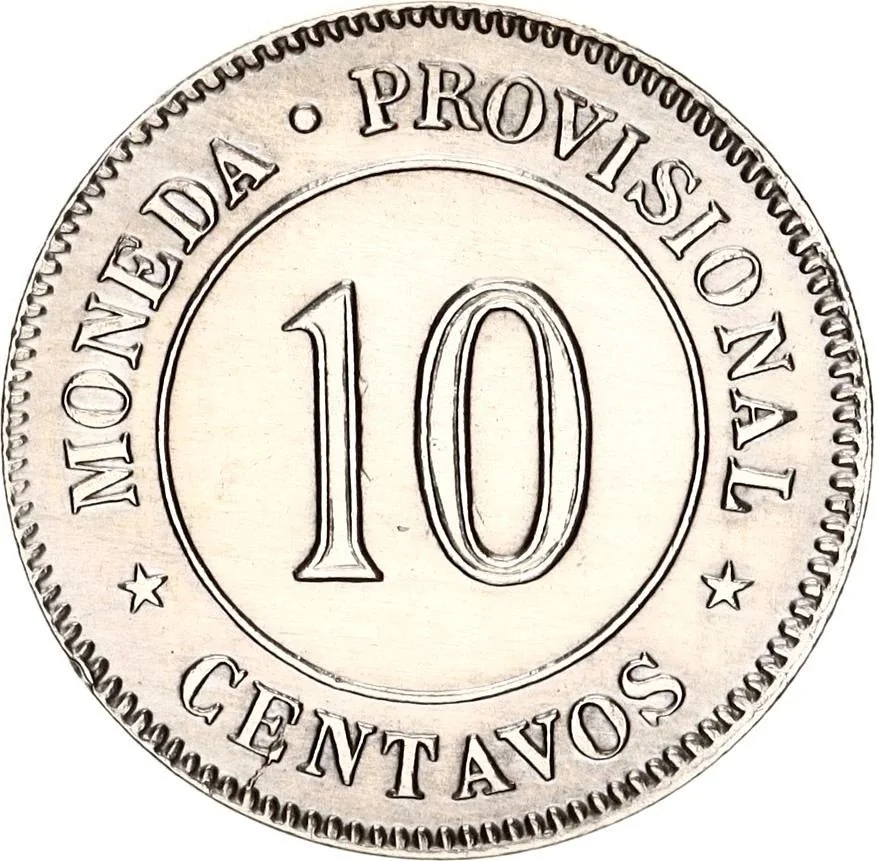
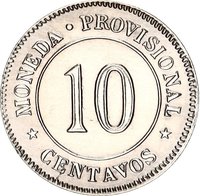
10 Centavos – Peru
Peru
Context
Material
Diameter: 22 mm
Weight: 5 g
Thickness: 1.6 mm
Shape: Round
Composition: Copper-nickel
Technique: Milled
Alignment: Coin alignment
flip
References
KM: #Click to copy to clipboard198
Numista: #5529
Value
Exchange value: 0.10 PEH
Obverse
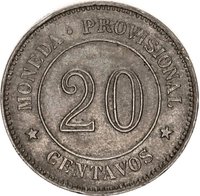
Reverse
Edge
ReededEstriado
Mints
| Name | Mark |
|---|---|
| Royal Mint of Belgium | — |
Mintings
| Year | Mint Mark | Mintage | Quality | Collection |
|---|---|---|---|---|
| 1879 | — | 3,005,000 | ||
| 1880 | — | 4,000,000 | ||
| 1880 | — | — | Proof |
Historical background
In 1879, Peru found itself on the brink of the War of the Pacific, a conflict that would catastrophically define its financial and monetary situation. The national currency, the Peruvian sol, was already under significant strain. Decades of heavy borrowing, particularly to finance railroad construction and other state projects, had led to substantial foreign debt and budget deficits. The government, led by President Mariano Ignacio Prado, was struggling to maintain convertibility and confidence in the sol, which was backed by a silver standard in an era of globally declining silver prices.
The immediate pre-war monetary landscape was characterized by a scarcity of hard currency (specie) in circulation. To address this, the government and private banks increasingly relied on the emission of paper money, known as billetes fiscales (treasury notes) and banknotes. However, these issues were not always fully convertible to silver, leading to a de facto separation between the value of paper money and metal coinage. This created a complex and unstable system with multiple types of circulating media, including silver soles, fractional coinage, and paper of questionable value, which eroded public trust.
Consequently, as Peru mobilized for war against Chile in early 1879, its fiscal foundation was already precarious. The state's ability to finance a major military campaign was severely limited by its empty coffers, existing debt obligations, and an unstable currency. The massive wartime expenditures that followed would quickly exhaust reserves, leading to the suspension of specie payments and the unchecked printing of paper money, setting the stage for the hyperinflation and monetary collapse that would devastate the Peruvian economy throughout and long after the war.
The immediate pre-war monetary landscape was characterized by a scarcity of hard currency (specie) in circulation. To address this, the government and private banks increasingly relied on the emission of paper money, known as billetes fiscales (treasury notes) and banknotes. However, these issues were not always fully convertible to silver, leading to a de facto separation between the value of paper money and metal coinage. This created a complex and unstable system with multiple types of circulating media, including silver soles, fractional coinage, and paper of questionable value, which eroded public trust.
Consequently, as Peru mobilized for war against Chile in early 1879, its fiscal foundation was already precarious. The state's ability to finance a major military campaign was severely limited by its empty coffers, existing debt obligations, and an unstable currency. The massive wartime expenditures that followed would quickly exhaust reserves, leading to the suspension of specie payments and the unchecked printing of paper money, setting the stage for the hyperinflation and monetary collapse that would devastate the Peruvian economy throughout and long after the war.
🌱 Common