

50 toea – Papua New Guinea
Add to wishlist
Circulating commemorative coins
Commemoration: IX South Pacific Games
Papua New Guinea
Context
Year: 1991
Issuer: Papua New Guinea
Ruler: Elizabeth II
Currency:
(since 1975)
Total mintage: 25,000
Material
Diameter: 30.2 mm
Weight: 13.8 g
Thickness: 2.4 mm
Shape: Heptagonal
Composition: Copper-nickel
Technique: Milled
Alignment: Medal alignment
flip
References
KM: #
Numista: #5526
Value
Exchange value: 0.50 PGK
Obverse
Description:
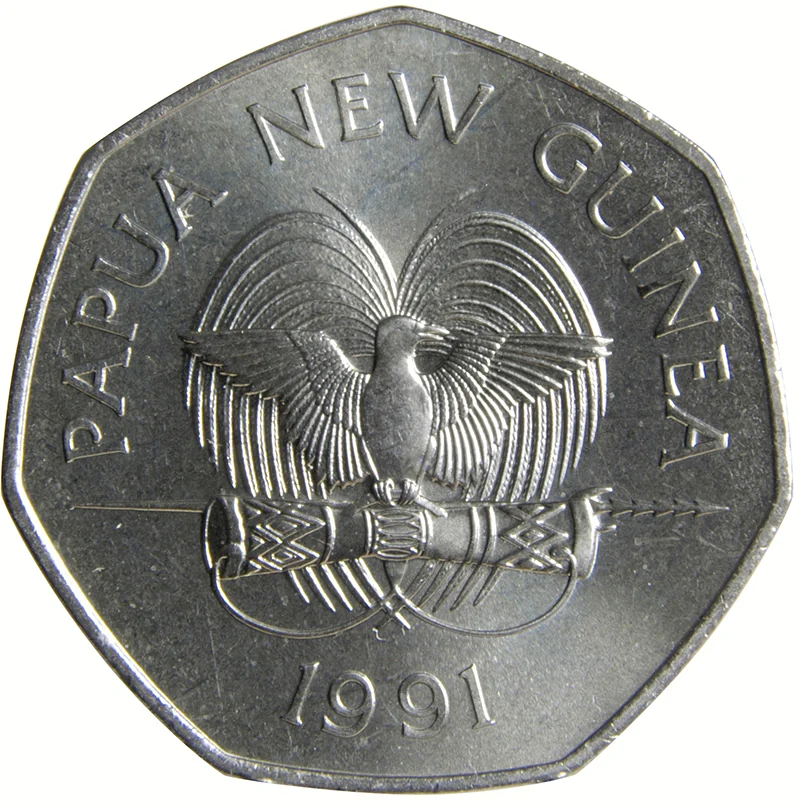
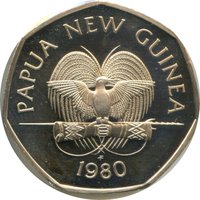
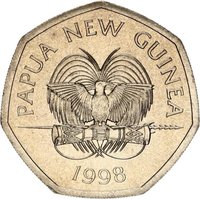
A bird-of-paradise over a spear and kundu drum.
Inscription:
PAPUA NEW GUINEA
1991
1991
Script: Latin
Reverse
Description:
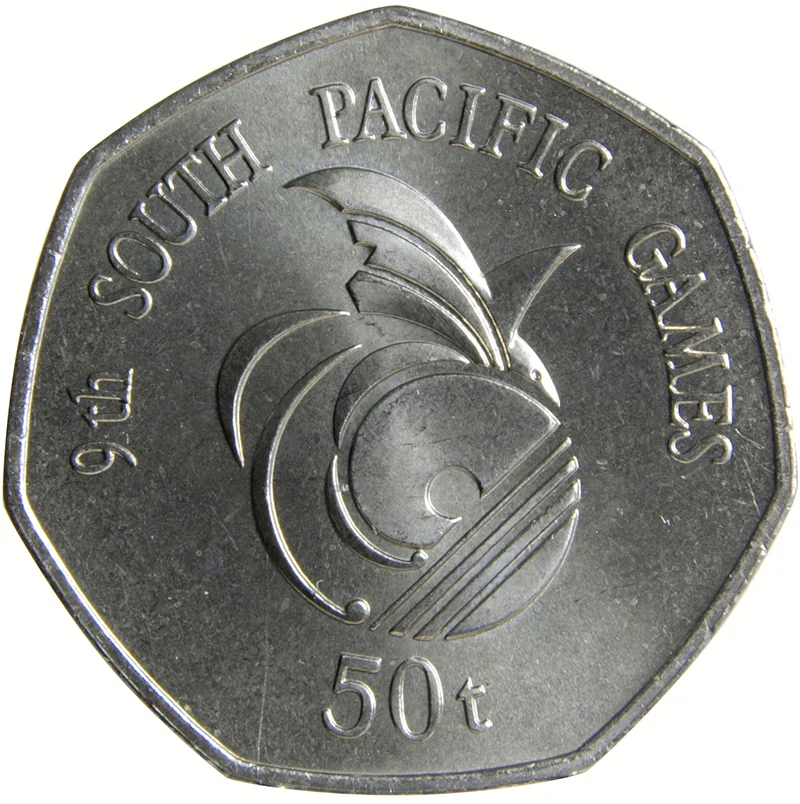
Stylized Bird of Paradise forming the number 9.
Inscription:
9th SOUTH PACIFIC GAMES
50t
50t
Script: Latin
Edge
Plain
Categories
| Object> Cold weapons |
| Animal> Bird |
| Art> Music |
| Symbols> Coat of Arms |
Mintings
| Year | Mint Mark | Mintage | Quality | Collection |
|---|---|---|---|---|
| 1991 | — | 25,000 |
Historical background
In 1991, Papua New Guinea's currency, the kina (PGK), was navigating a challenging period defined by the legacy of the 1990 economic crisis and ongoing structural adjustment pressures. The previous year had seen a severe balance of payments crisis, driven by a collapse in key export commodity prices (notably coffee and copper), civil unrest on Bougainville which shut the pivotal Panguna copper mine, and large fiscal deficits. In response, the government, under Prime Minister Rabbie Namaliu, had devalued the kina by 10% in 1990 and entered into a strict Structural Adjustment Program (SAP) with the World Bank and International Monetary Fund (IMF) to secure essential financing.
The core currency situation in 1991 was one of a managed float under intense strain, with the Bank of Papua New Guinea actively intervening to maintain stability amidst low foreign reserves. The SAP conditions mandated further economic liberalization, including trade reforms and public sector cuts, which created domestic political and social tension. While the devaluation aimed to improve export competitiveness and curb imports, it also contributed to rising inflation, squeezing household incomes. The government's struggle to control its budget deficit continued to place downward pressure on the kina's value.
Overall, 1991 was a year of consolidation and adjustment for the kina, rather than dramatic change. The currency was stabilising at its new, lower level as the government implemented unpopular austerity measures required by international lenders. The situation highlighted the kina's vulnerability to external commodity shocks and internal fiscal discipline, setting a precedent for the managed-float system's challenges in the decades to follow. The economic recovery remained fragile, deeply tied to the uncertain resolution of the Bougainville conflict and volatile global commodity markets.
The core currency situation in 1991 was one of a managed float under intense strain, with the Bank of Papua New Guinea actively intervening to maintain stability amidst low foreign reserves. The SAP conditions mandated further economic liberalization, including trade reforms and public sector cuts, which created domestic political and social tension. While the devaluation aimed to improve export competitiveness and curb imports, it also contributed to rising inflation, squeezing household incomes. The government's struggle to control its budget deficit continued to place downward pressure on the kina's value.
Overall, 1991 was a year of consolidation and adjustment for the kina, rather than dramatic change. The currency was stabilising at its new, lower level as the government implemented unpopular austerity measures required by international lenders. The situation highlighted the kina's vulnerability to external commodity shocks and internal fiscal discipline, setting a precedent for the managed-float system's challenges in the decades to follow. The economic recovery remained fragile, deeply tied to the uncertain resolution of the Bougainville conflict and volatile global commodity markets.
🌱 Common