

5 cents – Namibia
Add to wishlist
Namibia
Context
Years: 1993–2015
Issuer: Namibia
Issuing organization: Bank of Namibia
Period:
(since 1990)
Currency:
(since 1993)
Material
References
KM: #
Numista: #5518
Value
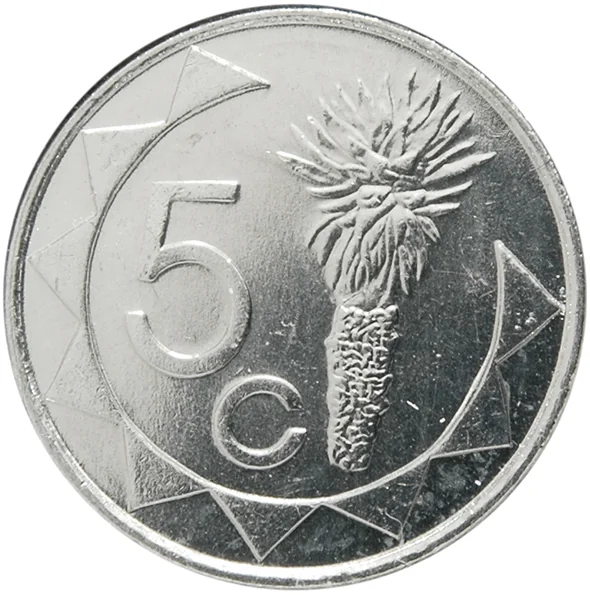
Exchange value: 0.05 NAD
Obverse
Description:
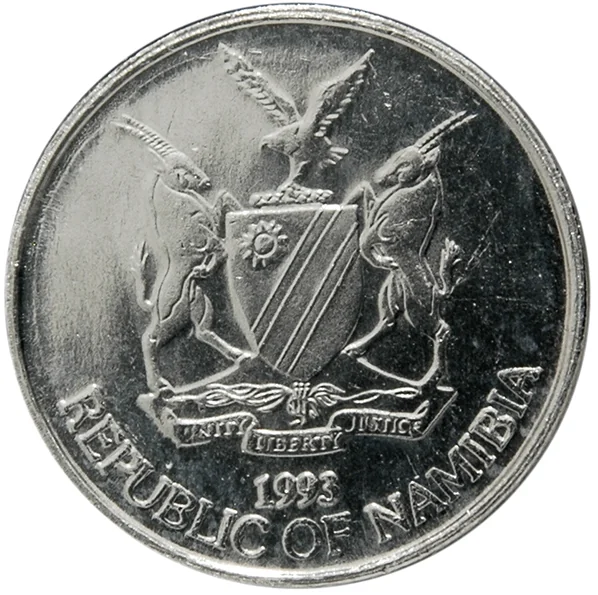
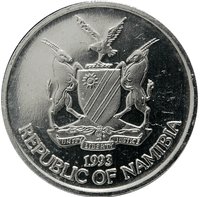
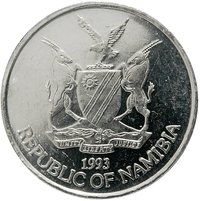
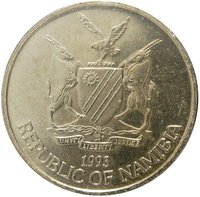
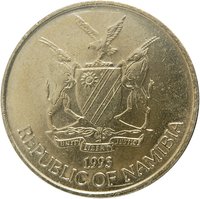
Namibia's arms above the date, above the country name.
Inscription:
UNITY LIBERTY JUSTICE
1993
REPUBLIC OF NAMIBIA
1993
REPUBLIC OF NAMIBIA
Script: Latin
Reverse
Edge
Plain
Mints
| Name | Mark |
|---|---|
| Mint of Finland | — |
Mintings
| Year | Mint Mark | Mintage | Quality | Collection |
|---|---|---|---|---|
| 1993 | — | — | ||
| 2002 | — | — | ||
| 2007 | — | — | ||
| 2009 | — | — | ||
| 2012 | — | — | ||
| 2015 | — | — |
Historical background
In 1993, Namibia's currency situation was defined by its continued use of the South African Rand, which had been the legal tender since the country's independence in 1990. This arrangement was formalized through the Common Monetary Area (CMA), which linked Namibia's monetary policy directly to that of South Africa. While this provided stability and facilitated trade with its dominant neighbor, it also meant Namibia had no independent monetary policy to address its own specific economic needs, such as high unemployment and a desire for greater economic sovereignty.
The year 1993 was pivotal as it marked the final preparations for the introduction of a distinct national currency. The Namibian Dollar (NAD) was established by the Bank of Namibia Act and the Namibian Dollar Act, with plans for it to be launched the following year. Crucially, it was designed to remain at par and fully interchangeable with the South African Rand, ensuring a seamless transition and maintaining the stability of the CMA agreement. This hybrid approach aimed to balance national identity with pragmatic economic continuity.
Therefore, the currency background of 1993 is one of a nation on the cusp of a symbolic economic milestone. The groundwork was complete: the Bank of Namibia was established as the central bank, the currency's design was finalized, and the legal framework was in place. The situation reflected a careful compromise—embracing the tangible symbol of sovereignty through a new currency while consciously retaining the economic safety and integration provided by its one-to-one peg to the Rand.
The year 1993 was pivotal as it marked the final preparations for the introduction of a distinct national currency. The Namibian Dollar (NAD) was established by the Bank of Namibia Act and the Namibian Dollar Act, with plans for it to be launched the following year. Crucially, it was designed to remain at par and fully interchangeable with the South African Rand, ensuring a seamless transition and maintaining the stability of the CMA agreement. This hybrid approach aimed to balance national identity with pragmatic economic continuity.
Therefore, the currency background of 1993 is one of a nation on the cusp of a symbolic economic milestone. The groundwork was complete: the Bank of Namibia was established as the central bank, the currency's design was finalized, and the legal framework was in place. The situation reflected a careful compromise—embracing the tangible symbol of sovereignty through a new currency while consciously retaining the economic safety and integration provided by its one-to-one peg to the Rand.
Series: 1993 Namibia circulation coins
🌱 Very Common