

10 Fils – Jordan
Jordan
Context
Years: 1955–1967
Issuer: Jordan 
Ruler: Hussein bin Talal
Currency:
(since 1949)
Total mintage: 7,118,000
Material
References
KM: #Click to copy to clipboard10
Numista: #5486
Value
Exchange value: 0.010 JOD
Obverse
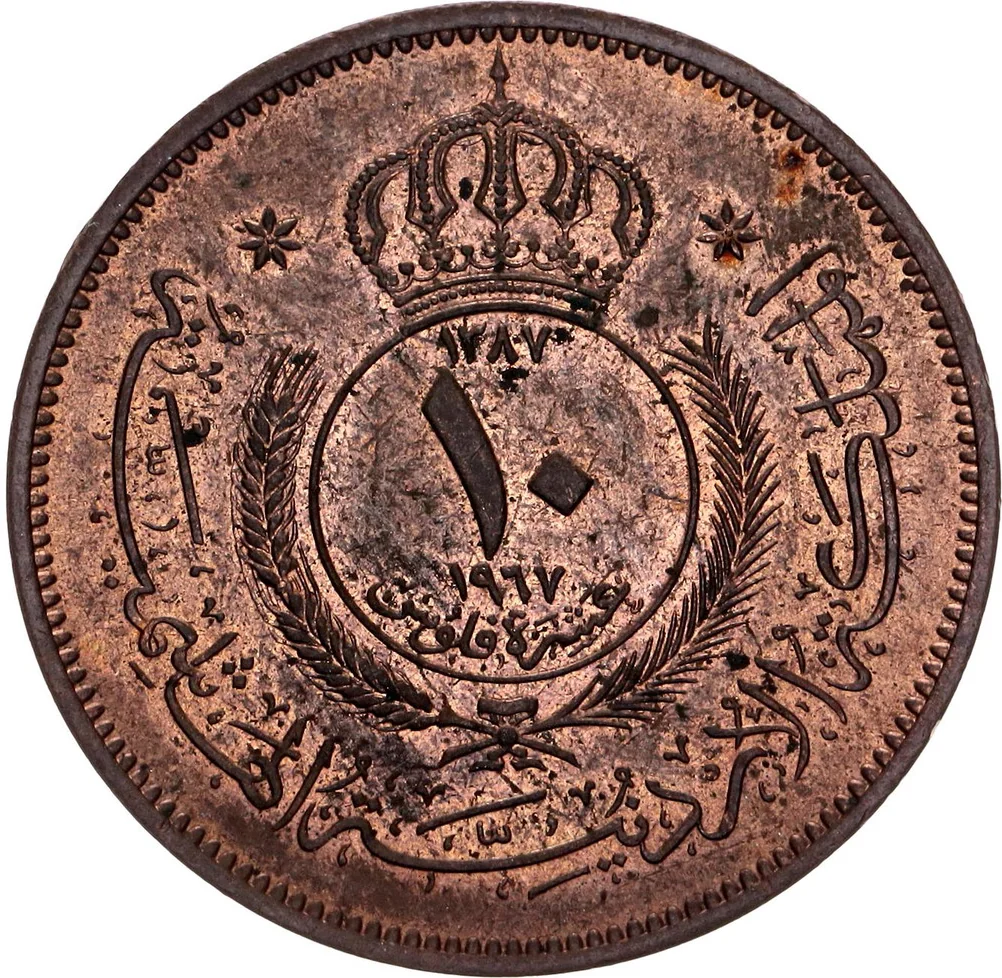
Description:
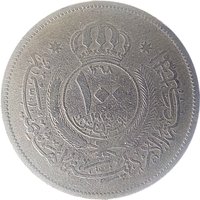
Value and date encircled by laurels.
Inscription:
١٣٨٥
١٠
١٩٦٥
عشرة فلوس
*المملكة الاردنية الهاشمية*
١٠
١٩٦٥
عشرة فلوس
*المملكة الاردنية الهاشمية*
Translation:
1385
10
1965
Ten Fils
*The Hashemite Kingdom of Jordan*
10
1965
Ten Fils
*The Hashemite Kingdom of Jordan*
Script: Arabic
Languages: numerals are Western Arabic, Arabic
Reverse
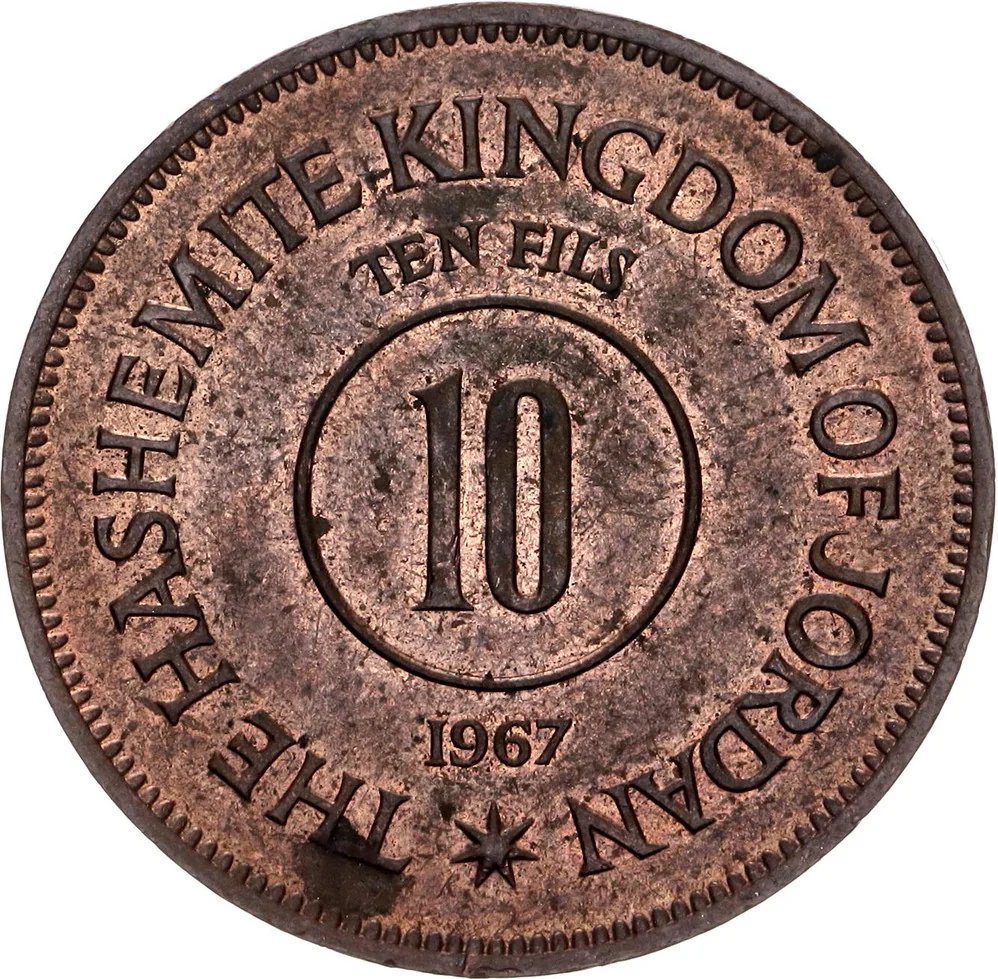
Description:
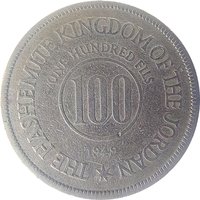
Value in circle above date and star.
Inscription:
THE HASHEMITE KINGDOM OF JORDAN *
TEN FILS
10
1965
TEN FILS
10
1965
Script: Latin
Edge
Plain
Mints
| Name | Mark |
|---|---|
| Royal Mint (Tower Hill) | — |
Mintings
| Year | Mint Mark | Mintage | Quality | Collection |
|---|---|---|---|---|
| 1955 | — | 1,500,000 | ||
| 1955 | — | — | Proof | |
| 1960 | — | — | Proof | |
| 1960 | — | 60,000 | ||
| 1962 | — | — | Proof | |
| 1962 | — | 2,300,000 | ||
| 1964 | — | 1,250,000 | ||
| 1965 | — | 998,000 | ||
| 1965 | — | 10,000 | Proof | |
| 1967 | — | 1,000,000 |
Historical background
In 1955, Jordan’s currency situation was defined by its reliance on the Jordanian Dinar (JOD), a currency that was still in its infancy but already establishing a reputation for stability. Introduced in 1950 to replace the Palestinian Pound, the dinar was pegged at par to the British Pound Sterling. This peg was a deliberate policy choice, reflecting Jordan’s close political and economic ties with the United Kingdom and providing a crucial anchor for confidence in a young nation navigating a turbulent regional environment.
The economy underpinning the currency was fragile, heavily dependent on British subsidies and foreign aid, with a limited domestic revenue base. A significant portion of the state budget was allocated to maintaining the Arab Legion, straining fiscal resources. Furthermore, Jordan lacked major natural resources or a diversified industrial sector, making it vulnerable to external shocks. The stability of the dinar, therefore, was not primarily a reflection of robust internal economic strength but of deliberate external support and conservative monetary management by the Jordan Currency Board, which maintained full sterling backing for the currency in circulation.
This cautious approach successfully prevented the high inflation and devaluation crises seen in some neighboring states, fostering trust in the banking system. However, it also meant Jordan’s monetary policy was effectively set in London, limiting the kingdom's ability to use currency tools for independent economic development. The situation in 1955 thus presented a duality: a stable and credible currency that facilitated trade and investment, but within a framework of economic dependency that would challenge policymakers in the years ahead as they sought greater financial sovereignty.
The economy underpinning the currency was fragile, heavily dependent on British subsidies and foreign aid, with a limited domestic revenue base. A significant portion of the state budget was allocated to maintaining the Arab Legion, straining fiscal resources. Furthermore, Jordan lacked major natural resources or a diversified industrial sector, making it vulnerable to external shocks. The stability of the dinar, therefore, was not primarily a reflection of robust internal economic strength but of deliberate external support and conservative monetary management by the Jordan Currency Board, which maintained full sterling backing for the currency in circulation.
This cautious approach successfully prevented the high inflation and devaluation crises seen in some neighboring states, fostering trust in the banking system. However, it also meant Jordan’s monetary policy was effectively set in London, limiting the kingdom's ability to use currency tools for independent economic development. The situation in 1955 thus presented a duality: a stable and credible currency that facilitated trade and investment, but within a framework of economic dependency that would challenge policymakers in the years ahead as they sought greater financial sovereignty.
Series: 1955 Jordan circulation coins
🌱 Very Common