

50 Centimos – Costa Rica
Costa Rica
Context
Year: 1948
Issuer: Costa Rica 
Issuing organization: Banco National de Costa Rica
Period:
(since 1948)
Currency:
(since 1896)
Demonetized: Yes
Total mintage: 4,000,000
Material
References
KM: #Click to copy to clipboard176
Numista: #54603
Value
Exchange value: 0.50 CRC
Obverse
Description:
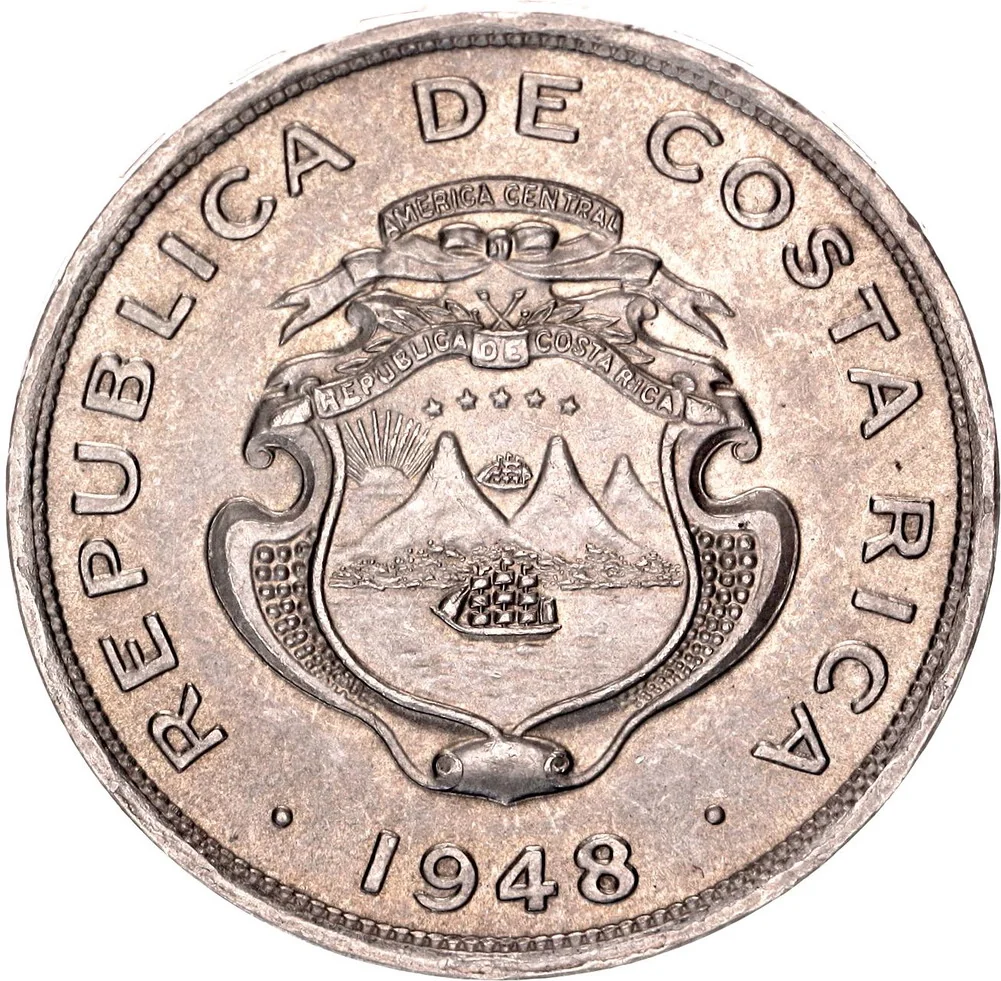
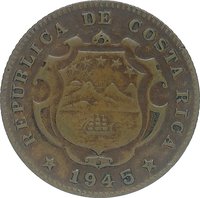
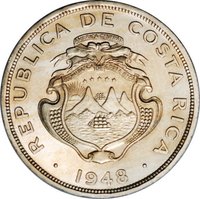
Costa Rica's coat of arms features five stars for its provinces, three volcanoes for its mountain ranges, two ships for its position between oceans, and a sunrise.
Inscription:
REPUBLICA DE COSTA RICA
AMERICA CENTRAL
REPUBLICA DE COSTA RICA
· 1948 ·
AMERICA CENTRAL
REPUBLICA DE COSTA RICA
· 1948 ·
Translation:
REPUBLIC OF COSTA RICA
CENTRAL AMERICA
REPUBLIC OF COSTA RICA
· 1948 ·
CENTRAL AMERICA
REPUBLIC OF COSTA RICA
· 1948 ·
Script: Latin
Language: Spanish
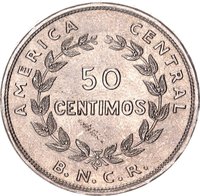
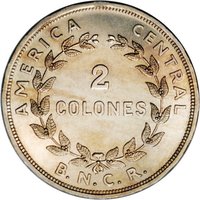
Reverse
Edge
Smooth with text (exist in position A and B)
Legend:
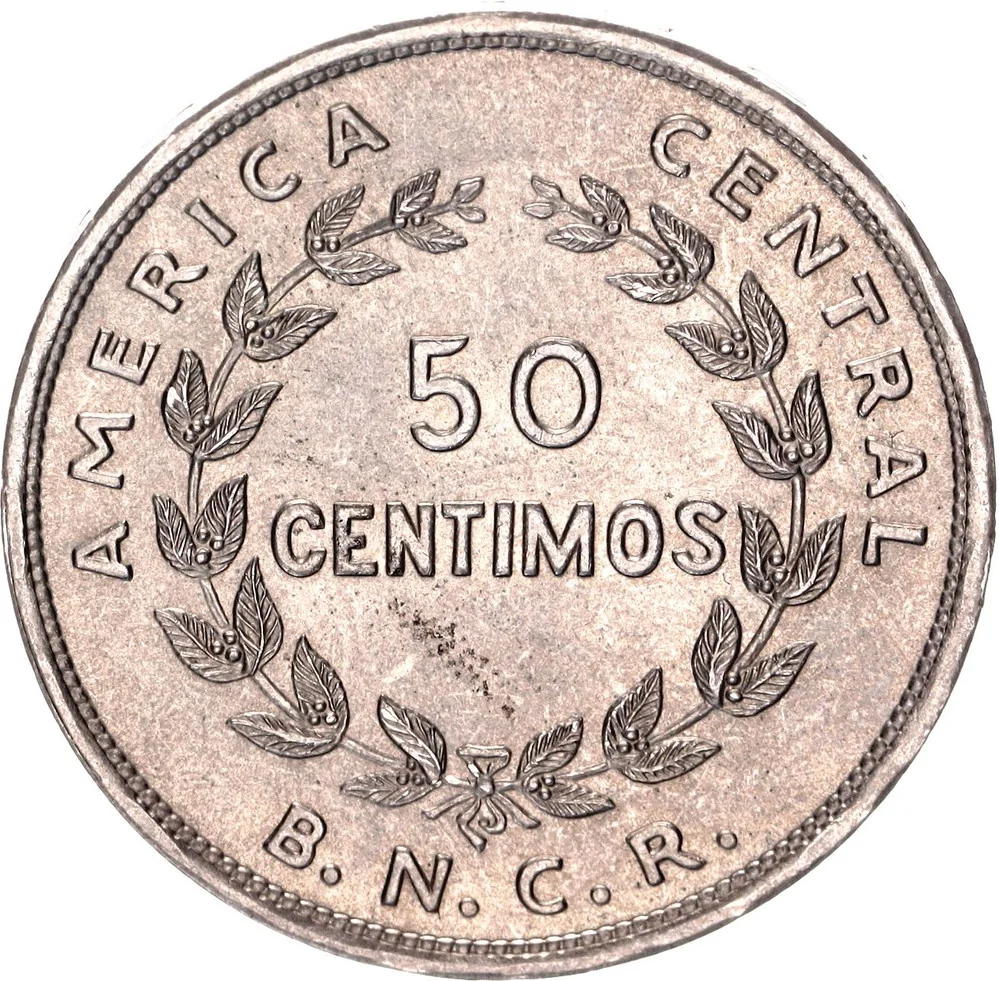
BNCR-BNCR-BNCR-BNCR
Translation:
VICTOR-VICTOR-VICTOR-VICTOR
Language: Latin
Categories
| Symbols> Coat of Arms |
| Symbol> Wreath |
Mints
| Name | Mark |
|---|---|
| Royal Mint (Tower Hill) | — |
Mintings
| Year | Mint Mark | Mintage | Quality | Collection |
|---|---|---|---|---|
| 1948 | — | 4,000,000 |
Historical background
In 1948, Costa Rica was emerging from a brief but intense civil war, known as the "War of National Liberation," which was triggered by a disputed presidential election. The 44-day conflict, won by the rebel forces under José Figueres Ferrer, left the national economy in disarray. The pre-war period had already seen fiscal strain and monetary instability under the administrations of Rafael Ángel Calderón Guardia and Teodoro Picado Michalski, with the colón's value being managed by a currency board system that was struggling to maintain confidence.
The immediate post-war currency situation was characterized by fragmentation and uncertainty. During the conflict, both the legitimate government and the rebel junta had printed their own money to finance their efforts, leading to a circulation of multiple, sometimes competing, banknotes. This proliferation of currency, combined with a significant public debt and depleted foreign reserves, created a climate of inflationary pressure and threatened the colón's stability. The banking system was also in crisis, with the privately owned Banco Internacional de Costa Rica, the nation's issuer of currency, effectively bankrupt.
Recognizing that monetary reform was foundational for national reconstruction, the victorious Founding Junta of the Second Republic, led by Figueres, moved decisively. One of its first major acts was the nationalization of the banking system in 1948, transferring the power to issue currency from private banks to the state. This monumental step paved the way for the creation of the Central Bank of Costa Rica (Banco Central de Costa Rica) in 1950, which would assume centralized control over monetary policy, stabilize the colón, and provide the financial architecture for the country's modern social and economic development. Thus, the crisis of 1948 directly catalyzed the creation of a sovereign monetary authority.
The immediate post-war currency situation was characterized by fragmentation and uncertainty. During the conflict, both the legitimate government and the rebel junta had printed their own money to finance their efforts, leading to a circulation of multiple, sometimes competing, banknotes. This proliferation of currency, combined with a significant public debt and depleted foreign reserves, created a climate of inflationary pressure and threatened the colón's stability. The banking system was also in crisis, with the privately owned Banco Internacional de Costa Rica, the nation's issuer of currency, effectively bankrupt.
Recognizing that monetary reform was foundational for national reconstruction, the victorious Founding Junta of the Second Republic, led by Figueres, moved decisively. One of its first major acts was the nationalization of the banking system in 1948, transferring the power to issue currency from private banks to the state. This monumental step paved the way for the creation of the Central Bank of Costa Rica (Banco Central de Costa Rica) in 1950, which would assume centralized control over monetary policy, stabilize the colón, and provide the financial architecture for the country's modern social and economic development. Thus, the crisis of 1948 directly catalyzed the creation of a sovereign monetary authority.
🌱 Common