

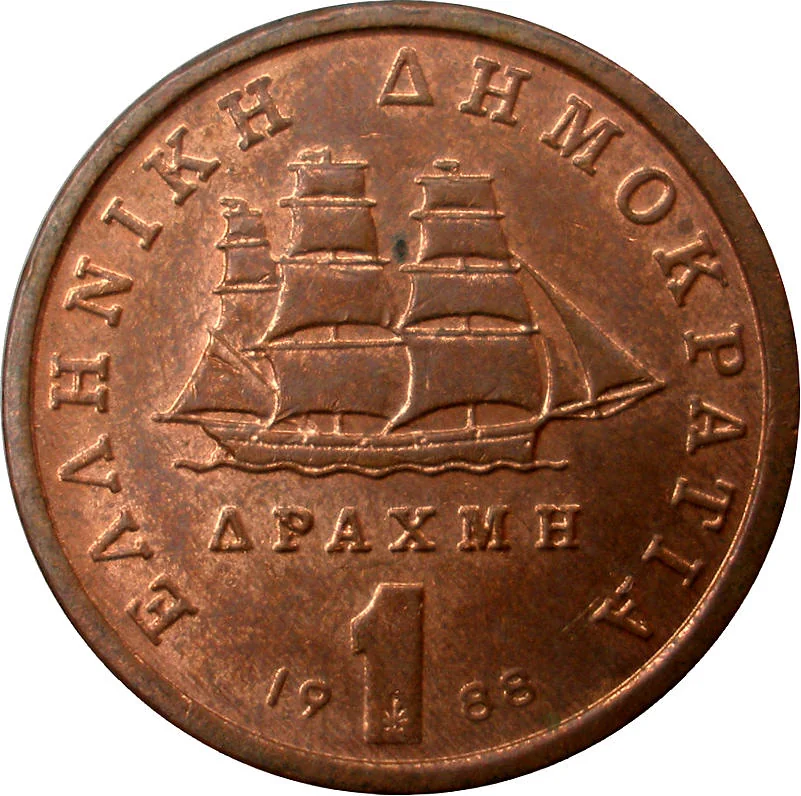
1 drachma – Greece
Add to wishlist
Greece
Context
Years: 1988–2000
Issuer: Greece
Period:
(since 1974)
Currency:
(1954—2001)
Demonetization: 28 February 2002
Total mintage: 36,707,000
Material
References
KM: #
Numista: #544
Value
Exchange value: 1 GRD
Inflation-adjusted value: 6.21 GRD
Obverse
Reverse
Description:
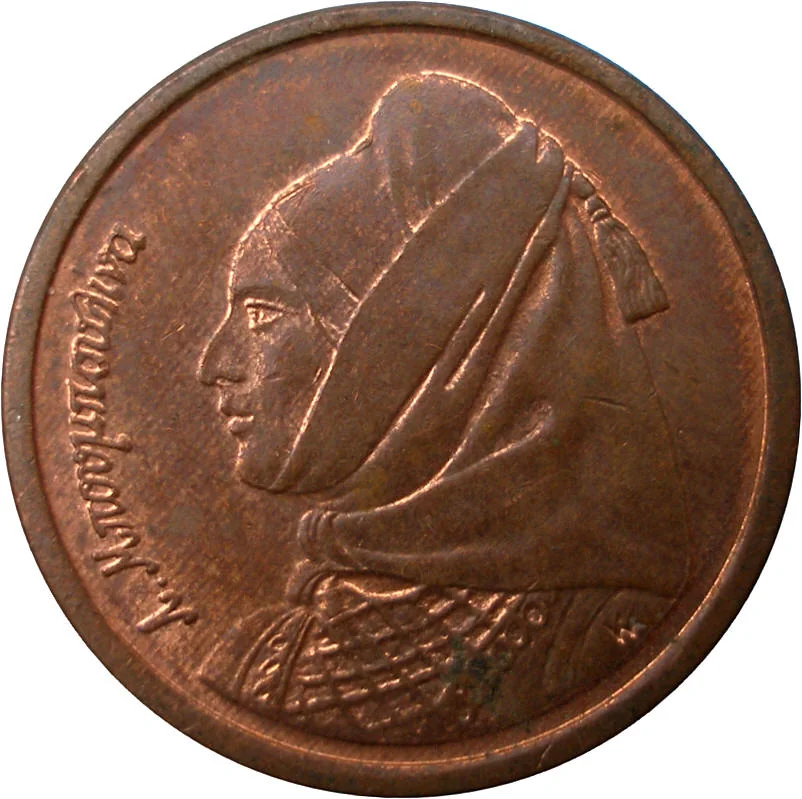
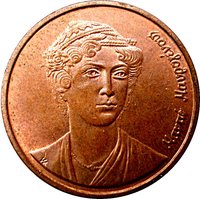
Portrait of Laskarina Bouboulina (1771–1825), a heroine of the Greek War of Independence, with the engraver's monogram at bottom left.
Inscription:
Λ. Μπουμπουλίνα
KK
KK
Translation:
L. Bouboulina
KK
KK
Script: Greek
Language: Greek
Engraver: Konstantinos Kazakos
Edge
Plain
Categories
| Person> Military leader |
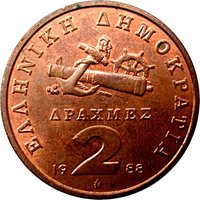
| Transportation> Watercraft |
Mints
| Name | Mark |
|---|---|
| National Mint of the Bank of Greece | — |
Mintings
| Year | Mint Mark | Mintage | Quality | Collection |
|---|---|---|---|---|
| 1988 | — | 36,707,000 | ||
| 1990 | — | — | ||
| 1992 | — | — | ||
| 1993 | — | — | In sets | |
| 1993 | — | — | Proof | |
| 1994 | — | — | ||
| 1998 | — | — | ||
| 2000 | — | — |
Historical background
By 1988, Greece's currency situation was characterized by a precarious stability maintained through stringent capital controls and a heavily managed drachma within the European Monetary System (EMS). Having joined the EMS in 1985, the drachma was placed in the wide ±6% fluctuation band, but its central parity was devalued multiple times (notably in 1985 and 1987) to compensate for Greece's persistently higher inflation compared to its European partners. This period was one of "crawling devaluation," where periodic official adjustments aimed to preserve export competitiveness rather than allowing a free float.
The underlying economic context was one of chronic imbalance. The public sector was bloated and inefficient, running large deficits that fueled inflation, which averaged nearly 15% annually in the late 1980s. This high inflation, combined with political instability and a lack of structural reforms, eroded international confidence and led to frequent speculative pressures against the drachma. To prevent a currency crisis and massive capital flight, authorities relied on extensive exchange controls, limiting the amount of drachmas that could be converted and taken abroad.
Consequently, 1988 represents a point of entrenched duality: an official policy of European monetary integration and stability existed alongside a domestic reality of inflationary financing and restricted financial freedom. The drachma's value was an administrative tool rather than a market price, masking the growing divergence between Greece's economy and the convergence criteria that would later underpin the single European currency—a divergence that sowed the seeds for future fiscal and monetary crises.
The underlying economic context was one of chronic imbalance. The public sector was bloated and inefficient, running large deficits that fueled inflation, which averaged nearly 15% annually in the late 1980s. This high inflation, combined with political instability and a lack of structural reforms, eroded international confidence and led to frequent speculative pressures against the drachma. To prevent a currency crisis and massive capital flight, authorities relied on extensive exchange controls, limiting the amount of drachmas that could be converted and taken abroad.
Consequently, 1988 represents a point of entrenched duality: an official policy of European monetary integration and stability existed alongside a domestic reality of inflationary financing and restricted financial freedom. The drachma's value was an administrative tool rather than a market price, masking the growing divergence between Greece's economy and the convergence criteria that would later underpin the single European currency—a divergence that sowed the seeds for future fiscal and monetary crises.
🌱 Very Common