

25 Centavos – Dominican Republic
Dominican Republic
Context
Years: 1967–1974
Issuer: Dominican Republic 
Period:
(since 1966)
Currency:
(since 1937)
Total mintage: 7,800,500
Material
Diameter: 24 mm
Weight: 6.25 g
Thickness: 1.7 mm
Shape: Round
Composition: Copper-nickel
Technique: Milled
Alignment: Coin alignment
flip
References
KM: #Click to copy to clipboard20a.1
Numista: #5407
Value
Exchange value: 0.25 DOP
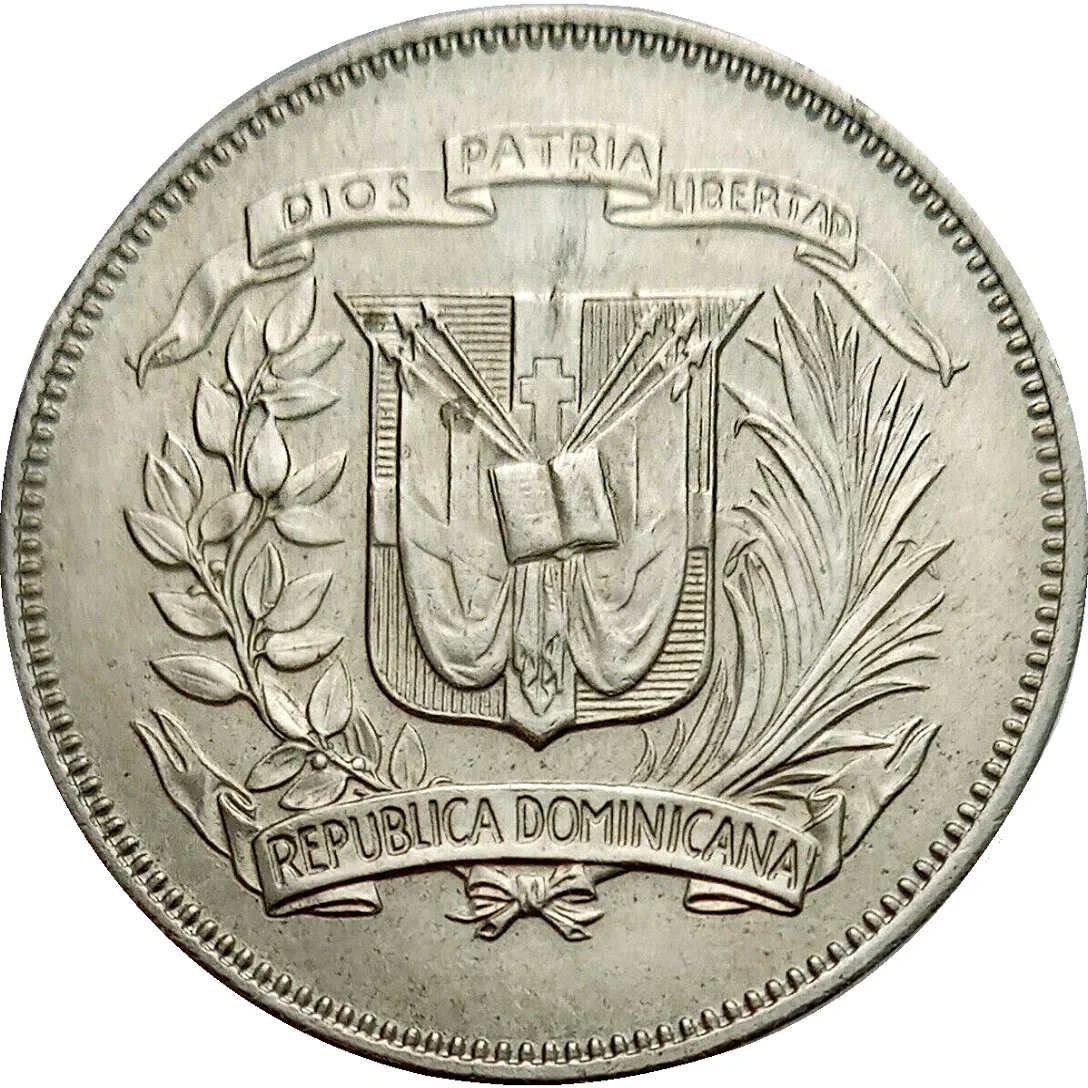
Obverse
Description:
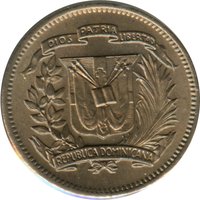
National coat of arms with motto.
Inscription:
DIOS PATRIA LIBERTAD
REPUBLICA DOMINICANA
REPUBLICA DOMINICANA
Translation:
God, Fatherland, Liberty
Dominican Republic
Dominican Republic
Script: Latin
Language: Spanish
Engraver: Casimiro Nemesio de Moya
Reverse
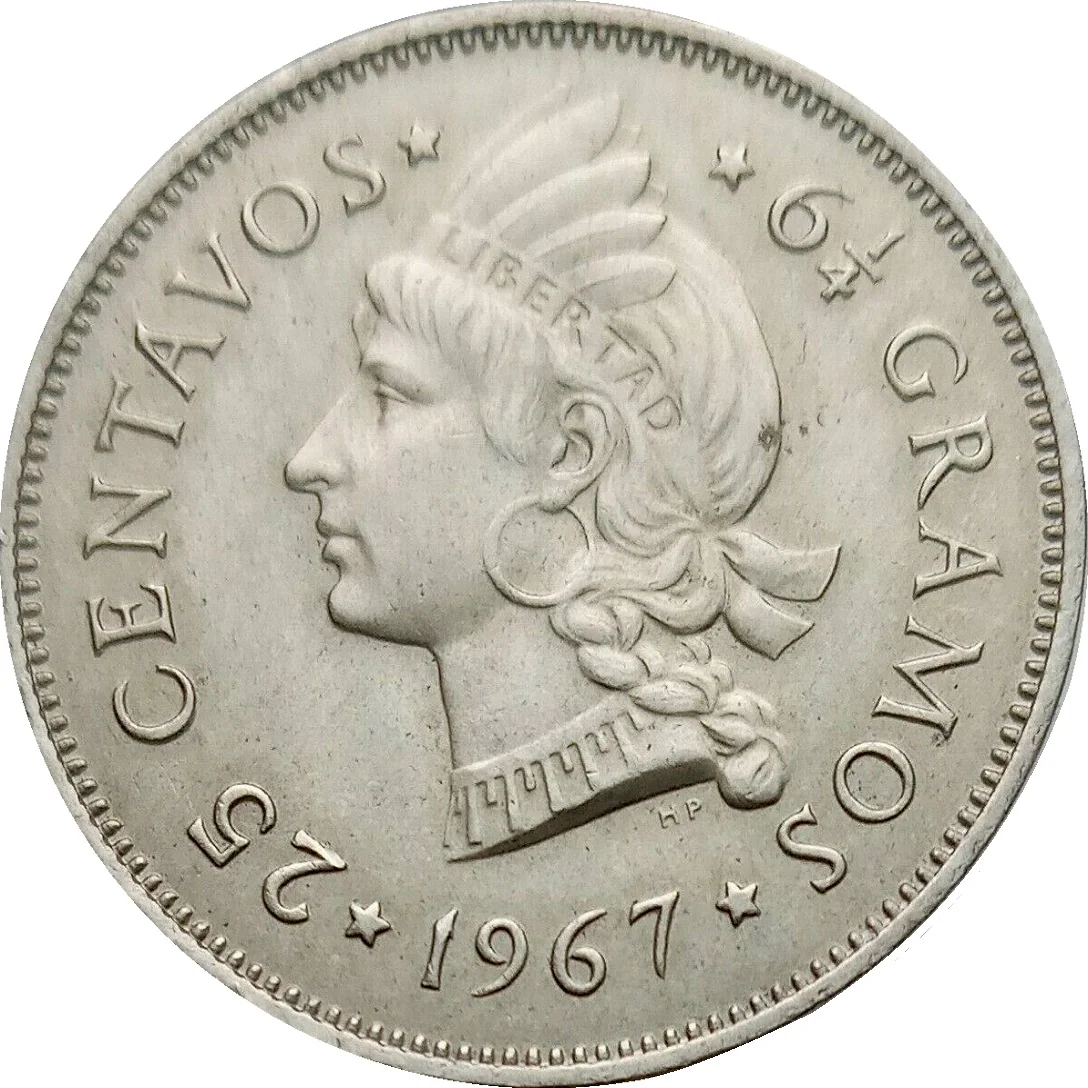
Description:
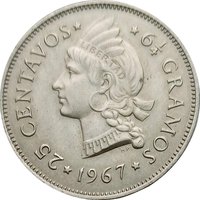
Indian "Liberty" head left, with denomination, weight, and issue year.
Inscription:
★ 25 CENTAVOS ★ ★ 6 1/4 GRAMOS ★
LIBERTAD
HP
1967
LIBERTAD
HP
1967
Translation:
★ 25 CENTAVOS ★ ★ 6 1/4 GRAMS ★
LIBERTY
HP
1967
LIBERTY
HP
1967
Script: Latin
Language: Spanish
Engraver: Thomas Humphrey Paget
Edge
Smooth (1967-1972).Reeded (1974).
Categories
| Symbols> Coat of Arms |
Mints
| Name | Mark |
|---|---|
| Royal Mint (Tower Hill) | — |
Mintings
| Year | Mint Mark | Mintage | Quality | Collection |
|---|---|---|---|---|
| 1967 | — | 5,000,000 | ||
| 1972 | — | 500 | Proof | |
| 1972 | — | 800,000 | ||
| 1974 | — | 2,000,000 |
Historical background
In 1967, the Dominican Republic's currency situation was characterized by relative stability under the authoritarian rule of President Joaquín Balaguer, who had taken office the previous year. The country was operating with the Dominican Peso (DOP), which was pegged to the United States Dollar at a fixed rate of 1 DOP = 1 USD. This parity, established in 1947, provided a crucial anchor for the economy, fostering predictability for trade and investment as the nation sought to recover from the political turmoil and economic disruption of the 1965 civil war and subsequent U.S. military intervention.
The primary economic focus of the Balaguer administration was on fiscal discipline and infrastructure development, funded largely by high international sugar prices and U.S. economic aid. This context helped maintain confidence in the peso's peg. However, the stability was somewhat artificial and reliant on controlled markets. The Central Bank managed exchange controls, and a parallel black market for dollars existed, albeit at a modest premium, reflecting underlying pressures from inflation and trade imbalances that official rates did not fully capture.
Looking ahead, the fixed parity would come under significant strain within a few years. The global oil price shocks of the 1970s and declining sugar revenues would expose structural weaknesses, ultimately leading to a devaluation in 1978 and the abandonment of the one-to-one peg. Thus, 1967 represents a point of calm—a managed stability before the economic challenges of the following decade would force a major adjustment in the Dominican Republic's monetary policy.
The primary economic focus of the Balaguer administration was on fiscal discipline and infrastructure development, funded largely by high international sugar prices and U.S. economic aid. This context helped maintain confidence in the peso's peg. However, the stability was somewhat artificial and reliant on controlled markets. The Central Bank managed exchange controls, and a parallel black market for dollars existed, albeit at a modest premium, reflecting underlying pressures from inflation and trade imbalances that official rates did not fully capture.
Looking ahead, the fixed parity would come under significant strain within a few years. The global oil price shocks of the 1970s and declining sugar revenues would expose structural weaknesses, ultimately leading to a devaluation in 1978 and the abandonment of the one-to-one peg. Thus, 1967 represents a point of calm—a managed stability before the economic challenges of the following decade would force a major adjustment in the Dominican Republic's monetary policy.
🌱 Very Common