

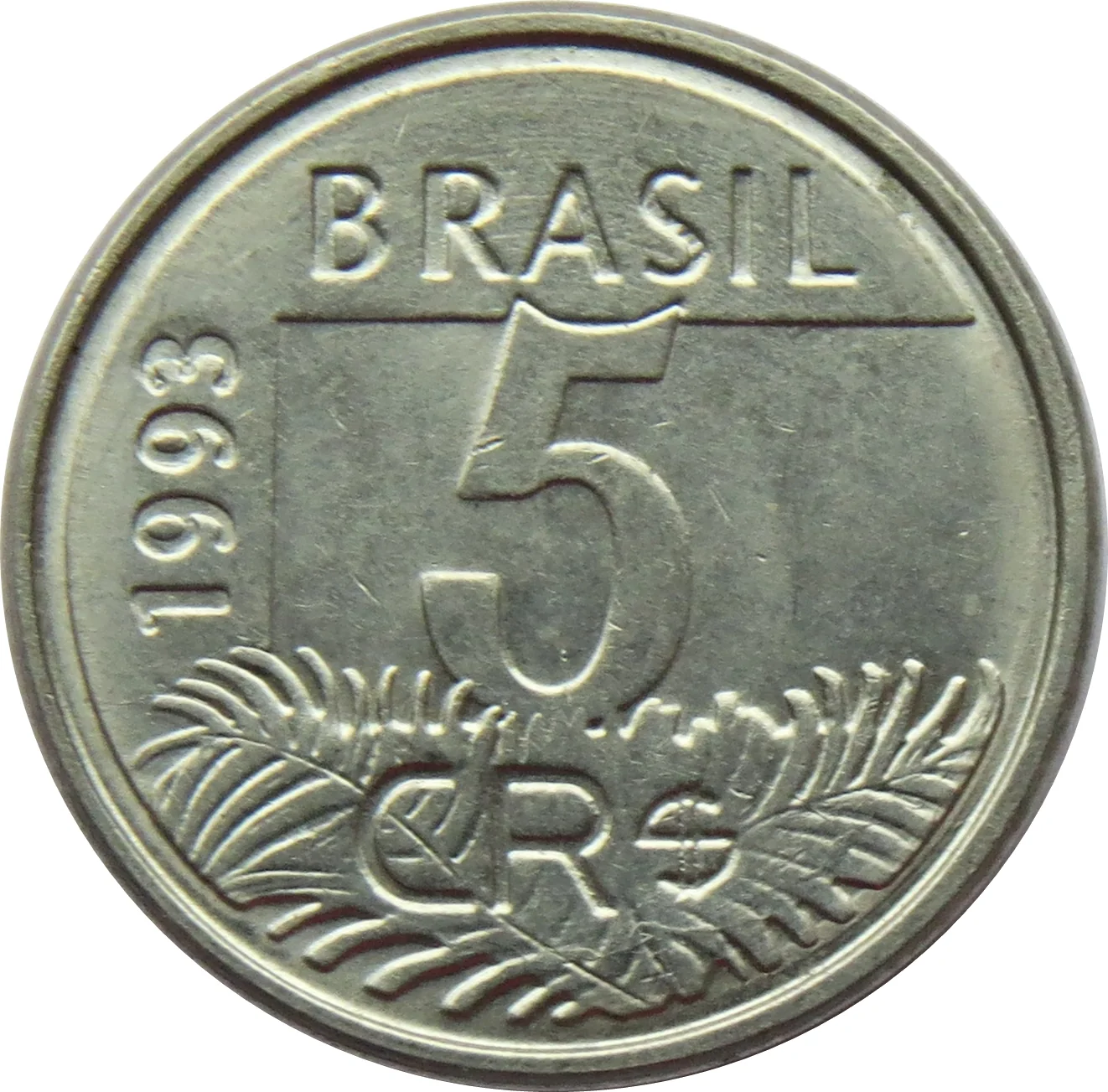
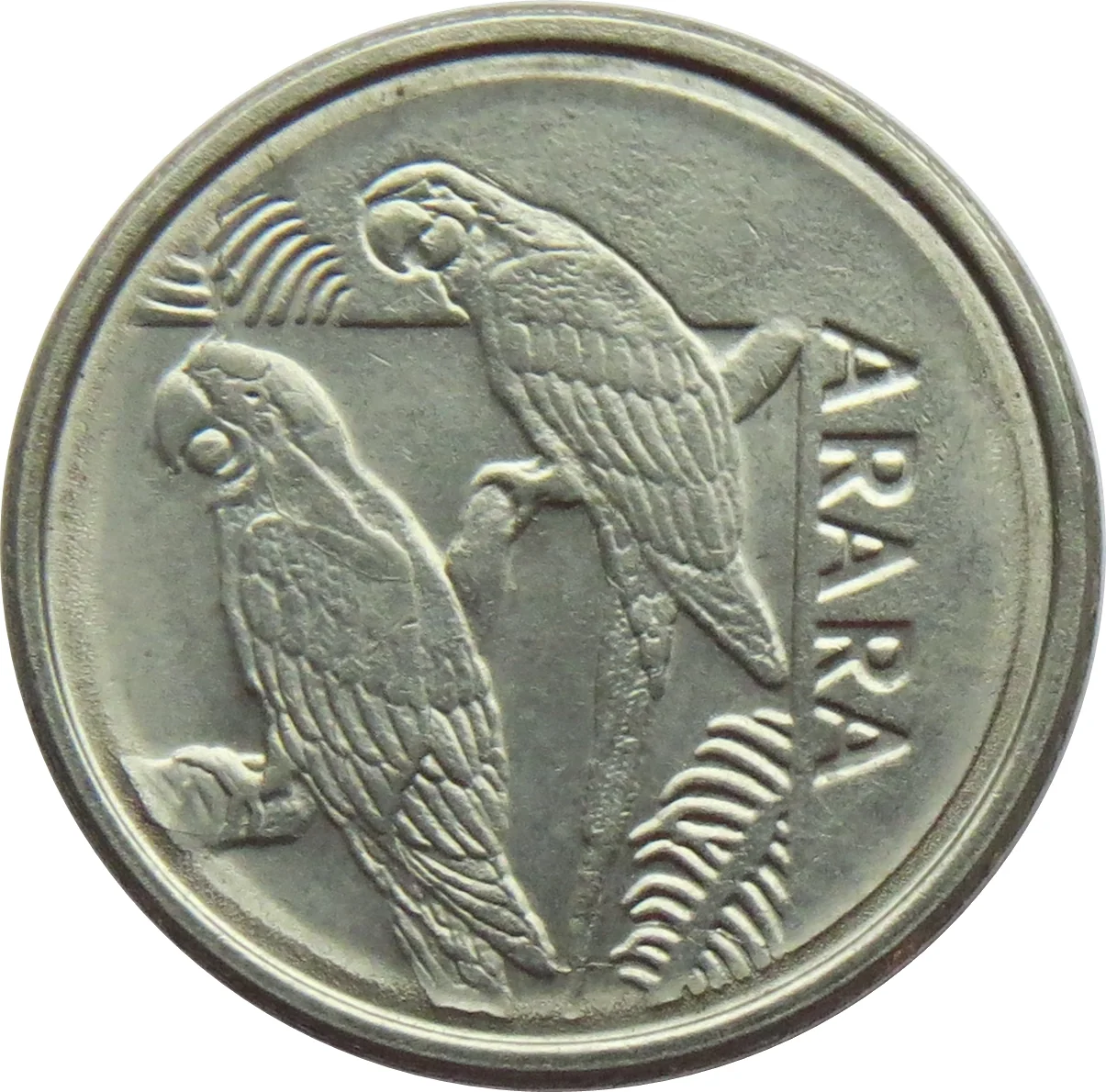
5 cruzeiros reais – Brazil
Add to wishlist
Brazil
Context
Years: 1993–1994
Issuer: Brazil
Period:
(since 1967)
Currency:
(1993—1994)
Demonetization: 1994
Total mintage: 320,000,000
Material
Diameter: 21 mm
Weight: 3.27 g
Thickness: 1.5 mm
Shape: Round
Composition: Stainless steel
Technique: Milled
Alignment: Coin alignment
flip
References
KM: #
Numista: #5393
Value
Exchange value: 5 BRR
Inflation-adjusted value: 22309.80 BRR
Obverse
Description:
Denomination left of date.
Inscription:
BRASIL
1993 5
CR$
1993 5
CR$
Translation:
BRASIL
1993 5
CR$
1993 5
CR$
Script: Latin
Language: Portuguese
Reverse
Edge
Plain
Mintings
| Year | Mint Mark | Mintage | Quality | Collection |
|---|---|---|---|---|
| 1993 | — | 250,000,000 | ||
| 1994 | — | 70,000,000 |
Historical background
In 1993, Brazil was in the throes of its final and most severe phase of chronic hyperinflation, a crisis that had plagued the country for over a decade. The year began with the monthly inflation rate exceeding 30%, peaking at nearly 50% in June, which effectively meant prices were doubling every few weeks. This was the legacy of failed stabilization plans like the Collor Plans, which had relied on price freezes and confiscatory monetary measures, eroding public confidence and creating a deeply indexed economy where wages and contracts were automatically adjusted almost daily to keep pace with prices.
President Itamar Franco, who had assumed office after the impeachment of Fernando Collor, initially struggled to find a coherent economic direction. His fourth finance minister, Fernando Henrique Cardoso, appointed in May 1993, orchestrated a crucial shift in strategy. Instead of another shock treatment, Cardoso's team, led by economist Persio Arida, developed the Plano Real—a meticulous, multi-stage program to be implemented over several months. The critical first step, the Unidade Real de Valor (URV), was being designed in late 1993. This was not a new currency but a stable unit of account, a virtual "parallel currency" for pricing, which would gradually decouple the economy from inflationary inertia.
Thus, 1993 was a year of foundational crisis and pivotal preparation. While the public endured the devastating practical effects of hyperinflation—eroded savings, speculative hoarding, and economic uncertainty—the government was laying the technical and political groundwork for a radical new approach. The work done in 1993 set the stage for the successful launch of the URV in March 1994 and the ultimate introduction of the stable Brazilian Real in July 1994, which would finally break the inflationary cycle.
President Itamar Franco, who had assumed office after the impeachment of Fernando Collor, initially struggled to find a coherent economic direction. His fourth finance minister, Fernando Henrique Cardoso, appointed in May 1993, orchestrated a crucial shift in strategy. Instead of another shock treatment, Cardoso's team, led by economist Persio Arida, developed the Plano Real—a meticulous, multi-stage program to be implemented over several months. The critical first step, the Unidade Real de Valor (URV), was being designed in late 1993. This was not a new currency but a stable unit of account, a virtual "parallel currency" for pricing, which would gradually decouple the economy from inflationary inertia.
Thus, 1993 was a year of foundational crisis and pivotal preparation. While the public endured the devastating practical effects of hyperinflation—eroded savings, speculative hoarding, and economic uncertainty—the government was laying the technical and political groundwork for a radical new approach. The work done in 1993 set the stage for the successful launch of the URV in March 1994 and the ultimate introduction of the stable Brazilian Real in July 1994, which would finally break the inflationary cycle.
Series: 1993 Brazil circulation coins
🌱 Very Common