

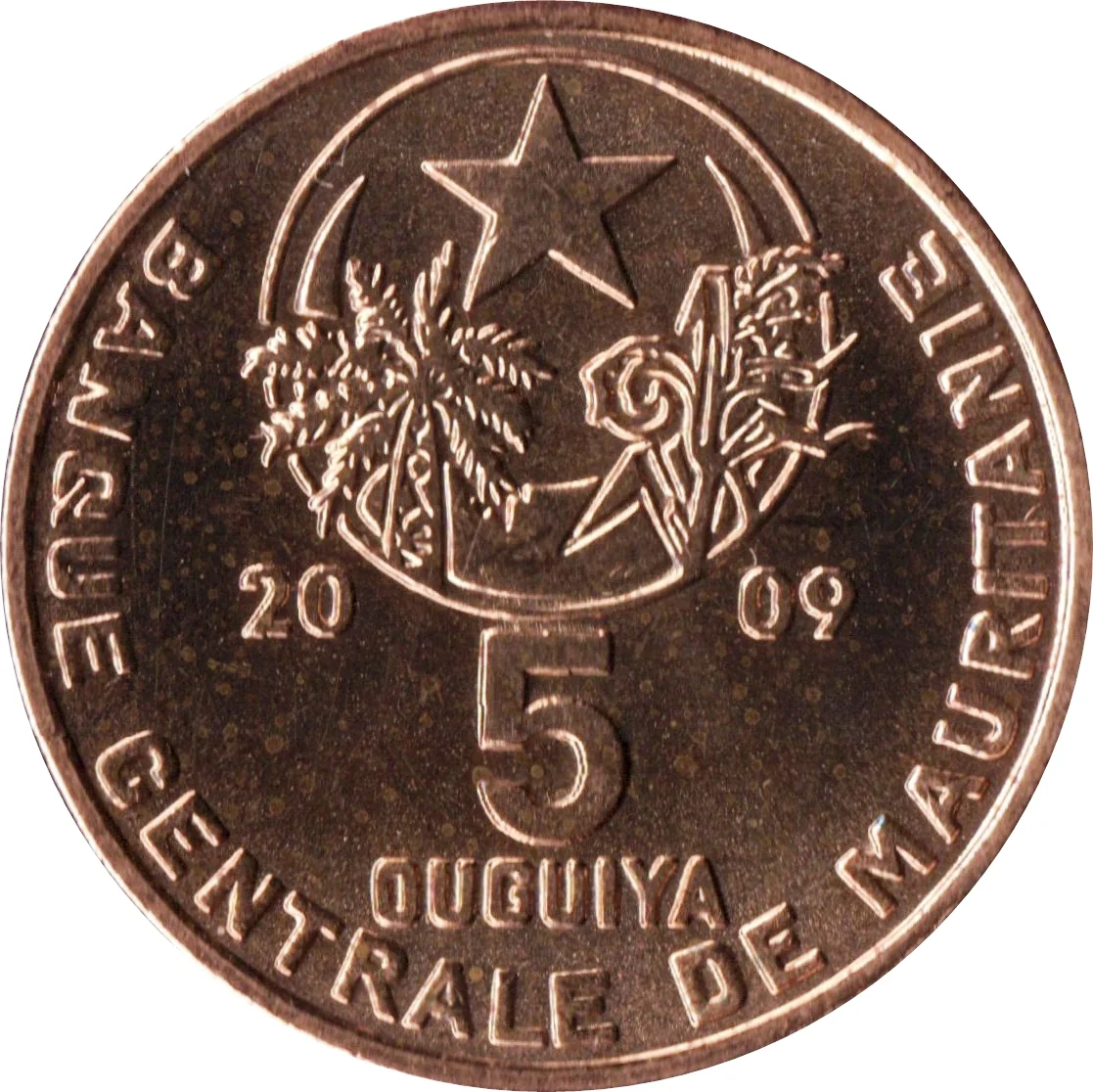
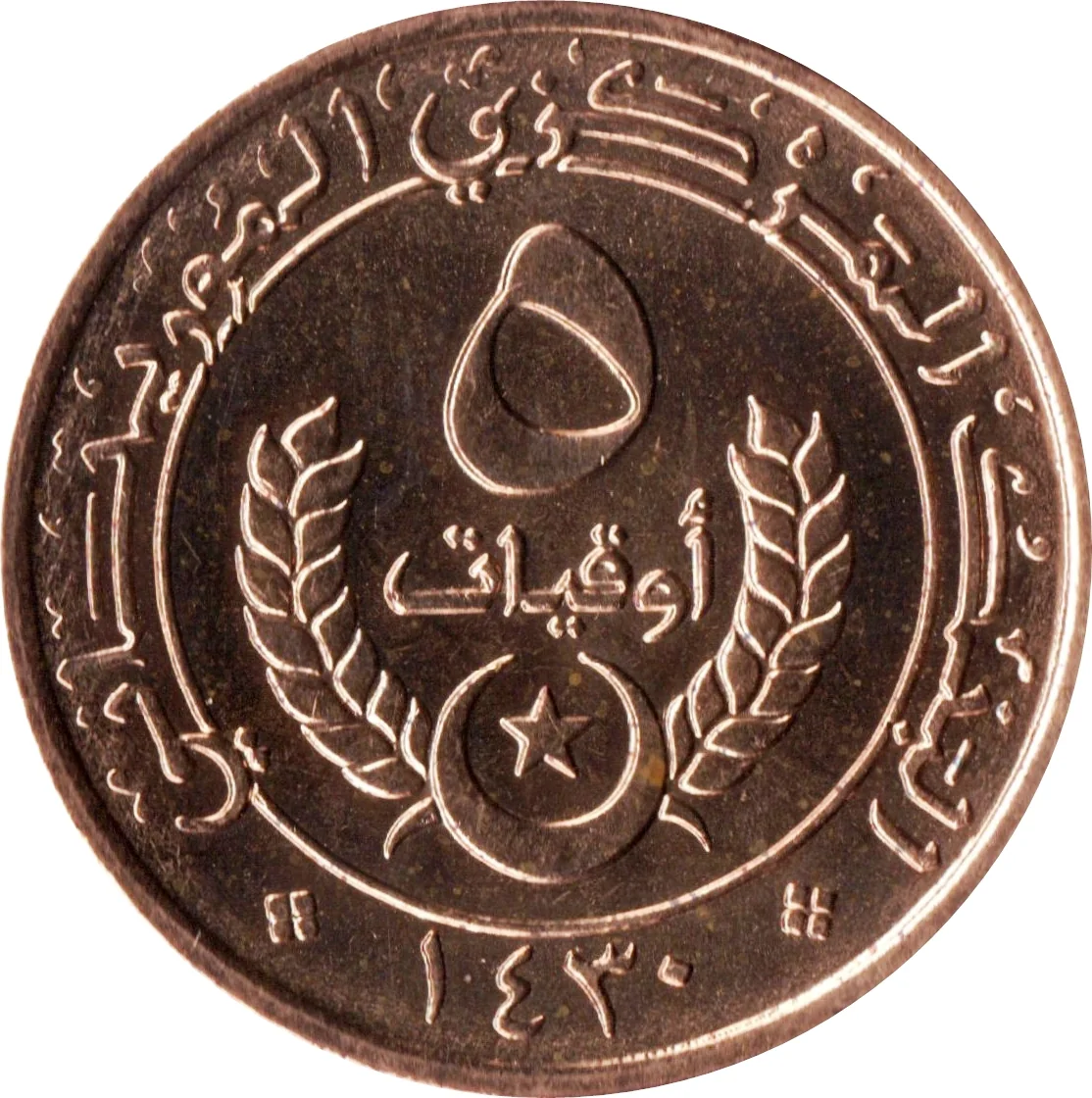
5 ouguiya – Mauritania
Add to wishlist
Mauritania
Context
Years: 2009–2012
Issuer: Mauritania
Issuing organization: Central Bank of Mauritania
Period:
(since 1960)
Currency:
(1973—2018)
Demonetization: 30 June 2018
Material

References
KM: #
Numista: #53895
Value
Exchange value: 5 MRO
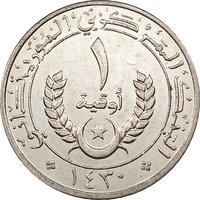
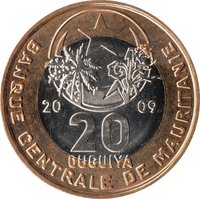
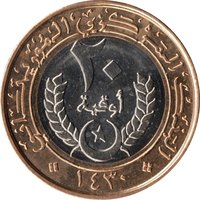
Obverse
Reverse
Edge
Plain
Mintings
| Year | Mint Mark | Mintage | Quality | Collection |
|---|---|---|---|---|
| 2009 | — | — | ||
| 2012 | — | — |
Historical background
In 2009, Mauritania's currency, the ouguiya (MRO), operated under a tightly managed float, with its value primarily pegged to a basket of currencies dominated by the US dollar. This system was administered by the Central Bank of Mauritania (BCM), which aimed to maintain stability and control inflation. However, the economy faced significant external pressures that year, primarily from a sharp decline in global iron ore prices—a critical export—and rising global food prices. These factors strained foreign exchange reserves and created downward pressure on the ouguiya.
The country's economic situation was further complicated by the political context. The government of General Mohamed Ould Abdel Aziz, who came to power in a 2008 coup, was working to gain international legitimacy and secure financial support. To this end, it had agreed to an IMF Poverty Reduction and Growth Facility (PRGF) program in 2006. A key focus of the 2009 program reviews was maintaining prudent monetary policy and a sustainable exchange rate. While the official exchange rate remained relatively stable, a significant parallel market for foreign currency persisted, indicating a gap between the official valuation and market sentiment.
Overall, 2009 was a year of economic vulnerability for Mauritania, with the managed currency regime acting as a key tool for stability amidst external shocks. The central bank's priority was to defend the ouguiya's peg to preserve purchasing power and meet IMF program targets, even as the trade deficit widened. This cautious approach sought to balance the need for external competitiveness with the imperative of controlling inflation in a nation heavily reliant on imported food and goods.
The country's economic situation was further complicated by the political context. The government of General Mohamed Ould Abdel Aziz, who came to power in a 2008 coup, was working to gain international legitimacy and secure financial support. To this end, it had agreed to an IMF Poverty Reduction and Growth Facility (PRGF) program in 2006. A key focus of the 2009 program reviews was maintaining prudent monetary policy and a sustainable exchange rate. While the official exchange rate remained relatively stable, a significant parallel market for foreign currency persisted, indicating a gap between the official valuation and market sentiment.
Overall, 2009 was a year of economic vulnerability for Mauritania, with the managed currency regime acting as a key tool for stability amidst external shocks. The central bank's priority was to defend the ouguiya's peg to preserve purchasing power and meet IMF program targets, even as the trade deficit widened. This cautious approach sought to balance the need for external competitiveness with the imperative of controlling inflation in a nation heavily reliant on imported food and goods.
🌱 Common