

100 francs cfa – Western African States
Add to wishlist
Context
Years: 2006–2025
Issuer: Western African States
Issuing organization: Central Bank of Western African States
Currency:
(since 1958)
Material
References
KM: #
Numista: #53892
Value
Exchange value: 100 XOF
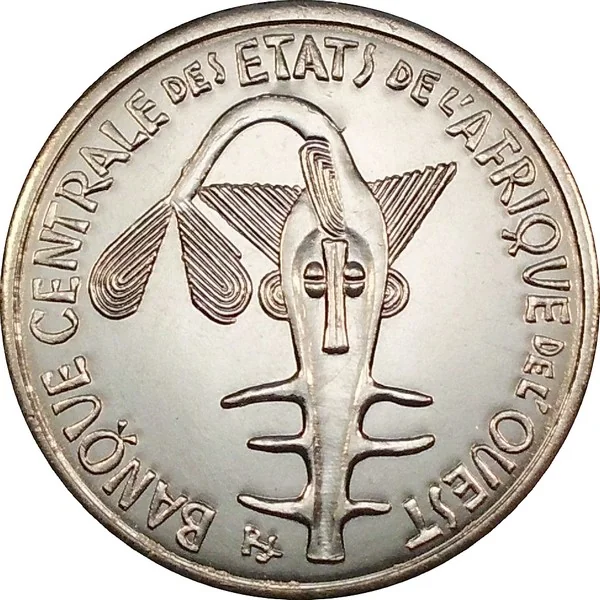
Obverse
Description:
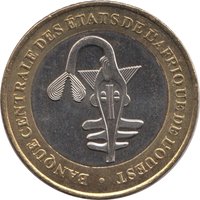
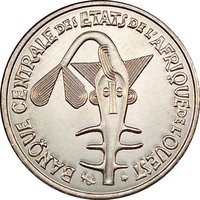
Central Bank of West African States emblem
Inscription:
BANQUE CENTRALE DES ETATS DE L'AFRIQUE DE L'OUEST
Translation:
CENTRAL BANK OF THE WEST AFRICAN STATES
Script: Latin
Language: French
Engraver: Raymond Joly
Reverse
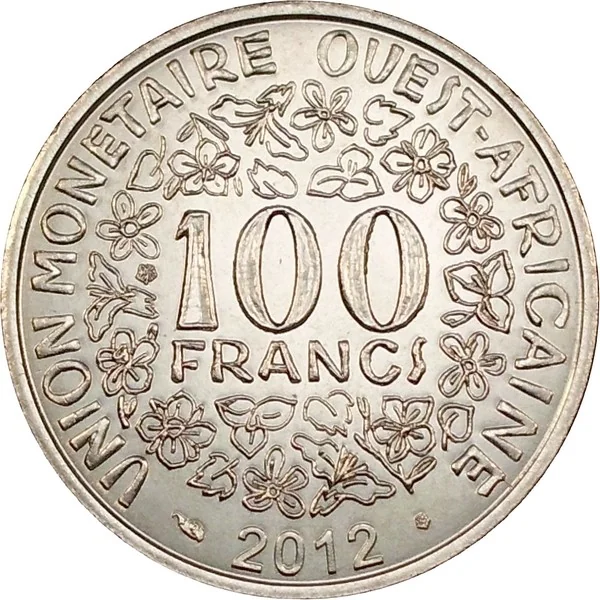
Description:
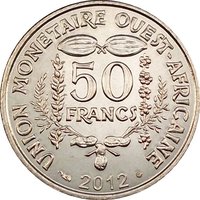
Denomination
Inscription:
100 FRANCS
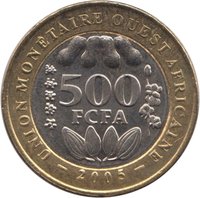
UNION MONETAIRE OUEST-AFRICAINE
2012
UNION MONETAIRE OUEST-AFRICAINE
2012
Translation:
100 Francs
West African Monetary Union
2012
West African Monetary Union
2012
Script: Latin
Language: French
Engraver: Raymond Joly
Edge
Reeded
Mints
| Name | Mark |
|---|---|
| Monnaie de Paris | — |
Mintings
| Year | Mint Mark | Mintage | Quality | Collection |
|---|---|---|---|---|
| — | — | — | ||
| 2006 | — | — | ||
| 2007 | — | — | ||
| 2009 | — | — | ||
| 2012 | — | — | ||
| 2013 | — | — | ||
| 2014 | — | — | ||
| 2016 | — | — | ||
| 2017 | — | — | ||
| 2018 | — | — | ||
| 2019 | — | — | ||
| 2020 | — | — | ||
| 2021 | — | — | ||
| 2022 | — | — | ||
| 2023 | — | — | ||
| 2024 | — | — | ||
| 2025 | — | — |
Historical background
In 2006, the currency situation in West Africa was defined by the coexistence of two major monetary zones, each with its own challenges. The dominant framework was the CFA franc, used by fourteen nations across two unions. In West Africa, the eight members of the West African Economic and Monetary Union (WAEMU/UEMOA)—including Senegal, Côte d'Ivoire, and Mali—used the CFA franc (XOF), which was (and remains) pegged to the euro and guaranteed by the French Treasury. This arrangement provided stability and low inflation but was often criticized for limiting monetary sovereignty and export competitiveness. Concurrently, the six members of the West African Monetary Zone (WAMZ), led by Nigeria, Ghana, and Guinea, maintained their own national currencies and were actively pursuing the launch of a second, independent common currency called the Eco, intended to eventually merge with the CFA franc to create a single monetary union for the entire ECOWAS region.
The year 2006 was a critical deadline within this broader integration roadmap. The WAMZ had already missed its initial launch target for the Eco in 2003 and then again in 2005 due to most member states failing to meet the four primary convergence criteria (on inflation, fiscal deficit, central bank financing, and foreign reserves). 2006 was set as the latest deadline for the Eco's launch, but it became clear early in the year that the necessary macroeconomic convergence was still elusive. Nigeria, the zone's largest economy, was particularly struggling with high inflation and fiscal pressures. Consequently, the launch was postponed indefinitely in 2006, marking a significant setback for regional monetary integration and highlighting the deep economic disparities between the anglophone WAMZ nations and the more stable, but externally anchored, francophone CFA zone.
Beyond the high-level policy negotiations, the on-the-ground currency reality for citizens and businesses involved navigating volatile national currencies in the WAMZ states, particularly the Nigerian naira and the Ghanaian cedi, against the stable but externally controlled CFA franc. This duality created complex trade and exchange dynamics within the region. The 2006 postponement effectively cemented the status quo for the remainder of the decade: a divided West Africa with two distinct monetary systems, one characterized by fixed stability with external oversight and the other by national monetary policies grappling with inflation and instability, all under an aspirational but distant goal of a unified single currency.
The year 2006 was a critical deadline within this broader integration roadmap. The WAMZ had already missed its initial launch target for the Eco in 2003 and then again in 2005 due to most member states failing to meet the four primary convergence criteria (on inflation, fiscal deficit, central bank financing, and foreign reserves). 2006 was set as the latest deadline for the Eco's launch, but it became clear early in the year that the necessary macroeconomic convergence was still elusive. Nigeria, the zone's largest economy, was particularly struggling with high inflation and fiscal pressures. Consequently, the launch was postponed indefinitely in 2006, marking a significant setback for regional monetary integration and highlighting the deep economic disparities between the anglophone WAMZ nations and the more stable, but externally anchored, francophone CFA zone.
Beyond the high-level policy negotiations, the on-the-ground currency reality for citizens and businesses involved navigating volatile national currencies in the WAMZ states, particularly the Nigerian naira and the Ghanaian cedi, against the stable but externally controlled CFA franc. This duality created complex trade and exchange dynamics within the region. The 2006 postponement effectively cemented the status quo for the remainder of the decade: a divided West Africa with two distinct monetary systems, one characterized by fixed stability with external oversight and the other by national monetary policies grappling with inflation and instability, all under an aspirational but distant goal of a unified single currency.
🌱 Very Common